

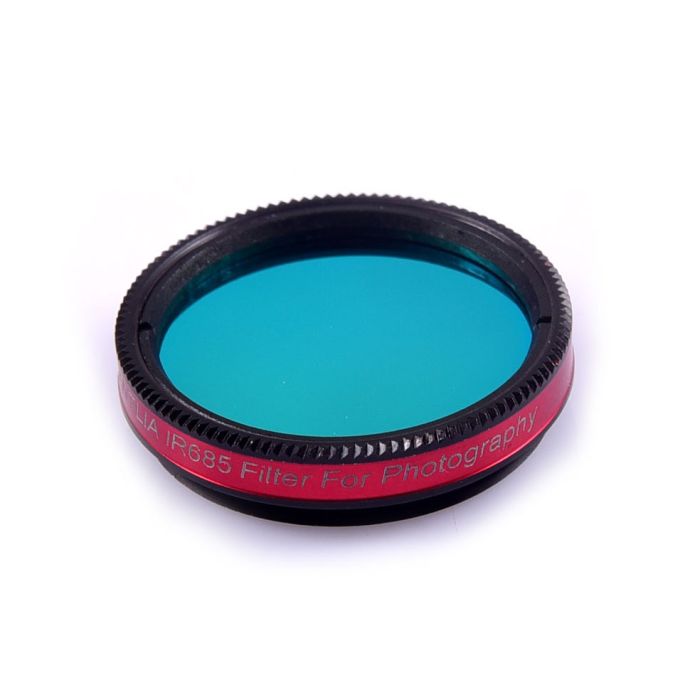
Antlia IR Pass Filter (685nm) - 1.25"
Stock count is accurate & shown in real time.
- This item is out of stock.
- Sign up for back-in-stock alerts to be notified when this item becomes available (account login required).
- This item is out of stock.
- Sign up for back-in-stock alerts to be notified when this item becomes available (account login required).
Contiguous US / Lower 48:
Free shipping applies to orders over $50 using our chosen carrier/method. Faster paid options are available at checkout.
Alaska, Hawaii & US Territories:
Free shipping applies to many—but not all—products. Enter your ZIP code in cart or upon checkout to confirm options and costs.
International:
International orders do not qualify for free shipping. Shipping, duties, brokerage, tariffs, and taxes are the customer’s responsibility. Some items may be restricted due to export, size, or manufacturer limitations.
The Antlia IR Pass 685nm filter is an absorptive filter that allows infrared light with wavelengths of more than 685nm to pass through. At these longer wavelengths, the sensitivity of the unaided eye is reduced, so it is not suitable for visual observations. The filter is highly recommended for any planetary photography. At long-wavelength spectral range the atmospheric air turbulence (seeing) has much lower impact on the sharpness. The closer to the infrared band, planetary images are less disturbed by wavefront distortions in the atmosphere (seeing), result in the sharpest and highest contrast image possible.
By combining a luminance image taken with the IR-Pass filter, along with RGB and U-Venus filters, overall image sharpness is significantly enhanced and details of planets in different bands are taken. The filter is also possible to image the other planets during daylight due to the dark background sky created by the 685nm IR Pass Filter.
Technical Data:
- Schott Optical Substrate
- 1.25" Mounted (2mm +/- 0.05mm)
- Surface Quality: 60/40 (MIL-O-13830)
- 2 Sides Fine-optically polished to ensure accurate 1/4 wavefront
- 30 arcsec parallelism
Filter Ring:
- 1.25” (28.5x0.6)
- Ultra-thin filter cell to minimize vignetting by maximize possible clear aperture
- Black Anodized Finish
- Laser Engraving No Fading
Not Recommended:
- Solar Observing and imaging
- Visual observation
- DO NOT LOOK AT THE SUN WITH ANTLIA FILTERS.
- Serious eye damage will result if you fail to observe the warning
Useful Resources
Filter Cell Specifications
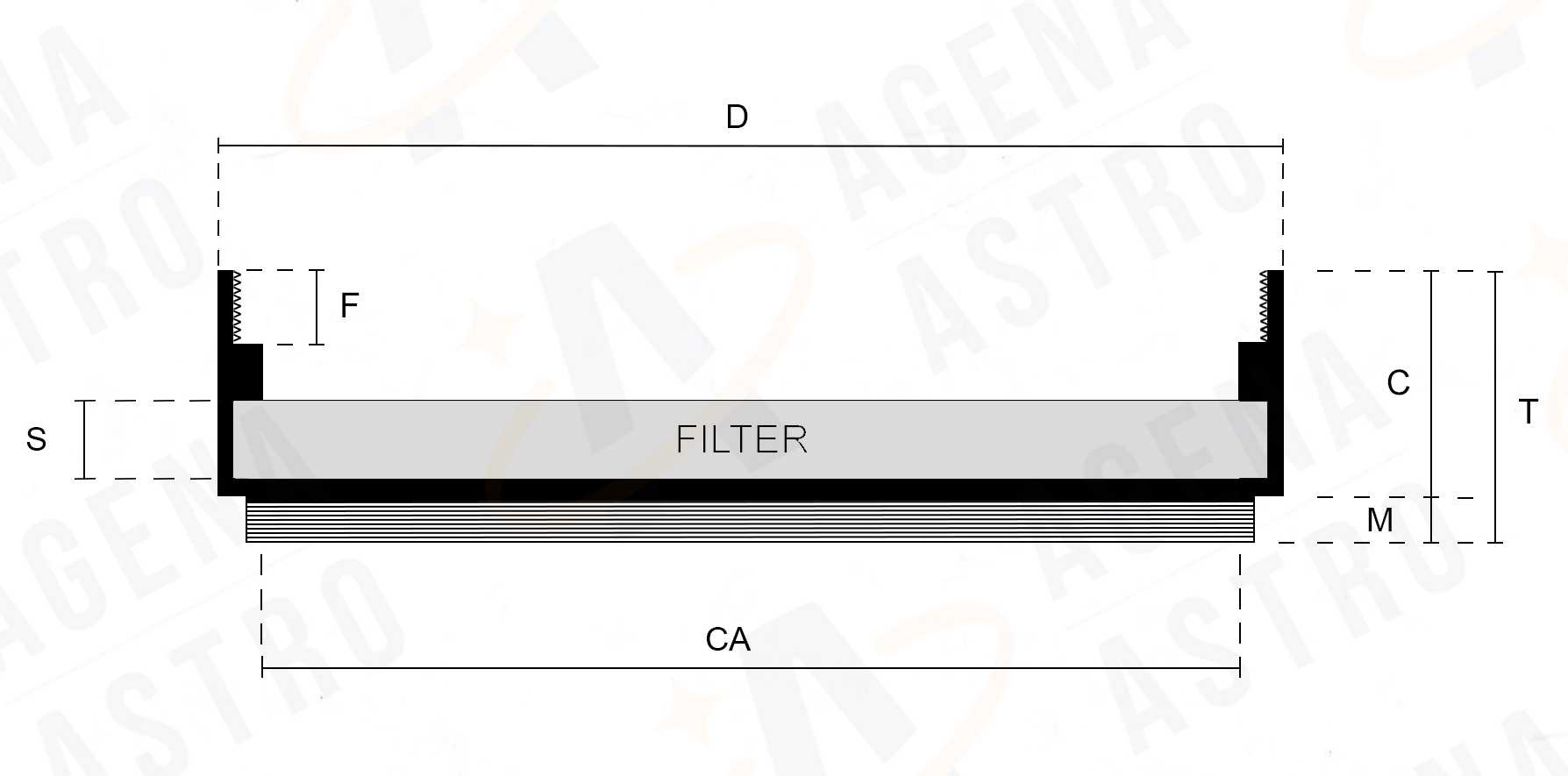
D = Filter Cell Diameter = 31.5 mm / 1.24 in
T = Total Filter Height = 7.3 mm / 0.28 in
C = Filter Cell Height (Excluding Male Thread) = 4.7mm / 0.18 in
M = Male Thread Length = 2.5 mm / 0.09 in
F = USABLE Female Filter Thread Length = Not threaded, so you cannot stack additional filters
S = Glass Substrate Thickness = 2 mm / 0.07 in
CA = Clear Aperture = 25.5 mm / 1.00 in
Other Information
- Country of Manufacture: China
The Antlia IR Pass 685nm filter is an absorptive filter that allows infrared light with wavelengths of more than 685nm to pass through. At these longer wavelengths, the sensitivity of the unaided eye is reduced, so it is not suitable for visual observations. The filter is highly recommended for any planetary photography. At long-wavelength spectral range the atmospheric air turbulence (seeing) has much lower impact on the sharpness. The closer to the infrared band, planetary images are less disturbed by wavefront distortions in the atmosphere (seeing), result in the sharpest and highest contrast image possible.
By combining a luminance image taken with the IR-Pass filter, along with RGB and U-Venus filters, overall image sharpness is significantly enhanced and details of planets in different bands are taken. The filter is also possible to image the other planets during daylight due to the dark background sky created by the 685nm IR Pass Filter.
Technical Data:
- Schott Optical Substrate
- 1.25" Mounted (2mm +/- 0.05mm)
- Surface Quality: 60/40 (MIL-O-13830)
- 2 Sides Fine-optically polished to ensure accurate 1/4 wavefront
- 30 arcsec parallelism
Filter Ring:
- 1.25” (28.5x0.6)
- Ultra-thin filter cell to minimize vignetting by maximize possible clear aperture
- Black Anodized Finish
- Laser Engraving No Fading
Not Recommended:
- Solar Observing and imaging
- Visual observation
- DO NOT LOOK AT THE SUN WITH ANTLIA FILTERS.
- Serious eye damage will result if you fail to observe the warning
The Antlia IR Pass 685nm filter is an absorptive filter that allows infrared light with wavelengths of more than 685nm to pass through. At these longer wavelengths, the sensitivity of the unaided eye is reduced, so it is not suitable for visual observations. The filter is highly recommended for any planetary photography. At long-wavelength spectral range the atmospheric air turbulence (seeing) has much lower impact on the sharpness. The closer to the infrared band, planetary images are less disturbed by wavefront distortions in the atmosphere (seeing), result in the sharpest and highest contrast image possible.
By combining a luminance image taken with the IR-Pass filter, along with RGB and U-Venus filters, overall image sharpness is significantly enhanced and details of planets in different bands are taken. The filter is also possible to image the other planets during daylight due to the dark background sky created by the 685nm IR Pass Filter.
Technical Data:
- Schott Optical Substrate
- 1.25" Mounted (2mm +/- 0.05mm)
- Surface Quality: 60/40 (MIL-O-13830)
- 2 Sides Fine-optically polished to ensure accurate 1/4 wavefront
- 30 arcsec parallelism
Filter Ring:
- 1.25” (28.5x0.6)
- Ultra-thin filter cell to minimize vignetting by maximize possible clear aperture
- Black Anodized Finish
- Laser Engraving No Fading
Not Recommended:
- Solar Observing and imaging
- Visual observation
- DO NOT LOOK AT THE SUN WITH ANTLIA FILTERS.
- Serious eye damage will result if you fail to observe the warning
Useful Resources
Filter Cell Specifications
D = Filter Cell Diameter = 31.5 mm / 1.24 in
T = Total Filter Height = 7.3 mm / 0.28 in
C = Filter Cell Height (Excluding Male Thread) = 4.7mm / 0.18 in
M = Male Thread Length = 2.5 mm / 0.09 in
F = USABLE Female Filter Thread Length = Not threaded, so you cannot stack additional filters
S = Glass Substrate Thickness = 2 mm / 0.07 in
CA = Clear Aperture = 25.5 mm / 1.00 in
Other Information
- Country of Manufacture: China

Antlia IR Pass Filter (685nm) - 1.25"