

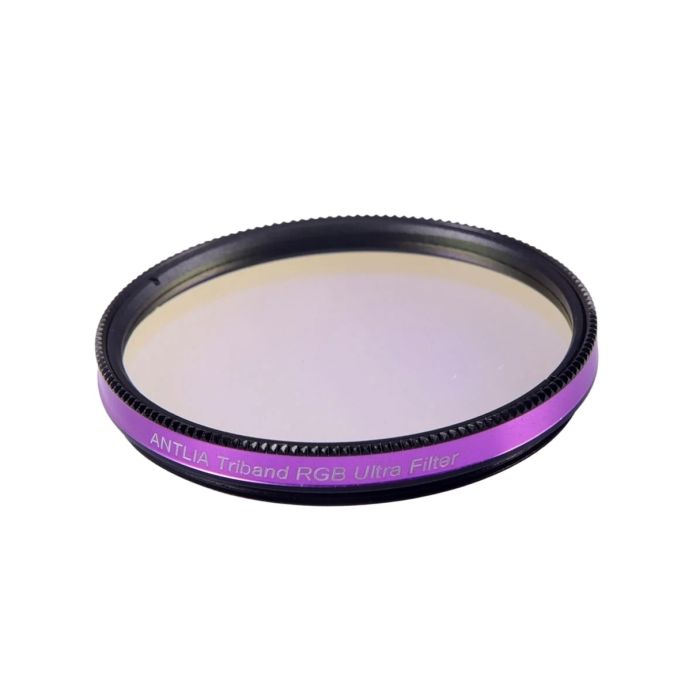
Antlia Triband RGB Ultra II Filter - 2" Mounted
Stock count is accurate & shown in real time.
- This item is out of stock.
- Sign up for back-in-stock alerts to be notified when this item becomes available (account login required).
- This item is out of stock.
- Sign up for back-in-stock alerts to be notified when this item becomes available (account login required).
Contiguous US / Lower 48:
Free shipping applies to orders over $50 using our chosen carrier/method. Faster paid options are available at checkout.
Alaska, Hawaii & US Territories:
Free shipping applies to many—but not all—products. Enter your ZIP code in cart or upon checkout to confirm options and costs.
International:
International orders do not qualify for free shipping. Shipping, duties, brokerage, tariffs, and taxes are the customer’s responsibility. Some items may be restricted due to export, size, or manufacturer limitations.
PLEASE NOTE: Antlia is making a running change to their packaging. They are transitioning from 2-piece magnetic plastic cases to a smaller 1-piece non-magnetic design. Depending on the item(s) you order, you may randomly get one case type or the other or a mix of the two. We cannot entertain requests for any specific case type.
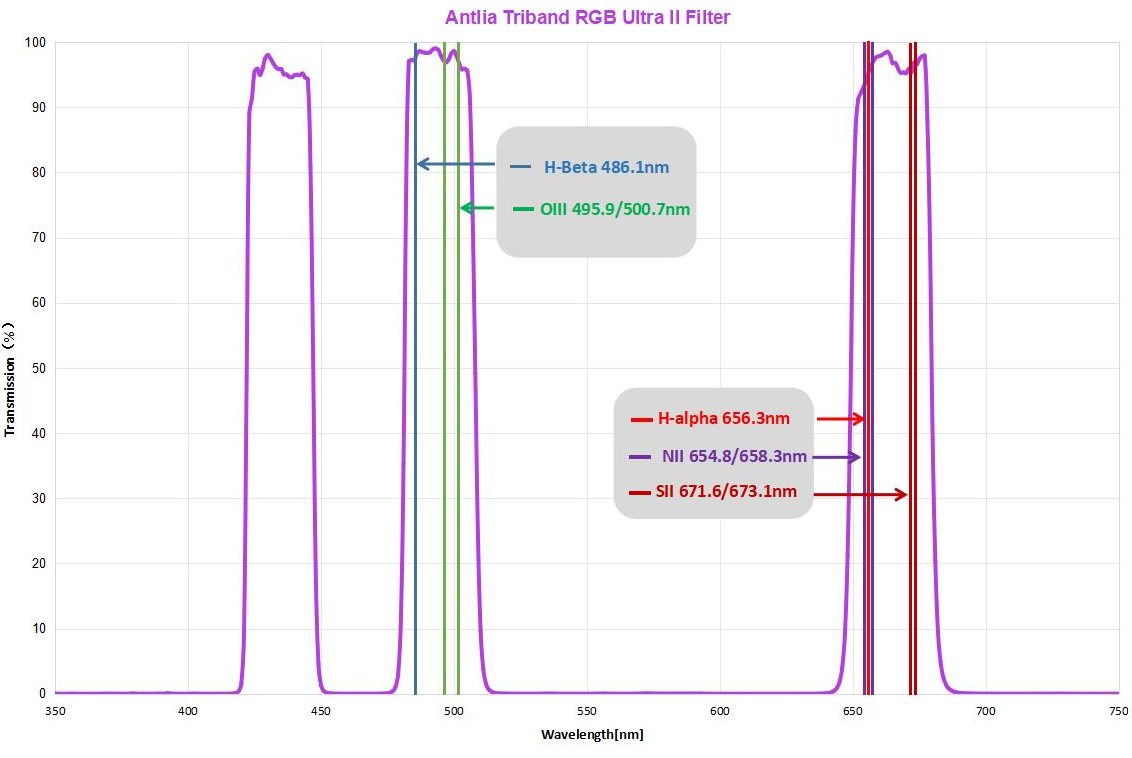
- Passes five emission lines at over 92% peak transmission each. These include H-alpha, NII, SII, OIII, and H-beta.
- OD4 blocking from 300 to 1050nm suppresses artificial light pollution
- Rated for optical systems as fast as f/2
- Compatible with both OSC and monochrome cameras
- Suitable for >90% of deep-sky objects such as galaxies, star clusters, and most nebulae
- Balanced RGB design with updated coating minimizes color cast and reduces star halos
- Can replace the luminance (L) filter in mono LRGB imaging workflows
A Modern Filter for Modern Light Pollution
The Antlia Triband RGB Ultra II is a multi-passband filter designed for deep-sky imaging under light-polluted skies. It passes five emission lines across the red, green, and blue portions of the spectrum, each at over 92% peak transmission. The addition of H-beta at 486.1nm is the key upgrade over the original Triband RGB Ultra. H-beta brings out nebula structure in the blue-green channel that the earlier version missed. The filter works with both OSC and mono cameras and handles focal ratios as fast as f/2. It goes beyond emission nebulae. Galaxies, reflection nebulae, and star clusters are all viable targets, allowing it to work with more than 90% of deep-sky objects.
Watch Agena Affiliate put the Antlia Triad Ultra to the Ultimate Test!
See the Antlia Triad Ultra in Action!
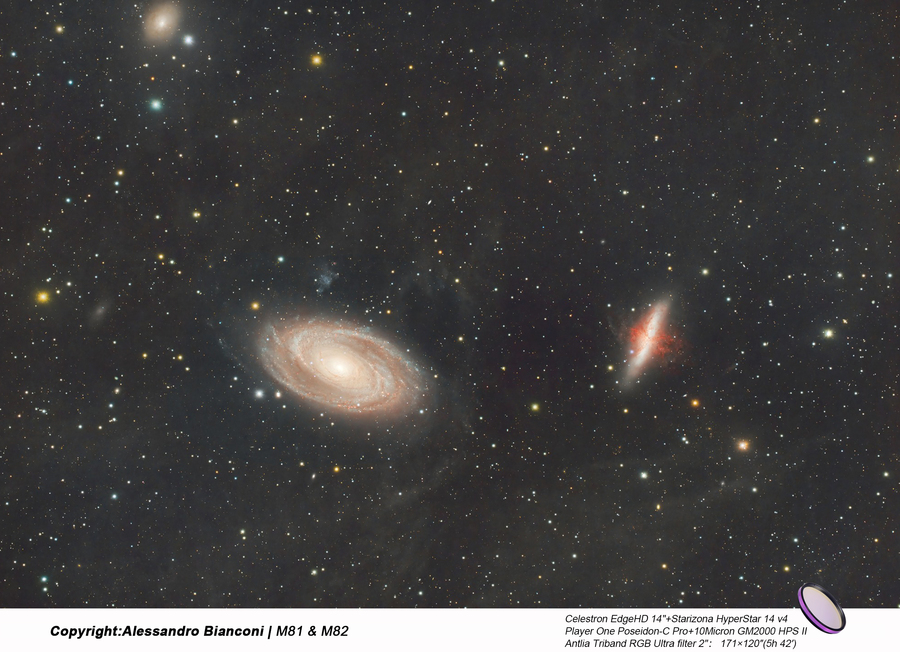
M81 & M82
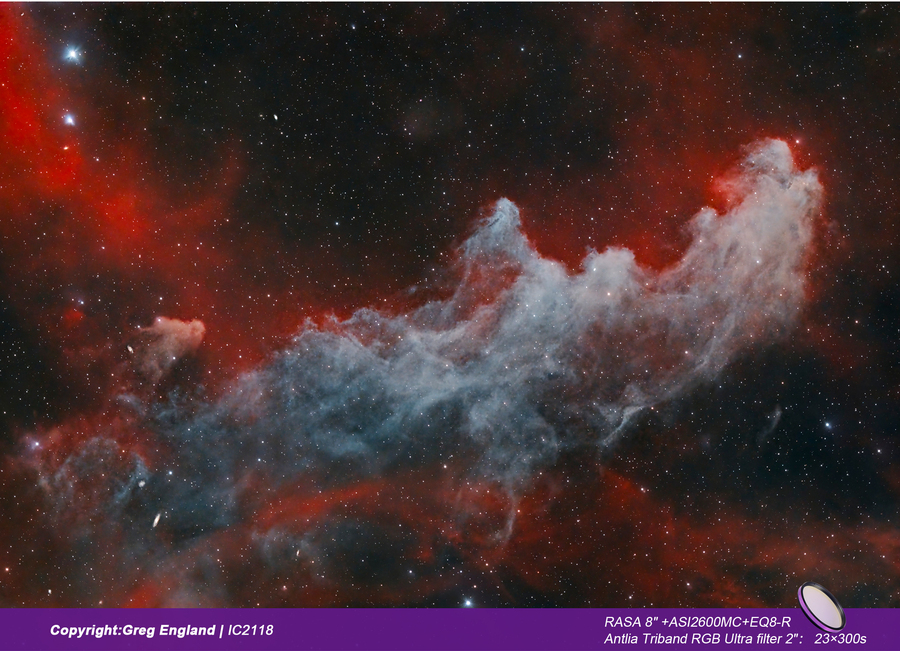
IC2118
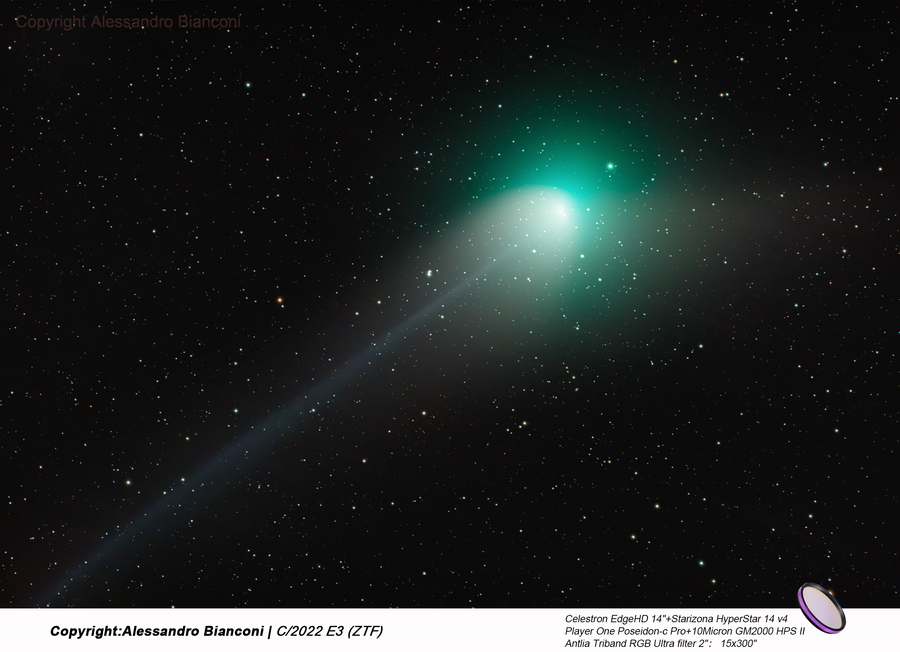
Comet/2022 E3
High-Transmission In Every Band
The Triband RGB Ultra II passes emission across three spectral regions in a single filter. In the red, it targets H-alpha at 656.3nm along with NII at 658.3nm and 654.8nm, and SII at 671.6nm and 673.1nm. In the green, it passes OIII at 495.9nm and 500.7nm. In the blue-green, it passes H-beta at 486.1nm. Every line achieves over 92% peak transmission. That level of efficiency means the filter is collecting strong signal in each channel rather than just allowing some light through. The result is complete spectral coverage across all three color channels in a single imaging session, with no need to swap filters between targets.
Fight Back Against Broadband Light Pollution
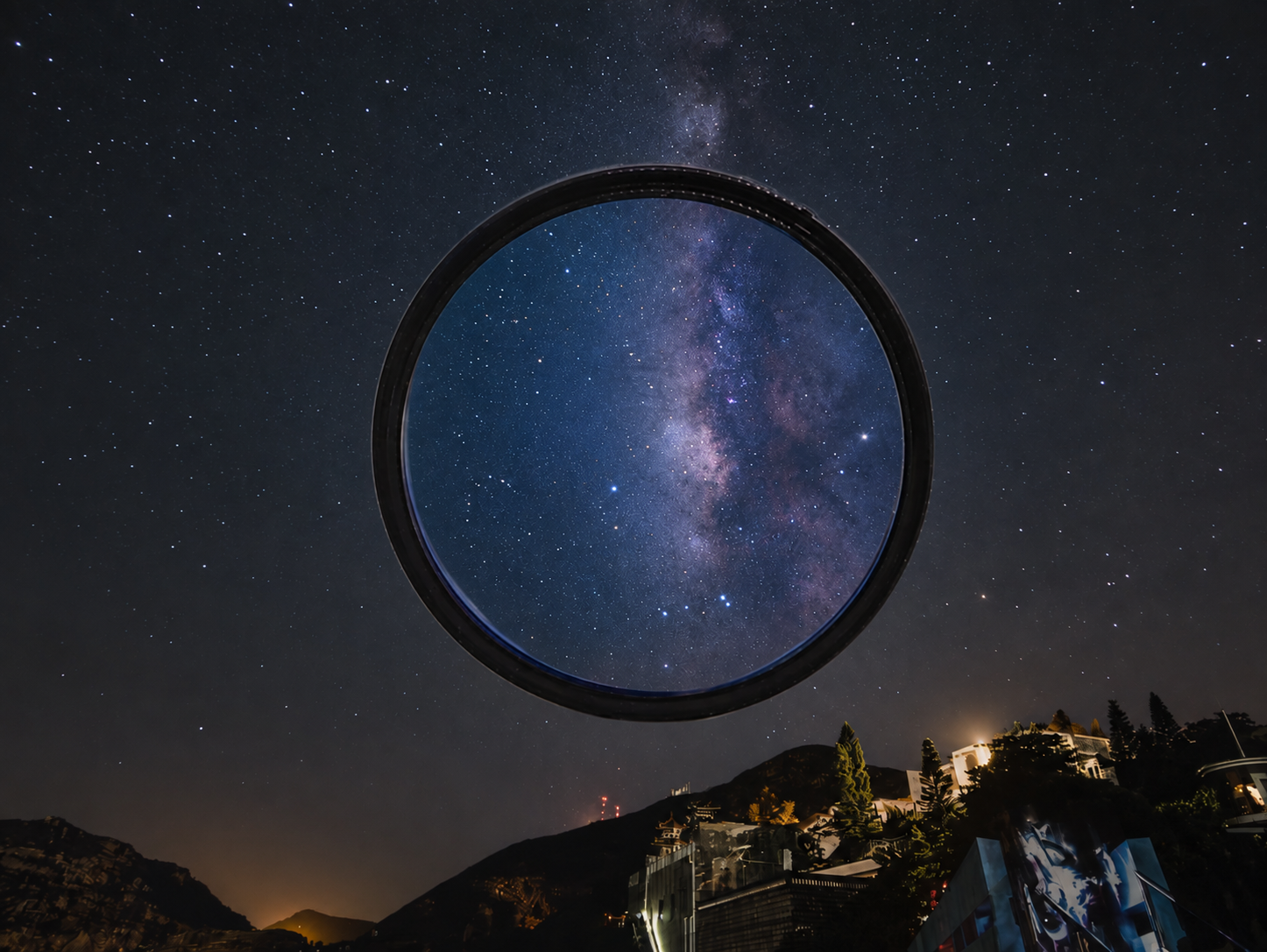
Outside its emission line passbands, the filter applies OD4 blocking from 300 to 1050nm. OD4 means less than 0.01% of light at those wavelengths passes through. This level of rejection suppresses the sodium vapor, mercury vapor, and broadband LED sources responsible for most artificial sky glow.
The filter is rated effective across all sky conditions, from Bortle 1 dark sites to Bortle 8 urban environments. Photographers shooting from rooftops, suburban backyards, or other compromised skies can use it with confidence that light pollution is being controlled at every wavelength outside the target passbands.
A Wider Range of Targets
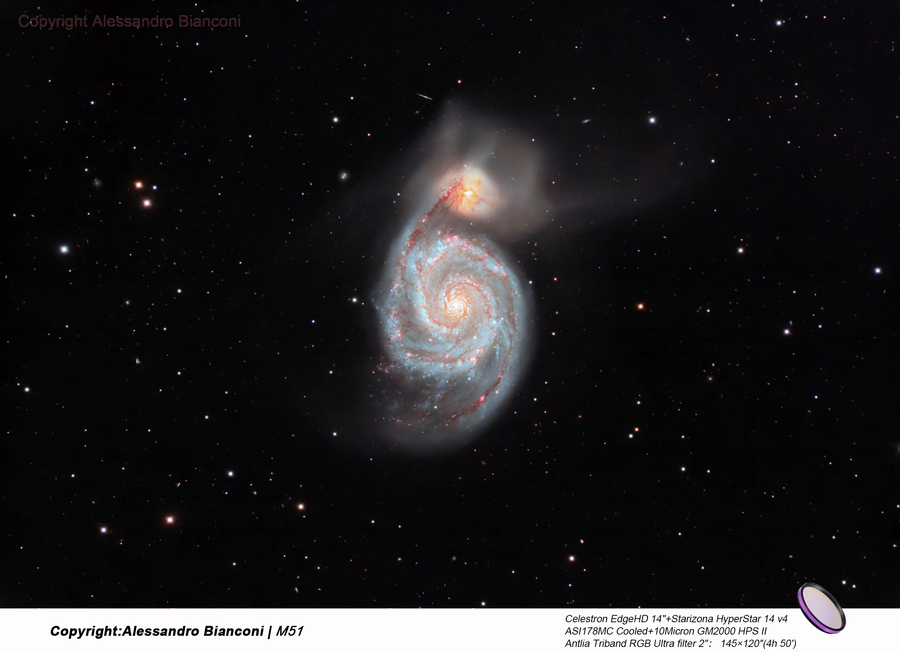
Most narrowband filters are built for emission nebulae only. The Triband RGB Ultra II works differently. Its spectral design passes enough broadband information to cover galaxies, reflection nebulae, and star clusters in addition to emission targets. Antlia estimates this gives it practical coverage of more than 90% of deep-sky objects.
Photographers imaging from light-polluted skies can work through a full range of target types without switching filters. The filter performs from Bortle 1 through Bortle 8, making it practical for traveling imagers who shoot from varying locations as well as those limited to a single fixed site.
Perfectly-Balanced Color Output
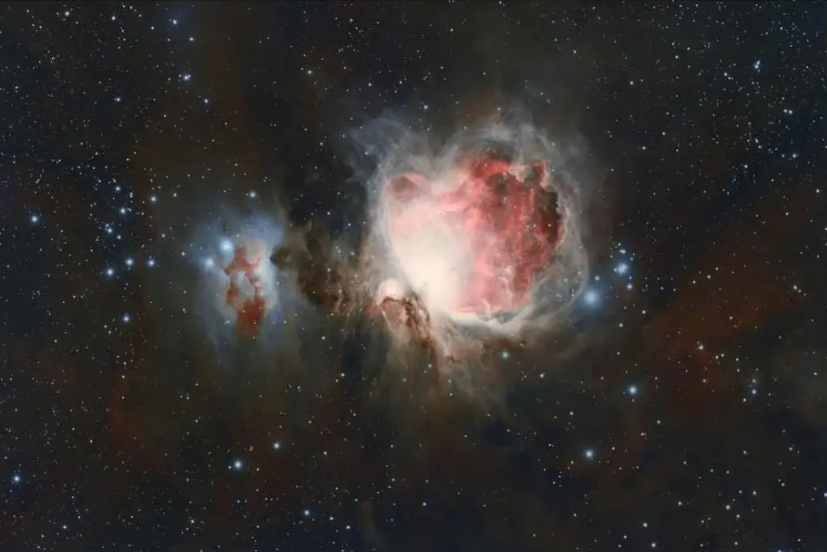
The filter uses a balanced transmission design that distributes signal evenly across the RGB channels. Stars, galaxies, and globular clusters come through with neutral color rather than the strong tint typical of narrowband filters. Antlia updated the coating on the Ultra II to produce cleaner stars and sharper data across the full frame.
In practice, this means images processed from Triband RGB Ultra II data require less aggressive color correction and produce cleaner, more natural-looking color in stars and background objects. The reduced halo effect is especially noticeable around bright stars near emission targets.
Great for Visual Observing Too!
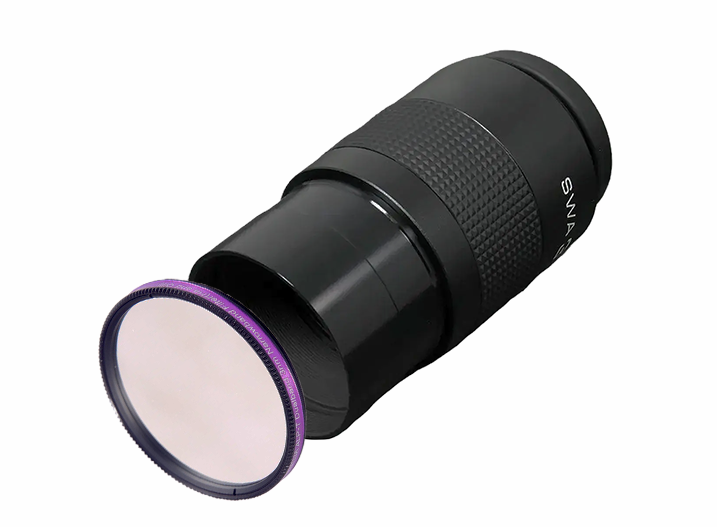
The Triband RGB Ultra II is not limited to astrophotography. The filter passes a strong emission line signal, and observers using large-aperture instruments will see noticeably improved object definition compared to an unfiltered eyepiece. Light pollution suppression extends the contrast visible from suburban and urban observing sites. Observers using large Dobsonians or other high-aperture instruments will see improved definition in emission targets compared to an unfiltered view from compromised skies. Eyepiece not included.
Specifications
Frequently Asked Questions
What is the difference between the Triband RGB Ultra and Triband RGB Ultra II?
The Ultra II adds H-beta at 486.1 nm to the filter's passband. The original Triband RGB Ultra passes H-alpha, NII, SII, and OIII. Adding H-beta extends coverage into the blue-green portion of the spectrum and helps reveal finer detail in nebulae with strong H-beta emission, including certain planetary and emission nebulae.
What is “OD4” blocking and why does it matter?
OD4 stands for optical density 4, meaning less than 0.01% of light at blocked wavelengths passes through the filter. This strong rejection helps suppress sodium vapor, mercury vapor, and broadband LED light pollution commonly found in artificial sky glow.
Can I use this filter with a DSLR or mirrorless camera?
Yes, with an appropriate 2-inch adapter. Modified DSLRs with the internal IR-cut filter removed provide better H-alpha sensitivity. Unmodified cameras still benefit from OIII and H-beta transmission and light pollution suppression, although H-alpha response at 656.3 nm will be reduced by the camera's internal filter.
Does this 2-inch version work with a camera clip-in holder?
No. This is a threaded 2-inch mounted filter designed for standard 2-inch filter drawers, nosepieces, and filter wheels. It is not a clip-in filter. For use inside a mirrorless camera body, check for a compatible Antlia clip-in version for your specific camera mount.
How does the Triband RGB Ultra II compare to a dual-band filter for light-polluted imaging?
A typical dual-band filter passes H-alpha and OIII, providing high contrast on emission nebulae. The Triband RGB Ultra II passes five emission lines, offering broader spectral coverage and more balanced RGB color. Dual-band filters may provide higher contrast on emission nebulae, while the Triband RGB Ultra II offers greater versatility depending on the targets you image.
Will the filter shift spectral response when used on a fast refractor?
The filter is rated for optical systems as fast as f/2, so refractors operating at f/5, f/6, f/7, or f/8 are well within its supported range. It is designed to maintain its spectral response from f/2 through slower focal ratios, making it suitable for fast Newtonians and HyperStar configurations as well.
Useful Resources
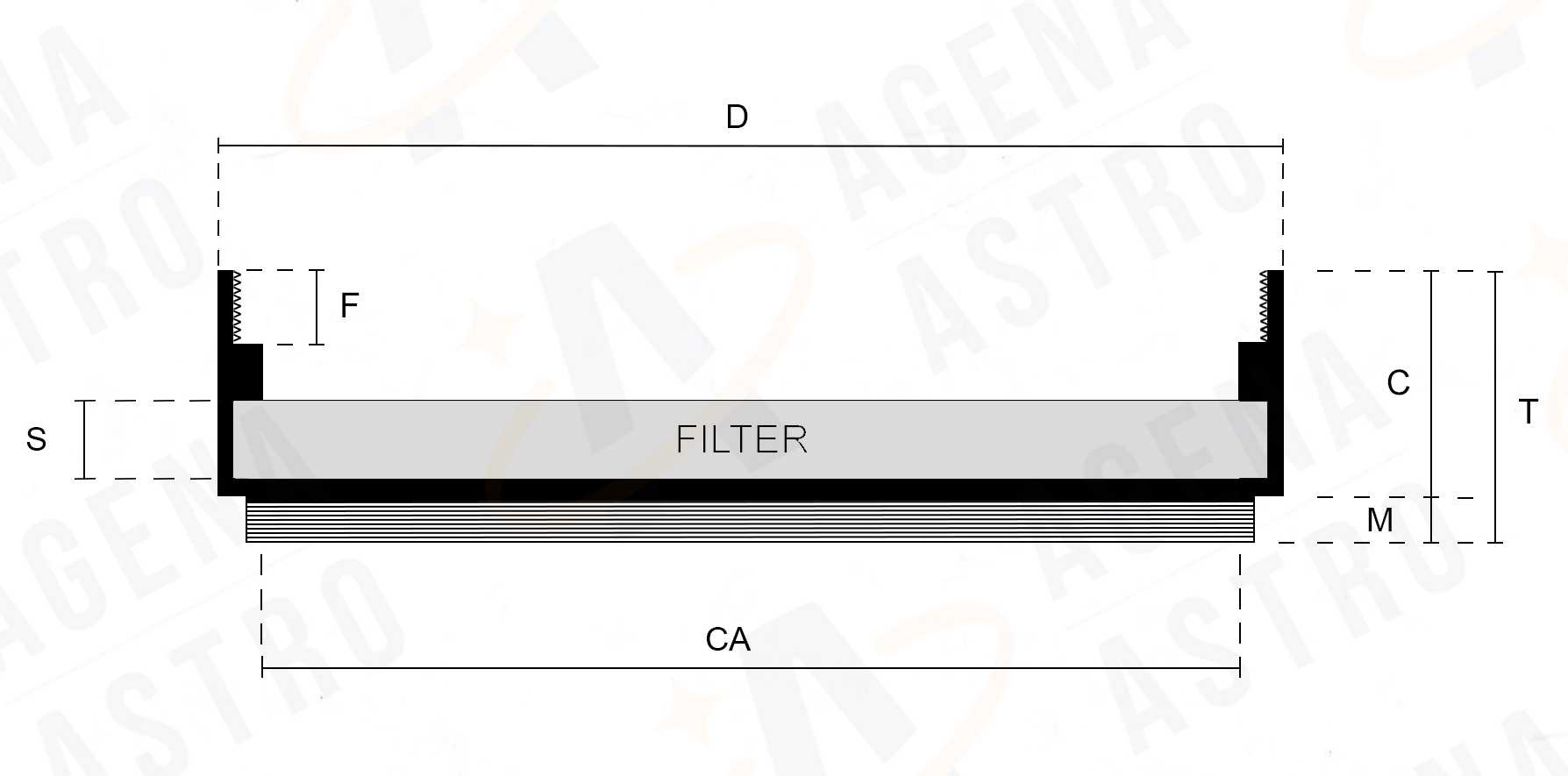
Filter Cell Specifications
D = Filter Cell Diameter = 50.3 mm / 2.0 in
T = Total Filter Height = 7.3 mm / 0.28 in
C = Filter Cell Height (Excluding Male Thread) = 4.9 mm / 0.19 in
M = Male Thread Length = 2.5 mm / 0.09 in
F = USABLE Female Filter Thread Length = Not threaded, so you cannot stack additional filters
S = Glass Substrate Thickness = 2 mm / 0.07 in
CA = Clear Aperture = 45 mm / 1.77 in
Other Information
- Country of Manufacture: China
A Modern Filter for Modern Light Pollution
The Antlia Triband RGB Ultra II is a multi-passband filter designed for deep-sky imaging under light-polluted skies. It passes five emission lines across the red, green, and blue portions of the spectrum, each at over 92% peak transmission. The addition of H-beta at 486.1nm is the key upgrade over the original Triband RGB Ultra. H-beta brings out nebula structure in the blue-green channel that the earlier version missed. The filter works with both OSC and mono cameras and handles focal ratios as fast as f/2. It goes beyond emission nebulae. Galaxies, reflection nebulae, and star clusters are all viable targets, allowing it to work with more than 90% of deep-sky objects.
Watch Agena Affiliate put the Antlia Triad Ultra to the Ultimate Test!
See the Antlia Triad Ultra in Action!
M81 & M82
IC2118
Comet/2022 E3
High-Transmission In Every Band
The Triband RGB Ultra II passes emission across three spectral regions in a single filter. In the red, it targets H-alpha at 656.3nm along with NII at 658.3nm and 654.8nm, and SII at 671.6nm and 673.1nm. In the green, it passes OIII at 495.9nm and 500.7nm. In the blue-green, it passes H-beta at 486.1nm. Every line achieves over 92% peak transmission. That level of efficiency means the filter is collecting strong signal in each channel rather than just allowing some light through. The result is complete spectral coverage across all three color channels in a single imaging session, with no need to swap filters between targets.
Fight Back Against Broadband Light Pollution
Outside its emission line passbands, the filter applies OD4 blocking from 300 to 1050nm. OD4 means less than 0.01% of light at those wavelengths passes through. This level of rejection suppresses the sodium vapor, mercury vapor, and broadband LED sources responsible for most artificial sky glow.
The filter is rated effective across all sky conditions, from Bortle 1 dark sites to Bortle 8 urban environments. Photographers shooting from rooftops, suburban backyards, or other compromised skies can use it with confidence that light pollution is being controlled at every wavelength outside the target passbands.
A Wider Range of Targets
Most narrowband filters are built for emission nebulae only. The Triband RGB Ultra II works differently. Its spectral design passes enough broadband information to cover galaxies, reflection nebulae, and star clusters in addition to emission targets. Antlia estimates this gives it practical coverage of more than 90% of deep-sky objects.
Photographers imaging from light-polluted skies can work through a full range of target types without switching filters. The filter performs from Bortle 1 through Bortle 8, making it practical for traveling imagers who shoot from varying locations as well as those limited to a single fixed site.
Perfectly-Balanced Color Output
The filter uses a balanced transmission design that distributes signal evenly across the RGB channels. Stars, galaxies, and globular clusters come through with neutral color rather than the strong tint typical of narrowband filters. Antlia updated the coating on the Ultra II to produce cleaner stars and sharper data across the full frame.
In practice, this means images processed from Triband RGB Ultra II data require less aggressive color correction and produce cleaner, more natural-looking color in stars and background objects. The reduced halo effect is especially noticeable around bright stars near emission targets.
Great for Visual Observing Too!
The Triband RGB Ultra II is not limited to astrophotography. The filter passes a strong emission line signal, and observers using large-aperture instruments will see noticeably improved object definition compared to an unfiltered eyepiece. Light pollution suppression extends the contrast visible from suburban and urban observing sites. Observers using large Dobsonians or other high-aperture instruments will see improved definition in emission targets compared to an unfiltered view from compromised skies. Eyepiece not included.
Specifications
Frequently Asked Questions
What is the difference between the Triband RGB Ultra and Triband RGB Ultra II?
The Ultra II adds H-beta at 486.1 nm to the filter's passband. The original Triband RGB Ultra passes H-alpha, NII, SII, and OIII. Adding H-beta extends coverage into the blue-green portion of the spectrum and helps reveal finer detail in nebulae with strong H-beta emission, including certain planetary and emission nebulae.
What is “OD4” blocking and why does it matter?
OD4 stands for optical density 4, meaning less than 0.01% of light at blocked wavelengths passes through the filter. This strong rejection helps suppress sodium vapor, mercury vapor, and broadband LED light pollution commonly found in artificial sky glow.
Can I use this filter with a DSLR or mirrorless camera?
Yes, with an appropriate 2-inch adapter. Modified DSLRs with the internal IR-cut filter removed provide better H-alpha sensitivity. Unmodified cameras still benefit from OIII and H-beta transmission and light pollution suppression, although H-alpha response at 656.3 nm will be reduced by the camera's internal filter.
Does this 2-inch version work with a camera clip-in holder?
No. This is a threaded 2-inch mounted filter designed for standard 2-inch filter drawers, nosepieces, and filter wheels. It is not a clip-in filter. For use inside a mirrorless camera body, check for a compatible Antlia clip-in version for your specific camera mount.
How does the Triband RGB Ultra II compare to a dual-band filter for light-polluted imaging?
A typical dual-band filter passes H-alpha and OIII, providing high contrast on emission nebulae. The Triband RGB Ultra II passes five emission lines, offering broader spectral coverage and more balanced RGB color. Dual-band filters may provide higher contrast on emission nebulae, while the Triband RGB Ultra II offers greater versatility depending on the targets you image.
Will the filter shift spectral response when used on a fast refractor?
The filter is rated for optical systems as fast as f/2, so refractors operating at f/5, f/6, f/7, or f/8 are well within its supported range. It is designed to maintain its spectral response from f/2 through slower focal ratios, making it suitable for fast Newtonians and HyperStar configurations as well.
- 1x Antlia Triband RGB Ultra II Filter, 2" Mounted (1)
- 1x Protective Case
PLEASE NOTE: Antlia is making a running change to their packaging. They are transitioning from 2-piece magnetic plastic cases to a smaller 1-piece non-magnetic design. Depending on the item(s) you order, you may randomly get one case type or the other or a mix of the two. We cannot entertain requests for any specific case type.
- Passes five emission lines at over 92% peak transmission each. These include H-alpha, NII, SII, OIII, and H-beta.
- OD4 blocking from 300 to 1050nm suppresses artificial light pollution
- Rated for optical systems as fast as f/2
- Compatible with both OSC and monochrome cameras
- Suitable for >90% of deep-sky objects such as galaxies, star clusters, and most nebulae
- Balanced RGB design with updated coating minimizes color cast and reduces star halos
- Can replace the luminance (L) filter in mono LRGB imaging workflows
A Modern Filter for Modern Light Pollution
The Antlia Triband RGB Ultra II is a multi-passband filter designed for deep-sky imaging under light-polluted skies. It passes five emission lines across the red, green, and blue portions of the spectrum, each at over 92% peak transmission. The addition of H-beta at 486.1nm is the key upgrade over the original Triband RGB Ultra. H-beta brings out nebula structure in the blue-green channel that the earlier version missed. The filter works with both OSC and mono cameras and handles focal ratios as fast as f/2. It goes beyond emission nebulae. Galaxies, reflection nebulae, and star clusters are all viable targets, allowing it to work with more than 90% of deep-sky objects.
Watch Agena Affiliate put the Antlia Triad Ultra to the Ultimate Test!
See the Antlia Triad Ultra in Action!
M81 & M82
IC2118
Comet/2022 E3
High-Transmission In Every Band
The Triband RGB Ultra II passes emission across three spectral regions in a single filter. In the red, it targets H-alpha at 656.3nm along with NII at 658.3nm and 654.8nm, and SII at 671.6nm and 673.1nm. In the green, it passes OIII at 495.9nm and 500.7nm. In the blue-green, it passes H-beta at 486.1nm. Every line achieves over 92% peak transmission. That level of efficiency means the filter is collecting strong signal in each channel rather than just allowing some light through. The result is complete spectral coverage across all three color channels in a single imaging session, with no need to swap filters between targets.
Fight Back Against Broadband Light Pollution
Outside its emission line passbands, the filter applies OD4 blocking from 300 to 1050nm. OD4 means less than 0.01% of light at those wavelengths passes through. This level of rejection suppresses the sodium vapor, mercury vapor, and broadband LED sources responsible for most artificial sky glow.
The filter is rated effective across all sky conditions, from Bortle 1 dark sites to Bortle 8 urban environments. Photographers shooting from rooftops, suburban backyards, or other compromised skies can use it with confidence that light pollution is being controlled at every wavelength outside the target passbands.
A Wider Range of Targets
Most narrowband filters are built for emission nebulae only. The Triband RGB Ultra II works differently. Its spectral design passes enough broadband information to cover galaxies, reflection nebulae, and star clusters in addition to emission targets. Antlia estimates this gives it practical coverage of more than 90% of deep-sky objects.
Photographers imaging from light-polluted skies can work through a full range of target types without switching filters. The filter performs from Bortle 1 through Bortle 8, making it practical for traveling imagers who shoot from varying locations as well as those limited to a single fixed site.
Perfectly-Balanced Color Output
The filter uses a balanced transmission design that distributes signal evenly across the RGB channels. Stars, galaxies, and globular clusters come through with neutral color rather than the strong tint typical of narrowband filters. Antlia updated the coating on the Ultra II to produce cleaner stars and sharper data across the full frame.
In practice, this means images processed from Triband RGB Ultra II data require less aggressive color correction and produce cleaner, more natural-looking color in stars and background objects. The reduced halo effect is especially noticeable around bright stars near emission targets.
Great for Visual Observing Too!
The Triband RGB Ultra II is not limited to astrophotography. The filter passes a strong emission line signal, and observers using large-aperture instruments will see noticeably improved object definition compared to an unfiltered eyepiece. Light pollution suppression extends the contrast visible from suburban and urban observing sites. Observers using large Dobsonians or other high-aperture instruments will see improved definition in emission targets compared to an unfiltered view from compromised skies. Eyepiece not included.
Specifications
Frequently Asked Questions
What is the difference between the Triband RGB Ultra and Triband RGB Ultra II?
The Ultra II adds H-beta at 486.1 nm to the filter's passband. The original Triband RGB Ultra passes H-alpha, NII, SII, and OIII. Adding H-beta extends coverage into the blue-green portion of the spectrum and helps reveal finer detail in nebulae with strong H-beta emission, including certain planetary and emission nebulae.
What is “OD4” blocking and why does it matter?
OD4 stands for optical density 4, meaning less than 0.01% of light at blocked wavelengths passes through the filter. This strong rejection helps suppress sodium vapor, mercury vapor, and broadband LED light pollution commonly found in artificial sky glow.
Can I use this filter with a DSLR or mirrorless camera?
Yes, with an appropriate 2-inch adapter. Modified DSLRs with the internal IR-cut filter removed provide better H-alpha sensitivity. Unmodified cameras still benefit from OIII and H-beta transmission and light pollution suppression, although H-alpha response at 656.3 nm will be reduced by the camera's internal filter.
Does this 2-inch version work with a camera clip-in holder?
No. This is a threaded 2-inch mounted filter designed for standard 2-inch filter drawers, nosepieces, and filter wheels. It is not a clip-in filter. For use inside a mirrorless camera body, check for a compatible Antlia clip-in version for your specific camera mount.
How does the Triband RGB Ultra II compare to a dual-band filter for light-polluted imaging?
A typical dual-band filter passes H-alpha and OIII, providing high contrast on emission nebulae. The Triband RGB Ultra II passes five emission lines, offering broader spectral coverage and more balanced RGB color. Dual-band filters may provide higher contrast on emission nebulae, while the Triband RGB Ultra II offers greater versatility depending on the targets you image.
Will the filter shift spectral response when used on a fast refractor?
The filter is rated for optical systems as fast as f/2, so refractors operating at f/5, f/6, f/7, or f/8 are well within its supported range. It is designed to maintain its spectral response from f/2 through slower focal ratios, making it suitable for fast Newtonians and HyperStar configurations as well.
Useful Resources
Filter Cell Specifications
D = Filter Cell Diameter = 50.3 mm / 2.0 in
T = Total Filter Height = 7.3 mm / 0.28 in
C = Filter Cell Height (Excluding Male Thread) = 4.9 mm / 0.19 in
M = Male Thread Length = 2.5 mm / 0.09 in
F = USABLE Female Filter Thread Length = Not threaded, so you cannot stack additional filters
S = Glass Substrate Thickness = 2 mm / 0.07 in
CA = Clear Aperture = 45 mm / 1.77 in
Other Information
- Country of Manufacture: China
- 1x Antlia Triband RGB Ultra II Filter, 2" Mounted (1)
- 1x Protective Case

Antlia Triband RGB Ultra II Filter - 2" Mounted