

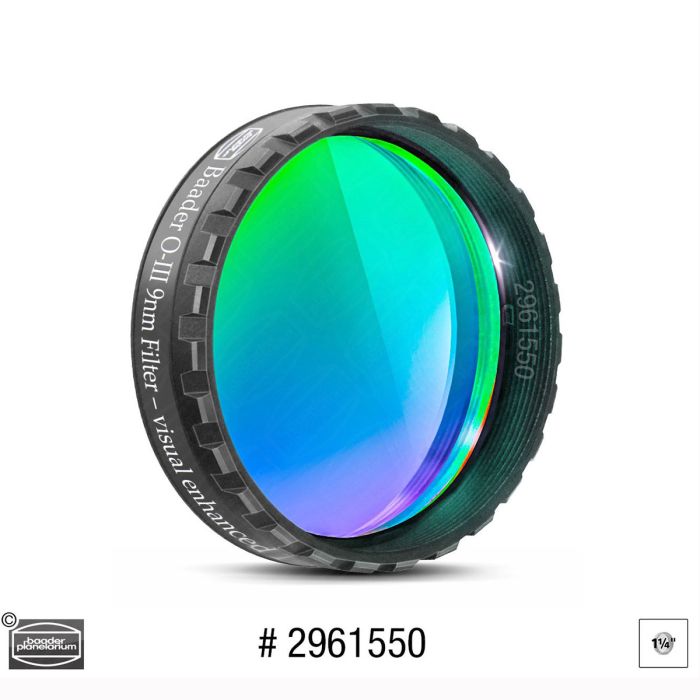
Baader CMOS Optimized 9mm O-III Super-G Filter - 1.25" Mounted
Stock count is accurate & shown in real time.
- This item is out of stock.
- Sign up for back-in-stock alerts to be notified when this item becomes available (account login required).
- This item is out of stock.
- Sign up for back-in-stock alerts to be notified when this item becomes available (account login required).
Contiguous US / Lower 48:
Free shipping applies to orders over $50 using our chosen carrier/method. Faster paid options are available at checkout.
Alaska, Hawaii & US Territories:
Free shipping applies to many—but not all—products. Enter your ZIP code in cart or upon checkout to confirm options and costs.
International:
International orders do not qualify for free shipping. Shipping, duties, brokerage, tariffs, and taxes are the customer’s responsibility. Some items may be restricted due to export, size, or manufacturer limitations.
- 1¼" Baader O-III Super-G filter with 9 nm FWHM
- With 1¼" (M28.5) filter thread and a maximum transmission of 97%.
- For visual and photographic observation of planetary nebulae and supernova remnants, even with small telescopes
- Can be used as a "Super-G filter" replacement for RGB photography. While regular G-filters suffer from bad seeing due to air turbulences, the narrow range of 9 nm passes less thermal noise, i.e. sharper images. Nevertheless, the transmission window is large enough not to be considered a pure narrowband filter.
- CMOS-optimized coating technolog with much steeper slopes of the filter passband - for increased contrast, longer life and to avoid reflections.
Baader O-III Super-G Filter, 1¼"
The O-III filter is designed for observing and photographing those gas nebulae in which doubly ionised oxygen fluoresces - i.e. primarily for planetary nebulae and supernova remnants. With a FWHM of only 9 nm and equipped with the CMOS-optimised coating technology, it darkens the sky background and thus also blocks stray light much better than its 10 nm predecessor (Baader O-III Filter (10nm) visual (various versions available)). But the narrower FWHM is not the most important improvement. More important is the significantly better blocking aside of the O III wavelength, as well as even steeper transmission slopes and a broad plateau in the transmission range. With a transmission of 97% for the emission line at 500.7 nm, practically all the light of the nebula passes through the filter. At the same time, this filter can be used photographically for practically any focal ratio from f/1.8 to f/12 without passing any light of the H-beta line. This makes the Super-G filter just as ideal for use in areas with high light pollution.
Photographic use
The 9 nm O-III filter can be excellently used photographically on all telescopes, especially with a DSLR or an astronomical OSC colour camera. It offers all the advantages of the CMOS-optimised Baader filters such as Reflex-Blocker™ coating against reflections, plano-optical polishing and age-resistant Life-Coat™ coating. For monochrome cameras, we recommend the even stronger Narrowband (6.5 nm) and Ultra-Narrowband (4 nm) filters , which are available specially adapted for different aperture ratios. For this comparatively broadband 9 nm filter, preshifting is not necessary at focal ratios faster than f/4, thus it can be used at all focal ratios.
Super-G filter
The filter has the same thickness as the 1.25"/2" Baader LRGB filters. This makes it suitable for use as a "super G filter": In the transmission range of the normal green filter (490-580nm) there are no emission lines other than OIII; H-Beta at 486 nm is already covered by the RGB blue filter. So, when using the 9 nm O-III filter instead of the standard RGB green filter, emission nebulae are consequently emphasised much more strongly, while the stars appear fainter.
The Baader O-III Super-G filter has got all the advantages of the new generation of CMOS-optimized Baader filters:
- Increased contrast, matched for typical CMOS quantum efficiency and s/n ratio
- Reflex-Blocker™ coatings, for largest ever freedom from halos, even under most adverse conditions concerning aux-optics
- Identical filter thickness to existing standards, with utmost care for parfocality
- Blackened edges all around, with filter-lead-side-indicator in the form of a telescope-sided black outer rim, to additionally eliminate any reflection due to light falling onto the edge of a filter, making additional front-masks obselete
- Each filter coated individually, with sealed coating edge (NOT cut out of a larger plate with coatings left exposed)
- Life-Coat™: evermore hard coatings to enable a non-aging coating for life – even in a most adverse environment
Specifications:
- MANUFACTURER: Baader Planetarium
- SKU (#): 2961550
- EAN CODE: 4047825048172
- NET WEIGHT (KG): 0.06
- TRANSMISSION RANGE: O-III
- FILTER THICKNESS (WITHOUT CELL): 2 mm
- HBW (HALFBANDWIDTH): 9nm
- CWL (CENTRAL WAVELENGTH): 502 nm
- AR-COATING: Reflex-Blocker™ hard coated, dielectrically coated, planeoptically polished
- FILTER SIZE: 1.25 inch
- FILTER USAGE: CMOS, Contrast Enhancement, O-III, Planetary
- FILTER MOUNTED: Mounted (LPFC 6mm)
- TYPE OF FILTER: Narrowband
- SINGLE OR SET?: Single Filter
- FILTER SHAPE: round
Useful Resources
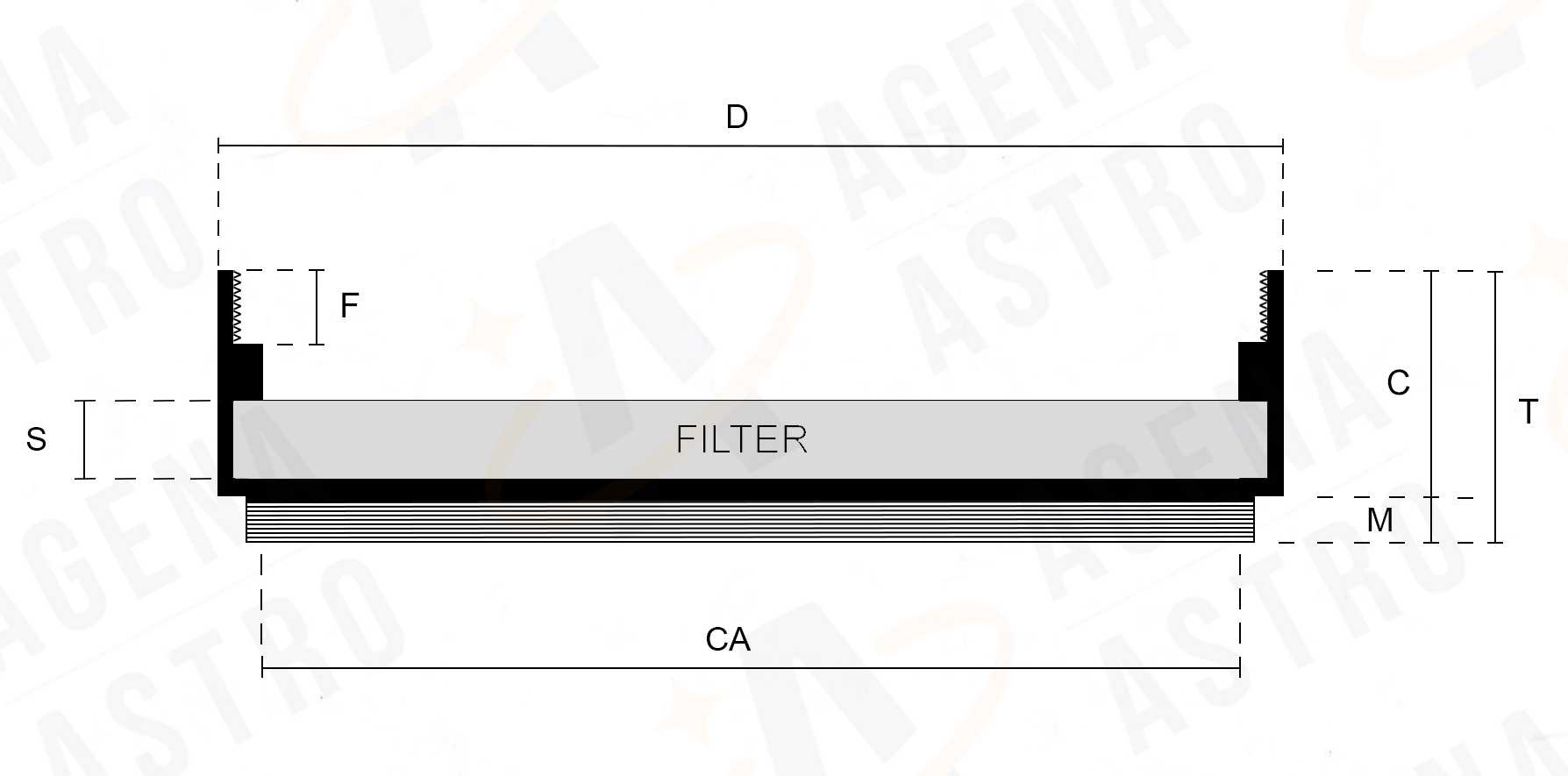
Filter Cell Specifications
D = Filter Cell Diameter = 30.9 mm / 1.21 in
T = Total Filter Height = 7.6 mm / 0.29 in
C = Filter Cell Height (Excluding Male Thread) = 5.9 mm / 0.23 in
M = Male Thread Length = 1.7 mm / 0.06 in
F = USABLE Female Filter Thread Length = 2.5 mm / 0.09 in
S = Glass Substrate Thickness = 2.0 mm / 0.07 in
CA = Clear Aperture = 26.5 mm / 1.04 in
Other Information
- Country of Manufacture: Germany
Baader O-III Super-G Filter, 1¼"
The O-III filter is designed for observing and photographing those gas nebulae in which doubly ionised oxygen fluoresces - i.e. primarily for planetary nebulae and supernova remnants. With a FWHM of only 9 nm and equipped with the CMOS-optimised coating technology, it darkens the sky background and thus also blocks stray light much better than its 10 nm predecessor (Baader O-III Filter (10nm) visual (various versions available)). But the narrower FWHM is not the most important improvement. More important is the significantly better blocking aside of the O III wavelength, as well as even steeper transmission slopes and a broad plateau in the transmission range. With a transmission of 97% for the emission line at 500.7 nm, practically all the light of the nebula passes through the filter. At the same time, this filter can be used photographically for practically any focal ratio from f/1.8 to f/12 without passing any light of the H-beta line. This makes the Super-G filter just as ideal for use in areas with high light pollution.
Photographic use
The 9 nm O-III filter can be excellently used photographically on all telescopes, especially with a DSLR or an astronomical OSC colour camera. It offers all the advantages of the CMOS-optimised Baader filters such as Reflex-Blocker™ coating against reflections, plano-optical polishing and age-resistant Life-Coat™ coating. For monochrome cameras, we recommend the even stronger Narrowband (6.5 nm) and Ultra-Narrowband (4 nm) filters , which are available specially adapted for different aperture ratios. For this comparatively broadband 9 nm filter, preshifting is not necessary at focal ratios faster than f/4, thus it can be used at all focal ratios.
Super-G filter
The filter has the same thickness as the 1.25"/2" Baader LRGB filters. This makes it suitable for use as a "super G filter": In the transmission range of the normal green filter (490-580nm) there are no emission lines other than OIII; H-Beta at 486 nm is already covered by the RGB blue filter. So, when using the 9 nm O-III filter instead of the standard RGB green filter, emission nebulae are consequently emphasised much more strongly, while the stars appear fainter.
The Baader O-III Super-G filter has got all the advantages of the new generation of CMOS-optimized Baader filters:
- Increased contrast, matched for typical CMOS quantum efficiency and s/n ratio
- Reflex-Blocker™ coatings, for largest ever freedom from halos, even under most adverse conditions concerning aux-optics
- Identical filter thickness to existing standards, with utmost care for parfocality
- Blackened edges all around, with filter-lead-side-indicator in the form of a telescope-sided black outer rim, to additionally eliminate any reflection due to light falling onto the edge of a filter, making additional front-masks obselete
- Each filter coated individually, with sealed coating edge (NOT cut out of a larger plate with coatings left exposed)
- Life-Coat™: evermore hard coatings to enable a non-aging coating for life – even in a most adverse environment
Specifications:
- MANUFACTURER: Baader Planetarium
- SKU (#): 2961550
- EAN CODE: 4047825048172
- NET WEIGHT (KG): 0.06
- TRANSMISSION RANGE: O-III
- FILTER THICKNESS (WITHOUT CELL): 2 mm
- HBW (HALFBANDWIDTH): 9nm
- CWL (CENTRAL WAVELENGTH): 502 nm
- AR-COATING: Reflex-Blocker™ hard coated, dielectrically coated, planeoptically polished
- FILTER SIZE: 1.25 inch
- FILTER USAGE: CMOS, Contrast Enhancement, O-III, Planetary
- FILTER MOUNTED: Mounted (LPFC 6mm)
- TYPE OF FILTER: Narrowband
- SINGLE OR SET?: Single Filter
- FILTER SHAPE: round
- 1¼" Baader O-III Super-G filter with 9 nm FWHM
- With 1¼" (M28.5) filter thread and a maximum transmission of 97%.
- For visual and photographic observation of planetary nebulae and supernova remnants, even with small telescopes
- Can be used as a "Super-G filter" replacement for RGB photography. While regular G-filters suffer from bad seeing due to air turbulences, the narrow range of 9 nm passes less thermal noise, i.e. sharper images. Nevertheless, the transmission window is large enough not to be considered a pure narrowband filter.
- CMOS-optimized coating technolog with much steeper slopes of the filter passband - for increased contrast, longer life and to avoid reflections.
Baader O-III Super-G Filter, 1¼"
The O-III filter is designed for observing and photographing those gas nebulae in which doubly ionised oxygen fluoresces - i.e. primarily for planetary nebulae and supernova remnants. With a FWHM of only 9 nm and equipped with the CMOS-optimised coating technology, it darkens the sky background and thus also blocks stray light much better than its 10 nm predecessor (Baader O-III Filter (10nm) visual (various versions available)). But the narrower FWHM is not the most important improvement. More important is the significantly better blocking aside of the O III wavelength, as well as even steeper transmission slopes and a broad plateau in the transmission range. With a transmission of 97% for the emission line at 500.7 nm, practically all the light of the nebula passes through the filter. At the same time, this filter can be used photographically for practically any focal ratio from f/1.8 to f/12 without passing any light of the H-beta line. This makes the Super-G filter just as ideal for use in areas with high light pollution.
Photographic use
The 9 nm O-III filter can be excellently used photographically on all telescopes, especially with a DSLR or an astronomical OSC colour camera. It offers all the advantages of the CMOS-optimised Baader filters such as Reflex-Blocker™ coating against reflections, plano-optical polishing and age-resistant Life-Coat™ coating. For monochrome cameras, we recommend the even stronger Narrowband (6.5 nm) and Ultra-Narrowband (4 nm) filters , which are available specially adapted for different aperture ratios. For this comparatively broadband 9 nm filter, preshifting is not necessary at focal ratios faster than f/4, thus it can be used at all focal ratios.
Super-G filter
The filter has the same thickness as the 1.25"/2" Baader LRGB filters. This makes it suitable for use as a "super G filter": In the transmission range of the normal green filter (490-580nm) there are no emission lines other than OIII; H-Beta at 486 nm is already covered by the RGB blue filter. So, when using the 9 nm O-III filter instead of the standard RGB green filter, emission nebulae are consequently emphasised much more strongly, while the stars appear fainter.
The Baader O-III Super-G filter has got all the advantages of the new generation of CMOS-optimized Baader filters:
- Increased contrast, matched for typical CMOS quantum efficiency and s/n ratio
- Reflex-Blocker™ coatings, for largest ever freedom from halos, even under most adverse conditions concerning aux-optics
- Identical filter thickness to existing standards, with utmost care for parfocality
- Blackened edges all around, with filter-lead-side-indicator in the form of a telescope-sided black outer rim, to additionally eliminate any reflection due to light falling onto the edge of a filter, making additional front-masks obselete
- Each filter coated individually, with sealed coating edge (NOT cut out of a larger plate with coatings left exposed)
- Life-Coat™: evermore hard coatings to enable a non-aging coating for life – even in a most adverse environment
Specifications:
- MANUFACTURER: Baader Planetarium
- SKU (#): 2961550
- EAN CODE: 4047825048172
- NET WEIGHT (KG): 0.06
- TRANSMISSION RANGE: O-III
- FILTER THICKNESS (WITHOUT CELL): 2 mm
- HBW (HALFBANDWIDTH): 9nm
- CWL (CENTRAL WAVELENGTH): 502 nm
- AR-COATING: Reflex-Blocker™ hard coated, dielectrically coated, planeoptically polished
- FILTER SIZE: 1.25 inch
- FILTER USAGE: CMOS, Contrast Enhancement, O-III, Planetary
- FILTER MOUNTED: Mounted (LPFC 6mm)
- TYPE OF FILTER: Narrowband
- SINGLE OR SET?: Single Filter
- FILTER SHAPE: round
Useful Resources
Filter Cell Specifications
D = Filter Cell Diameter = 30.9 mm / 1.21 in
T = Total Filter Height = 7.6 mm / 0.29 in
C = Filter Cell Height (Excluding Male Thread) = 5.9 mm / 0.23 in
M = Male Thread Length = 1.7 mm / 0.06 in
F = USABLE Female Filter Thread Length = 2.5 mm / 0.09 in
S = Glass Substrate Thickness = 2.0 mm / 0.07 in
CA = Clear Aperture = 26.5 mm / 1.04 in
Other Information
- Country of Manufacture: Germany

Baader CMOS Optimized 9mm O-III Super-G Filter - 1.25" Mounted