

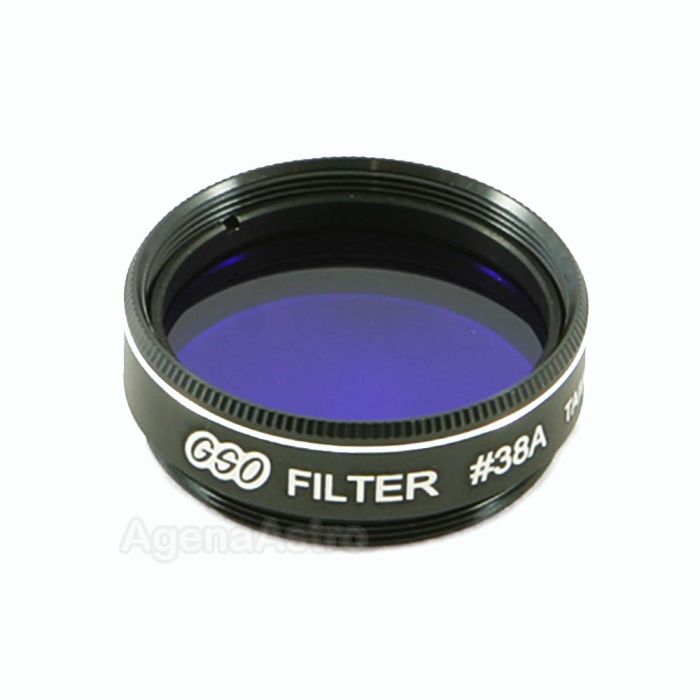
GSO 1.25" Color / Planetary Filter - No. 38A Dark Blue
Stock count is accurate & shown in real time.
- This item is out of stock.
- Sign up for back-in-stock alerts to be notified when this item becomes available (account login required).
- This item is out of stock.
- Sign up for back-in-stock alerts to be notified when this item becomes available (account login required).
Contiguous US / Lower 48:
Free shipping applies to orders over $50 using our chosen carrier/method. Faster paid options are available at checkout.
Alaska, Hawaii & US Territories:
Free shipping applies to many—but not all—products. Enter your ZIP code in cart or upon checkout to confirm options and costs.
International:
International orders do not qualify for free shipping. Shipping, duties, brokerage, tariffs, and taxes are the customer’s responsibility. Some items may be restricted due to export, size, or manufacturer limitations.
Color filters can be very useful for enhancing your views of the Moon and the planets. Depending on the atmospheric conditions, the telescope being used, the observer's experience, and the planet being observed or photographed, the advantages of color filters can be anywhere from subtle to dramatic. The right filter can make all the difference between seeing several small craters in the floor of Clavius on the Moon or not; seeing five or six swirls in Jupiter's belts or not; or seeing the inner Crepe Ring of Saturn or not.
GSO's 1.25" color/planetary filters are manufactured from the purest optical glass and are dyed-in-the-mass (not simply "color coated") for premium performance. They thread into the barrels of virtually any 1.25" telescope eyepiece. Each filter cell has a male and female 1.25" filter thread (M28.5x0.6) on opposite sides, so multiple filters can be stacked to achieve selective filtration of the visual color spectrum. The clear aperture is 25.6mm and each filter comes in a protective plastic storage case. Made in Taiwan.
The #38A Dark Blue Filter is a popular choice for the study of Jupiter's disc because it strongly rejects red and orange wavelengths in the belts, thus enhancing the boundaries between the reddish belts and the adjacent bright zones. It is useful for viewing the Great Red Spot. The filter works well on Martian surface phenomena like dust storms, and is very useful during the violet clearing and for polar caps.
The dark Blue filter also increases the contrast in the rings of Saturn and in low-contrast features between the zones. This is a good one to use on Venus, the low transmission increasing the contrast of dark shadings in the upper clouds. The #38A should only be used on telescopes of 8" of aperture or more, because of the reduced light transmission.
This filter is the best one to bring out the gas tails in comets.
Useful Resources
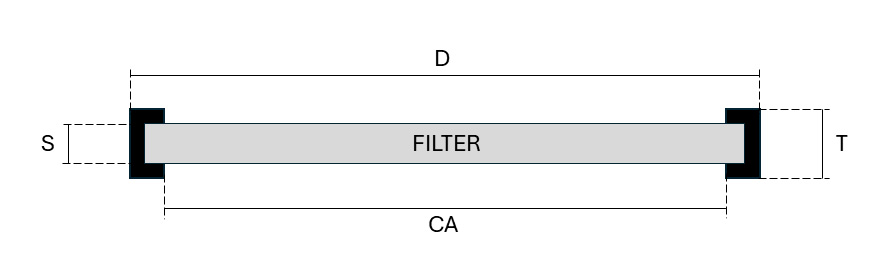
Filter Cell Specifications
D = Filter Cell Diameter = 31.1 mm / 1.22 in
T = Total Filter Height = 11.28 mm / 0.44 in
C = Filter Cell Height (Excluding Male Thread) = 7.8 mm / 0.31 in
M = Male Thread Length = 3.6 mm / 0.43 in
F = Female Thread = 2.12 mm / 0.08 in
S = Glass Substrate Thickness = 1.61 mm / 0.06 in
CA = Clear Aperture = 25.6 mm / 1.02 in
Agena Informational Article: Choosing a Color / Planetary Filter
Other Information
- Country of Manufacture: Taiwan
Color filters can be very useful for enhancing your views of the Moon and the planets. Depending on the atmospheric conditions, the telescope being used, the observer's experience, and the planet being observed or photographed, the advantages of color filters can be anywhere from subtle to dramatic. The right filter can make all the difference between seeing several small craters in the floor of Clavius on the Moon or not; seeing five or six swirls in Jupiter's belts or not; or seeing the inner Crepe Ring of Saturn or not.
GSO's 1.25" color/planetary filters are manufactured from the purest optical glass and are dyed-in-the-mass (not simply "color coated") for premium performance. They thread into the barrels of virtually any 1.25" telescope eyepiece. Each filter cell has a male and female 1.25" filter thread (M28.5x0.6) on opposite sides, so multiple filters can be stacked to achieve selective filtration of the visual color spectrum. The clear aperture is 25.6mm and each filter comes in a protective plastic storage case. Made in Taiwan.
The #38A Dark Blue Filter is a popular choice for the study of Jupiter's disc because it strongly rejects red and orange wavelengths in the belts, thus enhancing the boundaries between the reddish belts and the adjacent bright zones. It is useful for viewing the Great Red Spot. The filter works well on Martian surface phenomena like dust storms, and is very useful during the violet clearing and for polar caps.
The dark Blue filter also increases the contrast in the rings of Saturn and in low-contrast features between the zones. This is a good one to use on Venus, the low transmission increasing the contrast of dark shadings in the upper clouds. The #38A should only be used on telescopes of 8" of aperture or more, because of the reduced light transmission.
This filter is the best one to bring out the gas tails in comets.
Color filters can be very useful for enhancing your views of the Moon and the planets. Depending on the atmospheric conditions, the telescope being used, the observer's experience, and the planet being observed or photographed, the advantages of color filters can be anywhere from subtle to dramatic. The right filter can make all the difference between seeing several small craters in the floor of Clavius on the Moon or not; seeing five or six swirls in Jupiter's belts or not; or seeing the inner Crepe Ring of Saturn or not.
GSO's 1.25" color/planetary filters are manufactured from the purest optical glass and are dyed-in-the-mass (not simply "color coated") for premium performance. They thread into the barrels of virtually any 1.25" telescope eyepiece. Each filter cell has a male and female 1.25" filter thread (M28.5x0.6) on opposite sides, so multiple filters can be stacked to achieve selective filtration of the visual color spectrum. The clear aperture is 25.6mm and each filter comes in a protective plastic storage case. Made in Taiwan.
The #38A Dark Blue Filter is a popular choice for the study of Jupiter's disc because it strongly rejects red and orange wavelengths in the belts, thus enhancing the boundaries between the reddish belts and the adjacent bright zones. It is useful for viewing the Great Red Spot. The filter works well on Martian surface phenomena like dust storms, and is very useful during the violet clearing and for polar caps.
The dark Blue filter also increases the contrast in the rings of Saturn and in low-contrast features between the zones. This is a good one to use on Venus, the low transmission increasing the contrast of dark shadings in the upper clouds. The #38A should only be used on telescopes of 8" of aperture or more, because of the reduced light transmission.
This filter is the best one to bring out the gas tails in comets.
Useful Resources
Filter Cell Specifications
D = Filter Cell Diameter = 31.1 mm / 1.22 in
T = Total Filter Height = 11.28 mm / 0.44 in
C = Filter Cell Height (Excluding Male Thread) = 7.8 mm / 0.31 in
M = Male Thread Length = 3.6 mm / 0.43 in
F = Female Thread = 2.12 mm / 0.08 in
S = Glass Substrate Thickness = 1.61 mm / 0.06 in
CA = Clear Aperture = 25.6 mm / 1.02 in
Agena Informational Article: Choosing a Color / Planetary Filter
Other Information
- Country of Manufacture: Taiwan

GSO 1.25" Color / Planetary Filter - No. 38A Dark Blue