

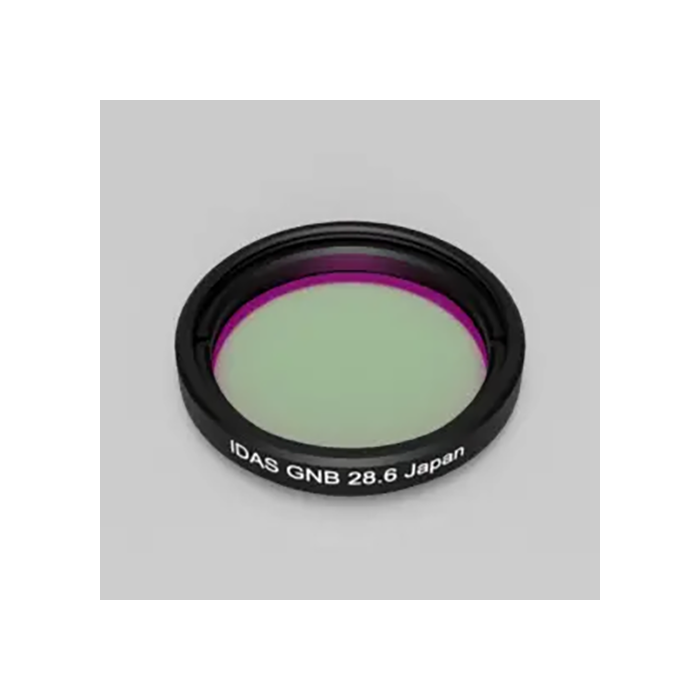
IDAS GNB Galaxy & Nebula Booster Narrowband Imaging Filter - 1.25" Mounted
Stock count is accurate & shown in real time.
- This item is out of stock.
- Sign up for back-in-stock alerts to be notified when this item becomes available (account login required).
- This item is out of stock.
- Sign up for back-in-stock alerts to be notified when this item becomes available (account login required).
Contiguous US / Lower 48:
Free shipping applies to orders over $50 using our chosen carrier/method. Faster paid options are available at checkout.
Alaska, Hawaii & US Territories:
Free shipping applies to many—but not all—products. Enter your ZIP code in cart or upon checkout to confirm options and costs.
International:
International orders do not qualify for free shipping. Shipping, duties, brokerage, tariffs, and taxes are the customer’s responsibility. Some items may be restricted due to export, size, or manufacturer limitations.
A new generation - the world's first - galaxy and nebula booster filter intended for shooting not only nebulae, but also galaxies by the use of the transmittance around the near infrared region.
The IDAS GNB filter passes through the Ha and OIII regions in the same manner as of the IDAS NBZ to suppress light pollutions in the visible light regions. Unlike any other filters available in the market, the GNB at the same time passes through the near infrared region intended for shooting galaxies that cannot be shot with any comventional nebula filters. The idea of designing this filter is based on the fact that the near infrared region can be hardly affected by artifical light pollution sources.
Notes:
We recommend the use with a NIR-enhanced sensor such as IMX585 and IMX464 especially where the GNB is used in a heavily light-polluted location.
The GNB filter will enhance the colorfulness of galaxies when used with a conventional sensor (such as IMX294).
n.b. on halos
Optical filters such as IDAS GNB and DTD utilizing infrared tend to cause haloing in the NUV and NIR regions. This is because the anti-reflection properties of off-the-shelf cameras' optical systems (oiptical window and sensor cover glass) are optimized for the visible spectrum only, not for the NIR region. Thus, haoling at the camera end in the unoptimized region becomes more apparent, coupled with haloing from the filter itself.
Here is a rough estimation of the magnitude of haloing where the haloing maginute of NBZ (NBZex) is counted as 1:
- GNB + IMX294 sensor results in 8.0 times
- GNB + IMX585 sensor results in 6.3 times
Specifications:
- M28.6 x 0.6
- Filter thickness: 2.0mm
Other Information
- Country of Manufacture: Japan
A new generation - the world's first - galaxy and nebula booster filter intended for shooting not only nebulae, but also galaxies by the use of the transmittance around the near infrared region.
The IDAS GNB filter passes through the Ha and OIII regions in the same manner as of the IDAS NBZ to suppress light pollutions in the visible light regions. Unlike any other filters available in the market, the GNB at the same time passes through the near infrared region intended for shooting galaxies that cannot be shot with any comventional nebula filters. The idea of designing this filter is based on the fact that the near infrared region can be hardly affected by artifical light pollution sources.
Notes:
We recommend the use with a NIR-enhanced sensor such as IMX585 and IMX464 especially where the GNB is used in a heavily light-polluted location.
The GNB filter will enhance the colorfulness of galaxies when used with a conventional sensor (such as IMX294).
n.b. on halos
Optical filters such as IDAS GNB and DTD utilizing infrared tend to cause haloing in the NUV and NIR regions. This is because the anti-reflection properties of off-the-shelf cameras' optical systems (oiptical window and sensor cover glass) are optimized for the visible spectrum only, not for the NIR region. Thus, haoling at the camera end in the unoptimized region becomes more apparent, coupled with haloing from the filter itself.
Here is a rough estimation of the magnitude of haloing where the haloing maginute of NBZ (NBZex) is counted as 1:
- GNB + IMX294 sensor results in 8.0 times
- GNB + IMX585 sensor results in 6.3 times
Specifications:
- M28.6 x 0.6
- Filter thickness: 2.0mm
A new generation - the world's first - galaxy and nebula booster filter intended for shooting not only nebulae, but also galaxies by the use of the transmittance around the near infrared region.
The IDAS GNB filter passes through the Ha and OIII regions in the same manner as of the IDAS NBZ to suppress light pollutions in the visible light regions. Unlike any other filters available in the market, the GNB at the same time passes through the near infrared region intended for shooting galaxies that cannot be shot with any comventional nebula filters. The idea of designing this filter is based on the fact that the near infrared region can be hardly affected by artifical light pollution sources.
Notes:
We recommend the use with a NIR-enhanced sensor such as IMX585 and IMX464 especially where the GNB is used in a heavily light-polluted location.
The GNB filter will enhance the colorfulness of galaxies when used with a conventional sensor (such as IMX294).
n.b. on halos
Optical filters such as IDAS GNB and DTD utilizing infrared tend to cause haloing in the NUV and NIR regions. This is because the anti-reflection properties of off-the-shelf cameras' optical systems (oiptical window and sensor cover glass) are optimized for the visible spectrum only, not for the NIR region. Thus, haoling at the camera end in the unoptimized region becomes more apparent, coupled with haloing from the filter itself.
Here is a rough estimation of the magnitude of haloing where the haloing maginute of NBZ (NBZex) is counted as 1:
- GNB + IMX294 sensor results in 8.0 times
- GNB + IMX585 sensor results in 6.3 times
Specifications:
- M28.6 x 0.6
- Filter thickness: 2.0mm
Other Information
- Country of Manufacture: Japan

IDAS GNB Galaxy & Nebula Booster Narrowband Imaging Filter - 1.25" Mounted