

Making a Refractor Telescope [By Remer]
This item has been discontinued by Agena and we no longer offer this.
Stock count is accurate & shown in real time.
- This item is out of stock.
- Sign up for back-in-stock alerts to be notified when this item becomes available (account login required).
- This item is out of stock.
- Sign up for back-in-stock alerts to be notified when this item becomes available (account login required).
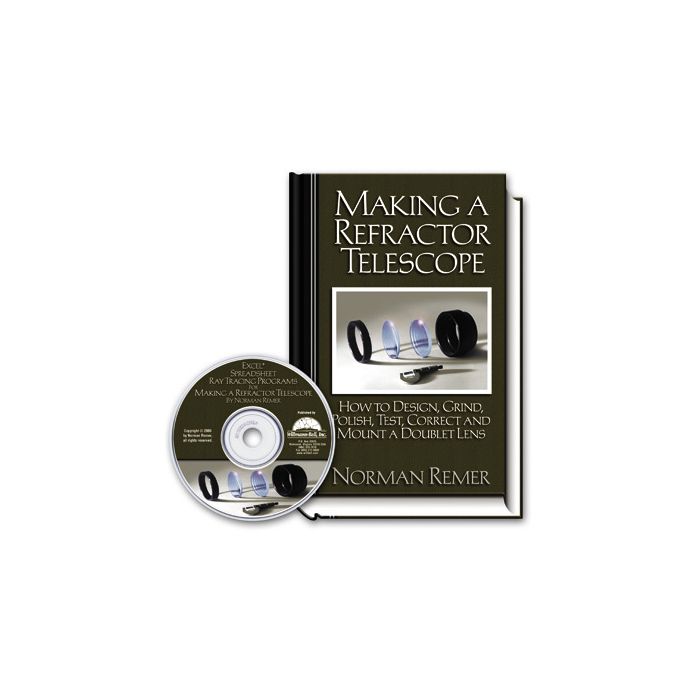
Title: Making a Refractor Telescope - How to Design, Grind, Polish, Test, Correct and Mount a Doublet Lens (With Excel Spreadsheet Ray Tracing Programs on CD-ROM)
Author(s): Norman Remer
Other Info: 6.0" by 9.0", 408 pages, Hardbound, 1.8 lb item wt.
Making a Refractor Telescope is a hands-on book for the amateur who has always thought making a refractor was too difficult to even consider. Since publication of Albert Ingall's first volume of Amateur Telescope Making, amateurs, using rudimentary tools, have made thousands of telescopes. In spite of the superior image forming capability of the unobstructed refractor, most of these instruments have used a parabolic mirror. There is a general perception that making a lens is an almost insurmountable task for an amateur. This is aided and abetted by the lack of literature on the subject of lens making for amateurs.
With this book, you will learn that making a lens involves the same simple practices and common tools involved in making a mirror. You will find there is nothing mysterious or unique. Yes, there are more surfaces to finish, but all are spherical. The author adopts the role of coach and guides the reader, step by step, through all aspects of making a doublet lens; from the characteristics of glass, abrasives, and pitch to methods for mounting the finished lens. Along the way you will learn how to grind the lens to shape, polish it, test and correct it. Not to be missed is a section covering the design of a two-element lens corrected for color, coma, and spherical aberration. The author's spreadsheet programs, included on CD-ROM, provide a direct approach to designing a well corrected lens. For those not interested in lens design, prescriptions are provided for several lenses ranging in aperture from 3 to 8 inches.
Do you know why a mirror surface must be figured four times as accurately as a lens? The author explains this, and much more, with discussions and demonstrations that explain the “why” along with the “how.”
Title: Making a Refractor Telescope - How to Design, Grind, Polish, Test, Correct and Mount a Doublet Lens (With Excel Spreadsheet Ray Tracing Programs on CD-ROM)
Author(s): Norman Remer
Other Info: 6.0" by 9.0", 408 pages, Hardbound, 1.8 lb item wt.
Making a Refractor Telescope is a hands-on book for the amateur who has always thought making a refractor was too difficult to even consider. Since publication of Albert Ingall's first volume of Amateur Telescope Making, amateurs, using rudimentary tools, have made thousands of telescopes. In spite of the superior image forming capability of the unobstructed refractor, most of these instruments have used a parabolic mirror. There is a general perception that making a lens is an almost insurmountable task for an amateur. This is aided and abetted by the lack of literature on the subject of lens making for amateurs.
With this book, you will learn that making a lens involves the same simple practices and common tools involved in making a mirror. You will find there is nothing mysterious or unique. Yes, there are more surfaces to finish, but all are spherical. The author adopts the role of coach and guides the reader, step by step, through all aspects of making a doublet lens; from the characteristics of glass, abrasives, and pitch to methods for mounting the finished lens. Along the way you will learn how to grind the lens to shape, polish it, test and correct it. Not to be missed is a section covering the design of a two-element lens corrected for color, coma, and spherical aberration. The author's spreadsheet programs, included on CD-ROM, provide a direct approach to designing a well corrected lens. For those not interested in lens design, prescriptions are provided for several lenses ranging in aperture from 3 to 8 inches.
Do you know why a mirror surface must be figured four times as accurately as a lens? The author explains this, and much more, with discussions and demonstrations that explain the “why” along with the “how.”
Title: Making a Refractor Telescope - How to Design, Grind, Polish, Test, Correct and Mount a Doublet Lens (With Excel Spreadsheet Ray Tracing Programs on CD-ROM)
Author(s): Norman Remer
Other Info: 6.0" by 9.0", 408 pages, Hardbound, 1.8 lb item wt.
Making a Refractor Telescope is a hands-on book for the amateur who has always thought making a refractor was too difficult to even consider. Since publication of Albert Ingall's first volume of Amateur Telescope Making, amateurs, using rudimentary tools, have made thousands of telescopes. In spite of the superior image forming capability of the unobstructed refractor, most of these instruments have used a parabolic mirror. There is a general perception that making a lens is an almost insurmountable task for an amateur. This is aided and abetted by the lack of literature on the subject of lens making for amateurs.
With this book, you will learn that making a lens involves the same simple practices and common tools involved in making a mirror. You will find there is nothing mysterious or unique. Yes, there are more surfaces to finish, but all are spherical. The author adopts the role of coach and guides the reader, step by step, through all aspects of making a doublet lens; from the characteristics of glass, abrasives, and pitch to methods for mounting the finished lens. Along the way you will learn how to grind the lens to shape, polish it, test and correct it. Not to be missed is a section covering the design of a two-element lens corrected for color, coma, and spherical aberration. The author's spreadsheet programs, included on CD-ROM, provide a direct approach to designing a well corrected lens. For those not interested in lens design, prescriptions are provided for several lenses ranging in aperture from 3 to 8 inches.
Do you know why a mirror surface must be figured four times as accurately as a lens? The author explains this, and much more, with discussions and demonstrations that explain the “why” along with the “how.”