

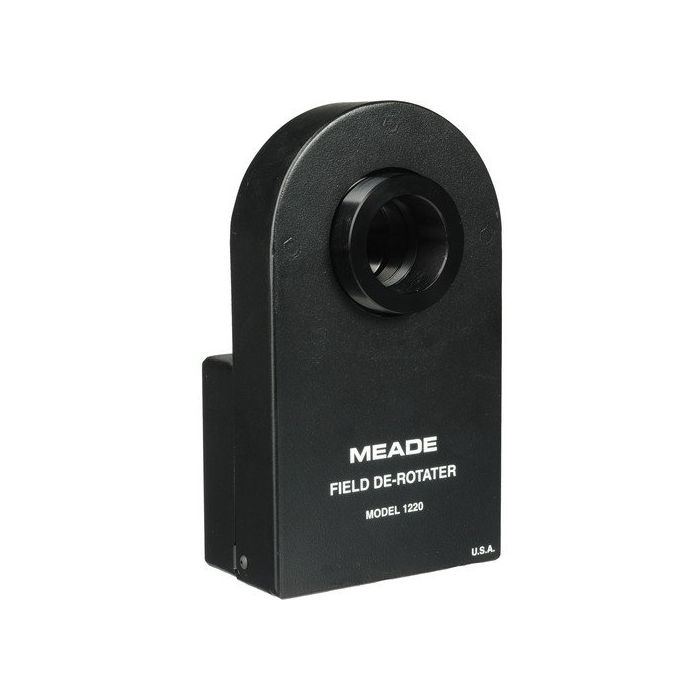
Meade #1220 Field De-Rotator
This item is discontinued by the manufacturer and is no longer available.
Stock count is accurate & shown in real time.
- This item is out of stock.
- Sign up for back-in-stock alerts to be notified when this item becomes available (account login required).
- This item is out of stock.
- Sign up for back-in-stock alerts to be notified when this item becomes available (account login required).
Availability: Item has been discontinued and is no longer available.
Meade LX200 model telescopes may be operated in the altazimuth mode (i.e., without polar alignment) for all visual applications and for photographic or CCD imaging exposures of up to about five minutes duration. During longer exposures in the altazimuth mode, however, an effect called field rotation becomes evident. Simply put, even if the telescope is perfectly guided on a central star during a long exposure, stars at the edge of the field appear to rotate about the field center during the exposure.
Traditionally, field rotation with an altazimuth-mounted telescope has been cured with an equatorial wedge or other mechanical device that causes the polar axis of the telescope to be aligned with the celestial pole. The Meade #1220 Field De-Rotator was designed to simplify operations by eliminating the effects of altazimuth-induced field rotation without the use of an equatorial wedge or other mechanical device.
The #1220 Field De-Rotator is shipped fully assembled and ready to install onto the LX200 model telescopes. Once installed, operation of the Field D-Rotator is controlled by the telescope's on board computer and is fully automatic.
Meade LX200 model telescopes may be operated in the altazimuth mode (i.e., without polar alignment) for all visual applications and for photographic or CCD imaging exposures of up to about five minutes duration. During longer exposures in the altazimuth mode, however, an effect called field rotation becomes evident. Simply put, even if the telescope is perfectly guided on a central star during a long exposure, stars at the edge of the field appear to rotate about the field center during the exposure.
Traditionally, field rotation with an altazimuth-mounted telescope has been cured with an equatorial wedge or other mechanical device that causes the polar axis of the telescope to be aligned with the celestial pole. The Meade #1220 Field De-Rotator was designed to simplify operations by eliminating the effects of altazimuth-induced field rotation without the use of an equatorial wedge or other mechanical device.
The #1220 Field De-Rotator is shipped fully assembled and ready to install onto the LX200 model telescopes. Once installed, operation of the Field D-Rotator is controlled by the telescope's on board computer and is fully automatic.
Availability: Item has been discontinued and is no longer available.
Meade LX200 model telescopes may be operated in the altazimuth mode (i.e., without polar alignment) for all visual applications and for photographic or CCD imaging exposures of up to about five minutes duration. During longer exposures in the altazimuth mode, however, an effect called field rotation becomes evident. Simply put, even if the telescope is perfectly guided on a central star during a long exposure, stars at the edge of the field appear to rotate about the field center during the exposure.
Traditionally, field rotation with an altazimuth-mounted telescope has been cured with an equatorial wedge or other mechanical device that causes the polar axis of the telescope to be aligned with the celestial pole. The Meade #1220 Field De-Rotator was designed to simplify operations by eliminating the effects of altazimuth-induced field rotation without the use of an equatorial wedge or other mechanical device.
The #1220 Field De-Rotator is shipped fully assembled and ready to install onto the LX200 model telescopes. Once installed, operation of the Field D-Rotator is controlled by the telescope's on board computer and is fully automatic.