

Antlia 3nm Narrowband Oxygen III (OIII) Pro Imaging Filter - 1.25" Mounted

Stock count is accurate & shown in real time.
- This item is out of stock.
- Sign up for back-in-stock alerts to be notified when this item becomes available (account login required).
- This item is out of stock.
- Sign up for back-in-stock alerts to be notified when this item becomes available (account login required).
Contiguous US / Lower 48:
Free shipping applies to orders over $50 using our chosen carrier/method. Faster paid options are available at checkout.
Alaska, Hawaii & US Territories:
Free shipping applies to many—but not all—products. Enter your ZIP code in cart or upon checkout to confirm options and costs.
International:
International orders do not qualify for free shipping. Shipping, duties, brokerage, tariffs, and taxes are the customer’s responsibility. Some items may be restricted due to export, size, or manufacturer limitations.
PLEASE NOTE: Antlia is making a running change to their packaging. They are transitioning from 2-piece magnetic plastic cases to a smaller 1-piece non-magnetic design. Depending on the item(s) you order, you may randomly get one case type or the other or a mix of the two. We cannot entertain requests for any specific case type.
IMPORTANT: Please read this important note below before buying Antlia narrowband filters. No returns will be accepted for Antlia narrowband filters exhibiting halos around bright stars as disclosed below.
Please note that some users may see halos around bright stars in images made with this filter. Such halos have been observed with filters from other leading manufacturers and in the previous generation of Antlia narrowband filters as well. These halos can be caused and/or made worse by other optical accessories in the imaging train, their relative positions, telescope design/optics, camera, software, or a combination thereof. In general, OIII filters seem to have a higher propensity to show halos compared to H-alpha or S-II filters, but in rare cases the latter filters can also exhibit faint halos around bright stars.
Antlia has made great strides in their coatings to minimize haloing of bright stars, but you may still observe this effect to some degree. See the sample OIII image below of Alnitak (magnitude 1.74) and IC434 in Orion (SkyRover 155mm Apo, ZWO 6200MM-P Camera, 20 min exposure) provided by Antlia. In most cases, haloing will not affect your image unless you have very bright stars in the field of view.
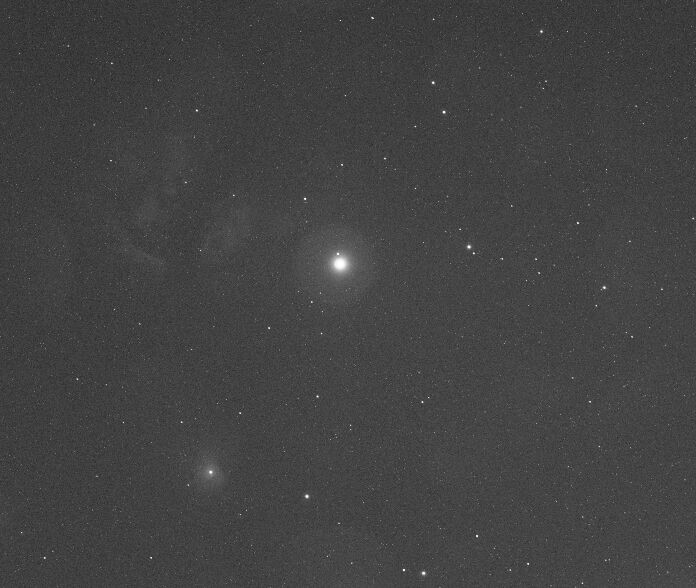
Please note we are unable to accept returns of any Antlia narrowband filters if you do observe this haloing effect in your images.
If you must ensure there are no detectable halos in your images, you may want to consider Astrodon or Chroma narrowband filters instead. These filters, however, cost two to three times as much as Antlia 3nm filters do. Antlia is being honest and upfront. They are the ones telling us about these halos, that their filters are great for the money but still not as good as Astrodon/Chroma, and pointing out that with this full disclosure, they will not accept returns. They are leaving it up to the customer to decide if this is good enough for them or not. We believe that for most imaging applications, Antlia filters continue to offer excellent value for astrophotographers and these continue to be among our top sellers.
The Antlia Oxygen III (OIII) 3nm filter is suitable for imaging of Oxygen III emissions from nebulas, planetary nebulas and supernova remnants. The 3nm bandwidth delivers a high transmission at a center wavelength of 500.7nm. The extreme narrowness in bandwidth enables astro-imaging from heavily light polluted locations and delivers improved contrast at darker sites. The filter effectively suppresses interference from other wavelengths, especially artificial mercury and sodium lamps.
Antlia narrowband filters are designed to bring out the faintest features in nebulosity by reducing the unwanted background frequencies – the narrower the filter, the better. Conventional broader narrowband filters cause a heavy loss in transmission due to the strong CWL (Center Wavelength) shift. Antlia's OIII filter is designed to deliver 85% or higher transmission within 1nm of the center at the 500.7nm line which means that the 3nm Pro narrowband filter can guarantee high transmittance for working with both long focal ratios and fast optical systems. Blue-shift data shows that Antlia 3nm Pro filters can be used with nearly all systems as fast as f/3 with minimal loss in emission signal and meets the requirements of fast optics like Hyperstar and RASA.
When Antlia designs filters for astronomy imaging systems, they look at how they will work together with optical systems, carefully designing the blocking and band-pass parameters to achieve an optimum result. The out-of-band blocking specification is rated OD5 (0.001%) which delivers an excellent signal-to-noise ratio and effective cut-off rate to minimize interference from other wavelengths. A sharp cut-off rate is a very important performance index since it is designed to sharply attenuate off-band wavelengths. The result is that the Antlia OIII filter delivers excellent contrast with extremely dark backgrounds whilst delivering a high transmission of the OIII signal. Such filters are more difficult to produce to a consistently high standard. The sharp cut-off also minimizes the effect of halos around stars, although halos may still be visible in some cases around bright stars as detailed above.
In the production process, Antlia uses very strict quality control standards. Each filter is individually tested and scanned to ensure that the product meets their high-performance parameters. The end result is a filter that achieves excellent contrast but with a higher production cost. We believe the price to performance ratio compares more favorably than similar premium filters on the market.
Application and Performance:
- High transmittance and ultra-narrow 3.0 nm bandwidth to maximize contrast.
- Steep spectral profile reduces halos around bright stars.
- Antlia narrowband Pro filters can be used down to f/3 systems with slight loss of signal
- A single substrate to eliminate internal reflections.
- Designed for astronomy imaging in both light polluted and dark sites.
- Extends imaging time when the Moon is up.
- Suitable for imaging of OIII emission in nebulas, planetary nebulas and supernova remnants.
- All Antlia Narrowband filters are edge blackened to minimize interference from stray light.
- Superior optical reliability reduces post image processing.
- This filter is not suited to deep sky objects that do not contain OIII emissions. It can be used to image OIII regions in galaxies and such images can be combined into LRGB images to better highlight the OIII emitting regions of galaxies.
- With the Ha, SII, OIII set of filters (Ha and SII sold separately), you are able to process your images to achieve the impressive Hubble color palette.
- The Ha and OIII filters (Ha sold separately) can be used to achieve great narrowband results using the Bi-Color process.
Technical Data:
- Schott optical substrate
- 1.25” mounted (2mm thickness +/-0.05mm). Additional sizes available separately
- FWHM (Full Width at Half Maximum): 3nm
- CWL (Center Wavelength): 500.7nm
- Peak transmission: >85% transmisson at OIII line at 500.7nm
- Blocking: >5 OD (0.001% out of band blocking) @ 300-1000nm
- Surface Quality: Scratch/Dig = 60/40 (Refer to MIL-O-13830)
- 2 sides fine-optically polished to ensure accurate 1/4 wavefront
- Less than 30 arcsec parallelism
- 2 sides Multi-layers anti-reflection coating
- Single / Non-glued substrate
Warranty:
- 3 years against delamination
Filter Ring:
- 1.25” Mounted (M28.5x0.6 thread)
- Ultra-thin filter cell to minimize vignetting by maximizing possible clear aperture
- Black Anodized Finish
- Laser Engraving, No Fading
Not Recommended:
- Solar Observing and imaging
- Visual observation
- DO NOT LOOK AT THE SUN WITH ANTLIA FILTERS. Serious eye damage will result if you fail to observe the warning.
Useful Resources
Filter Cell Specifications
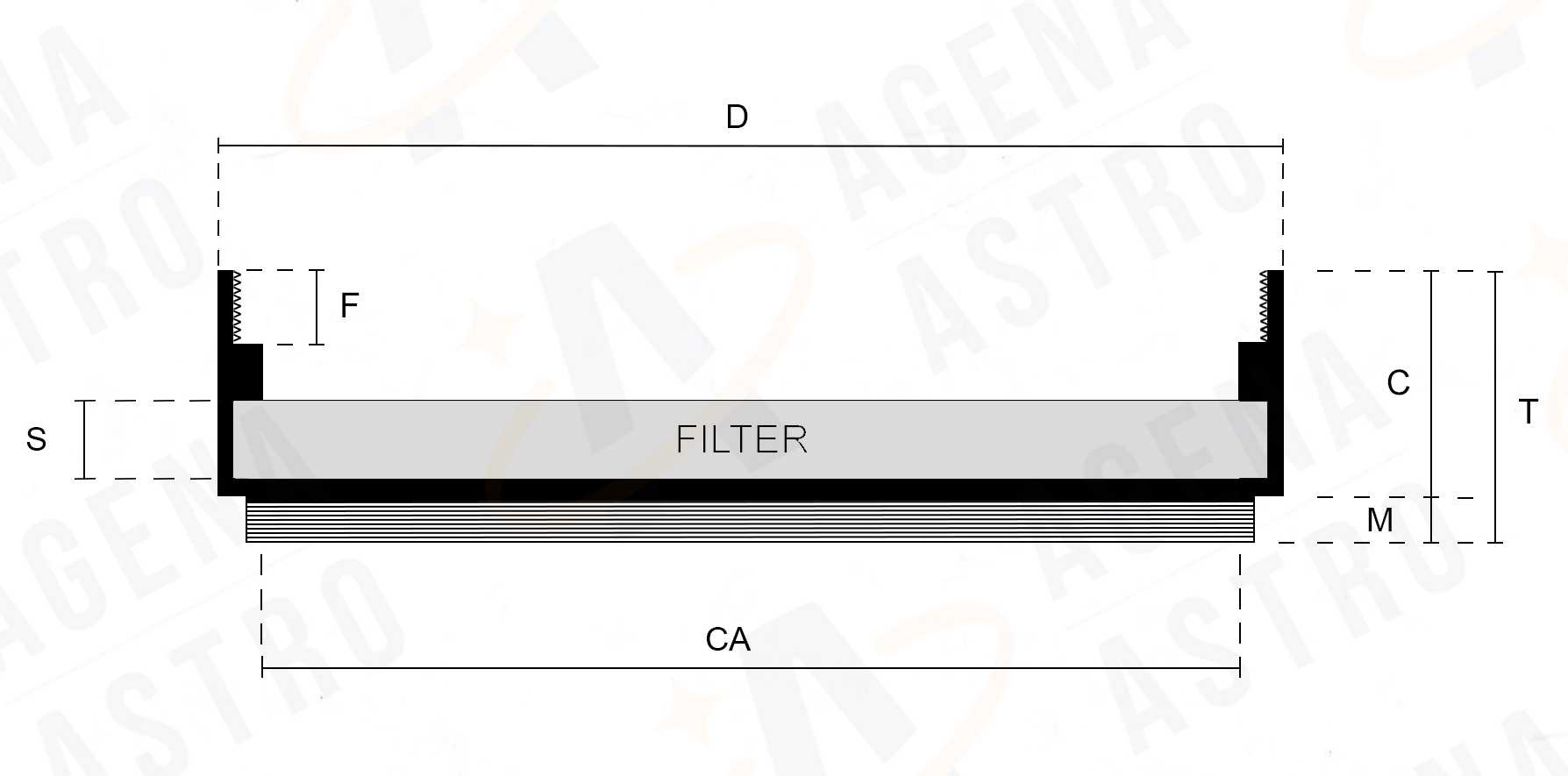
D = Filter Cell Diameter = 31.5 mm / 1.24 in
T = Total Filter Height = 7.3 mm / 0.28 in
C = Filter Cell Height (Excluding Male Thread) = 4.7mm / 0.18 in
M = Male Thread Length = 2.5 mm / 0.09 in
F = USABLE Female Filter Thread Length = Not threaded, so you cannot stack additional filters
S = Glass Substrate Thickness = 2 mm / 0.07 in
CA = Clear Aperture = 25.5 mm / 1.00 in
Other Information
- Country of Manufacture: China
The Antlia Oxygen III (OIII) 3nm filter is suitable for imaging of Oxygen III emissions from nebulas, planetary nebulas and supernova remnants. The 3nm bandwidth delivers a high transmission at a center wavelength of 500.7nm. The extreme narrowness in bandwidth enables astro-imaging from heavily light polluted locations and delivers improved contrast at darker sites. The filter effectively suppresses interference from other wavelengths, especially artificial mercury and sodium lamps.
Antlia narrowband filters are designed to bring out the faintest features in nebulosity by reducing the unwanted background frequencies – the narrower the filter, the better. Conventional broader narrowband filters cause a heavy loss in transmission due to the strong CWL (Center Wavelength) shift. Antlia's OIII filter is designed to deliver 85% or higher transmission within 1nm of the center at the 500.7nm line which means that the 3nm Pro narrowband filter can guarantee high transmittance for working with both long focal ratios and fast optical systems. Blue-shift data shows that Antlia 3nm Pro filters can be used with nearly all systems as fast as f/3 with minimal loss in emission signal and meets the requirements of fast optics like Hyperstar and RASA.
When Antlia designs filters for astronomy imaging systems, they look at how they will work together with optical systems, carefully designing the blocking and band-pass parameters to achieve an optimum result. The out-of-band blocking specification is rated OD5 (0.001%) which delivers an excellent signal-to-noise ratio and effective cut-off rate to minimize interference from other wavelengths. A sharp cut-off rate is a very important performance index since it is designed to sharply attenuate off-band wavelengths. The result is that the Antlia OIII filter delivers excellent contrast with extremely dark backgrounds whilst delivering a high transmission of the OIII signal. Such filters are more difficult to produce to a consistently high standard. The sharp cut-off also minimizes the effect of halos around stars, although halos may still be visible in some cases around bright stars as detailed above.
In the production process, Antlia uses very strict quality control standards. Each filter is individually tested and scanned to ensure that the product meets their high-performance parameters. The end result is a filter that achieves excellent contrast but with a higher production cost. We believe the price to performance ratio compares more favorably than similar premium filters on the market.
Application and Performance:
- High transmittance and ultra-narrow 3.0 nm bandwidth to maximize contrast.
- Steep spectral profile reduces halos around bright stars.
- Antlia narrowband Pro filters can be used down to f/3 systems with slight loss of signal
- A single substrate to eliminate internal reflections.
- Designed for astronomy imaging in both light polluted and dark sites.
- Extends imaging time when the Moon is up.
- Suitable for imaging of OIII emission in nebulas, planetary nebulas and supernova remnants.
- All Antlia Narrowband filters are edge blackened to minimize interference from stray light.
- Superior optical reliability reduces post image processing.
- This filter is not suited to deep sky objects that do not contain OIII emissions. It can be used to image OIII regions in galaxies and such images can be combined into LRGB images to better highlight the OIII emitting regions of galaxies.
- With the Ha, SII, OIII set of filters (Ha and SII sold separately), you are able to process your images to achieve the impressive Hubble color palette.
- The Ha and OIII filters (Ha sold separately) can be used to achieve great narrowband results using the Bi-Color process.
Technical Data:
- Schott optical substrate
- 1.25” mounted (2mm thickness +/-0.05mm). Additional sizes available separately
- FWHM (Full Width at Half Maximum): 3nm
- CWL (Center Wavelength): 500.7nm
- Peak transmission: >85% transmisson at OIII line at 500.7nm
- Blocking: >5 OD (0.001% out of band blocking) @ 300-1000nm
- Surface Quality: Scratch/Dig = 60/40 (Refer to MIL-O-13830)
- 2 sides fine-optically polished to ensure accurate 1/4 wavefront
- Less than 30 arcsec parallelism
- 2 sides Multi-layers anti-reflection coating
- Single / Non-glued substrate
Warranty:
- 3 years against delamination
Filter Ring:
- 1.25” Mounted (M28.5x0.6 thread)
- Ultra-thin filter cell to minimize vignetting by maximizing possible clear aperture
- Black Anodized Finish
- Laser Engraving, No Fading
Not Recommended:
- Solar Observing and imaging
- Visual observation
- DO NOT LOOK AT THE SUN WITH ANTLIA FILTERS. Serious eye damage will result if you fail to observe the warning.
PLEASE NOTE: Antlia is making a running change to their packaging. They are transitioning from 2-piece magnetic plastic cases to a smaller 1-piece non-magnetic design. Depending on the item(s) you order, you may randomly get one case type or the other or a mix of the two. We cannot entertain requests for any specific case type.
IMPORTANT: Please read this important note below before buying Antlia narrowband filters. No returns will be accepted for Antlia narrowband filters exhibiting halos around bright stars as disclosed below.
Please note that some users may see halos around bright stars in images made with this filter. Such halos have been observed with filters from other leading manufacturers and in the previous generation of Antlia narrowband filters as well. These halos can be caused and/or made worse by other optical accessories in the imaging train, their relative positions, telescope design/optics, camera, software, or a combination thereof. In general, OIII filters seem to have a higher propensity to show halos compared to H-alpha or S-II filters, but in rare cases the latter filters can also exhibit faint halos around bright stars.
Antlia has made great strides in their coatings to minimize haloing of bright stars, but you may still observe this effect to some degree. See the sample OIII image below of Alnitak (magnitude 1.74) and IC434 in Orion (SkyRover 155mm Apo, ZWO 6200MM-P Camera, 20 min exposure) provided by Antlia. In most cases, haloing will not affect your image unless you have very bright stars in the field of view.
Please note we are unable to accept returns of any Antlia narrowband filters if you do observe this haloing effect in your images.
If you must ensure there are no detectable halos in your images, you may want to consider Astrodon or Chroma narrowband filters instead. These filters, however, cost two to three times as much as Antlia 3nm filters do. Antlia is being honest and upfront. They are the ones telling us about these halos, that their filters are great for the money but still not as good as Astrodon/Chroma, and pointing out that with this full disclosure, they will not accept returns. They are leaving it up to the customer to decide if this is good enough for them or not. We believe that for most imaging applications, Antlia filters continue to offer excellent value for astrophotographers and these continue to be among our top sellers.
The Antlia Oxygen III (OIII) 3nm filter is suitable for imaging of Oxygen III emissions from nebulas, planetary nebulas and supernova remnants. The 3nm bandwidth delivers a high transmission at a center wavelength of 500.7nm. The extreme narrowness in bandwidth enables astro-imaging from heavily light polluted locations and delivers improved contrast at darker sites. The filter effectively suppresses interference from other wavelengths, especially artificial mercury and sodium lamps.
Antlia narrowband filters are designed to bring out the faintest features in nebulosity by reducing the unwanted background frequencies – the narrower the filter, the better. Conventional broader narrowband filters cause a heavy loss in transmission due to the strong CWL (Center Wavelength) shift. Antlia's OIII filter is designed to deliver 85% or higher transmission within 1nm of the center at the 500.7nm line which means that the 3nm Pro narrowband filter can guarantee high transmittance for working with both long focal ratios and fast optical systems. Blue-shift data shows that Antlia 3nm Pro filters can be used with nearly all systems as fast as f/3 with minimal loss in emission signal and meets the requirements of fast optics like Hyperstar and RASA.
When Antlia designs filters for astronomy imaging systems, they look at how they will work together with optical systems, carefully designing the blocking and band-pass parameters to achieve an optimum result. The out-of-band blocking specification is rated OD5 (0.001%) which delivers an excellent signal-to-noise ratio and effective cut-off rate to minimize interference from other wavelengths. A sharp cut-off rate is a very important performance index since it is designed to sharply attenuate off-band wavelengths. The result is that the Antlia OIII filter delivers excellent contrast with extremely dark backgrounds whilst delivering a high transmission of the OIII signal. Such filters are more difficult to produce to a consistently high standard. The sharp cut-off also minimizes the effect of halos around stars, although halos may still be visible in some cases around bright stars as detailed above.
In the production process, Antlia uses very strict quality control standards. Each filter is individually tested and scanned to ensure that the product meets their high-performance parameters. The end result is a filter that achieves excellent contrast but with a higher production cost. We believe the price to performance ratio compares more favorably than similar premium filters on the market.
Application and Performance:
- High transmittance and ultra-narrow 3.0 nm bandwidth to maximize contrast.
- Steep spectral profile reduces halos around bright stars.
- Antlia narrowband Pro filters can be used down to f/3 systems with slight loss of signal
- A single substrate to eliminate internal reflections.
- Designed for astronomy imaging in both light polluted and dark sites.
- Extends imaging time when the Moon is up.
- Suitable for imaging of OIII emission in nebulas, planetary nebulas and supernova remnants.
- All Antlia Narrowband filters are edge blackened to minimize interference from stray light.
- Superior optical reliability reduces post image processing.
- This filter is not suited to deep sky objects that do not contain OIII emissions. It can be used to image OIII regions in galaxies and such images can be combined into LRGB images to better highlight the OIII emitting regions of galaxies.
- With the Ha, SII, OIII set of filters (Ha and SII sold separately), you are able to process your images to achieve the impressive Hubble color palette.
- The Ha and OIII filters (Ha sold separately) can be used to achieve great narrowband results using the Bi-Color process.
Technical Data:
- Schott optical substrate
- 1.25” mounted (2mm thickness +/-0.05mm). Additional sizes available separately
- FWHM (Full Width at Half Maximum): 3nm
- CWL (Center Wavelength): 500.7nm
- Peak transmission: >85% transmisson at OIII line at 500.7nm
- Blocking: >5 OD (0.001% out of band blocking) @ 300-1000nm
- Surface Quality: Scratch/Dig = 60/40 (Refer to MIL-O-13830)
- 2 sides fine-optically polished to ensure accurate 1/4 wavefront
- Less than 30 arcsec parallelism
- 2 sides Multi-layers anti-reflection coating
- Single / Non-glued substrate
Warranty:
- 3 years against delamination
Filter Ring:
- 1.25” Mounted (M28.5x0.6 thread)
- Ultra-thin filter cell to minimize vignetting by maximizing possible clear aperture
- Black Anodized Finish
- Laser Engraving, No Fading
Not Recommended:
- Solar Observing and imaging
- Visual observation
- DO NOT LOOK AT THE SUN WITH ANTLIA FILTERS. Serious eye damage will result if you fail to observe the warning.
Useful Resources
Filter Cell Specifications
D = Filter Cell Diameter = 31.5 mm / 1.24 in
T = Total Filter Height = 7.3 mm / 0.28 in
C = Filter Cell Height (Excluding Male Thread) = 4.7mm / 0.18 in
M = Male Thread Length = 2.5 mm / 0.09 in
F = USABLE Female Filter Thread Length = Not threaded, so you cannot stack additional filters
S = Glass Substrate Thickness = 2 mm / 0.07 in
CA = Clear Aperture = 25.5 mm / 1.00 in
Other Information
- Country of Manufacture: China

Antlia 3nm Narrowband Oxygen III (OIII) Pro Imaging Filter - 1.25" Mounted