

Optolong Oxygen III / O-III Narrowband (18nm) Nebula Filter - 1.25"

Stock count is accurate & shown in real time.
- This item is out of stock.
- Sign up for back-in-stock alerts to be notified when this item becomes available (account login required).
- This item is out of stock.
- Sign up for back-in-stock alerts to be notified when this item becomes available (account login required).
Contiguous US / Lower 48:
Free shipping applies to orders over $50 using our chosen carrier/method. Faster paid options are available at checkout.
Alaska, Hawaii & US Territories:
Free shipping applies to many—but not all—products. Enter your ZIP code in cart or upon checkout to confirm options and costs.
International:
International orders do not qualify for free shipping. Shipping, duties, brokerage, tariffs, and taxes are the customer’s responsibility. Some items may be restricted due to export, size, or manufacturer limitations.
A. About Optolong's O-III (18nm) FIlter
The Optolong O-III (Oxygen-III) filter is designed to improve the visibility of various deep sky objects. It does this by:
- Selectively reducing the transmission of wavelengths of light pollutants, specifically those produced by artificial lighting (including mercury vapor lamps, both high & low pressure sodium vapor lights, and the unwanted natural light caused by neutral oxygen emission in our atmosphere (i.e. skyglow)).
- Allowing 18nm bandwidth of light centered on a wavelength of 500nm to pass through, which corresponds to OIII emission lines.
This is a blue-green colored filter as OIII emits 495.9nm and 500.7nm. Many images of planetary nebulae and supernova remnants are taken only with H-alpha and OIII filters. They show great structural details, but have natural colors, looking like an RGB image.
B. Main Uses and Performance
- Suitable for visual observation on most emission nebulae, planetary nebulae and supernova remnants.
- Suitable for viewing on bright nebulae like M42 Orion Nebula under heavy light pollution.
- Use with a large aperture telescope under clear and dark viewing conditions with good seeing.
C. Spectral Curve Transmission Characteristics
- 90% transmission at major O-III lines at 495.9nm and 500.7nm.
- Precise and high blocking of major transmission lines of artificial light pollution:
- Hg (Mercury) at 435.8nm, 546.1nm, 577nm, and 578.1nm.
- Na (Sodium) at 598nm, 589.6nm, 615.4nm, and 616.1nm.
D. Technical Specifications
- Both surfaces are fine optically polished, accurate to 1/4 wavelength or better, and parallel to within 30 seconds or arc.
- 2mm thick Schott B270 optical glass substrate material.
- Very high surface quality of 60/40 or better (US Military Spec MIL-O-13830).
E. Optical Coating Specifications
- Multi layer anti-reflection coated.
- Non-cementing optical substrate coating.
- Electron-beam gun evaporation with Ion-assisted deposition coating technology for durability and resistance to scratching, as well as stability on CWL (central wavelength) so that there is no deviation due to temperature changes during use.
- Precise and homogeneous coatings ensure high values of desired passband and blocking of unwanted offband.
- Every single filter is tested and passed by Optolong before shipping to dealers.
F. Other
- 1.25" astronomy filter with standard M28.5x0.6 male filter thread (no female thread, so it cannot be stacked with other filters).
- Ultra-thin filter cell to minimize vignetting; clear optical aperture of 26mm.
- Precision CNC-machined metal filter cell with sand blasted black anodized finish, anti-reflection treatment, and laser engraving.
- High quality protective plastic storage case.
WARNING: Optolong filters are not designed for direct solar observation. NEVER use these filters for observing the Sun, or permanent eye and equipment damage will result.
Useful Resources
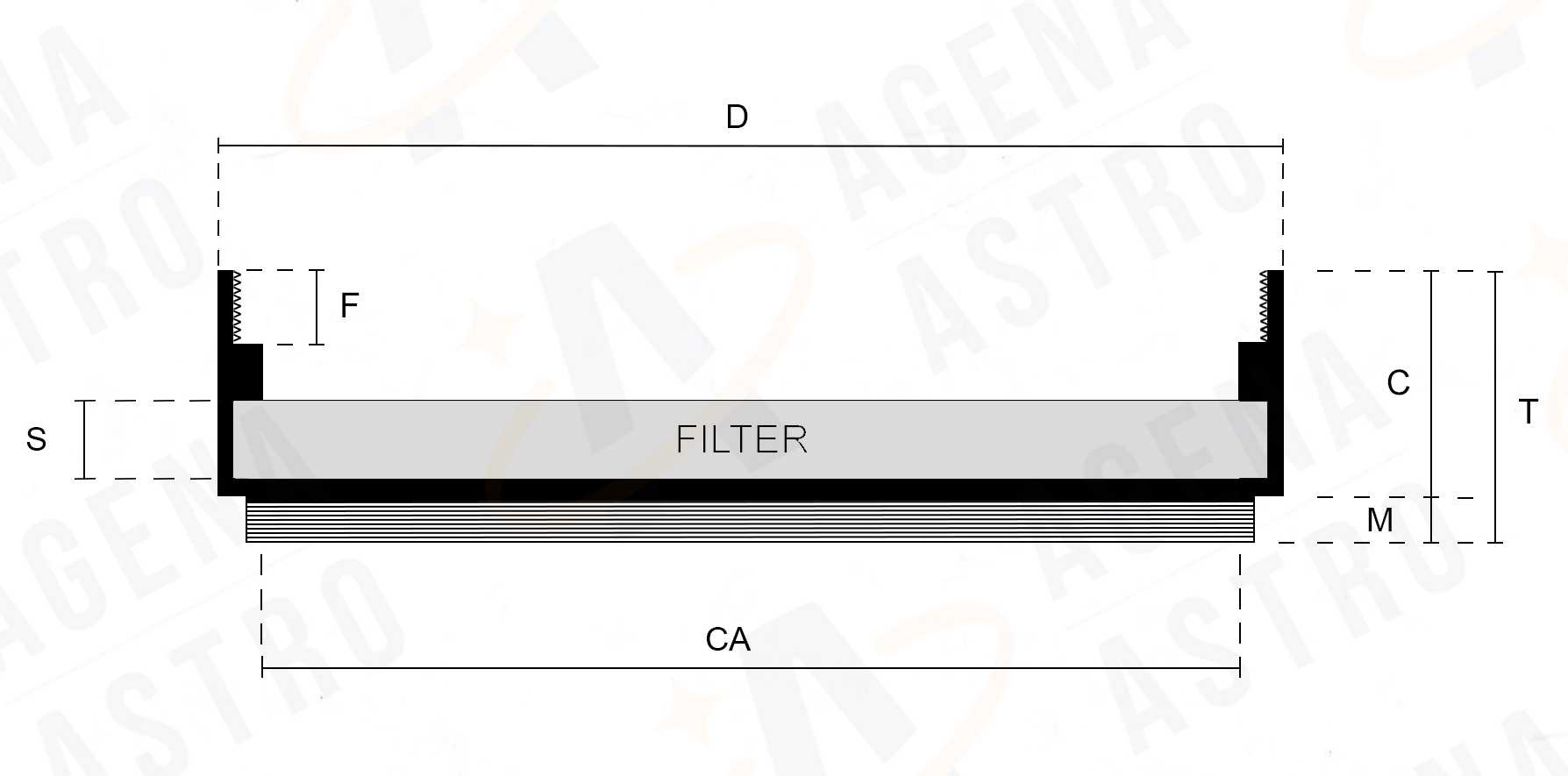
Filter Cell Specifications
D = Filter Cell Diameter = 31.3 mm / 1.23 in
T = Total Filter Height = 6.8 mm / 0.26 in
C = Filter Cell Height (Excluding Male Thread) = 4.8 mm / 0.18 in
M = Male Thread Length = 2.0 mm / 0.07 in
F = USABLE Female Filter Thread Length = Not threaded, so you cannot stack additional filters
S = Glass Substrate Thickness = 2 mm / 0.07 in
CA = Clear Aperture = 26.1 mm / 1.02 in
Other Information
- Country of Manufacture: China
A. About Optolong's O-III (18nm) FIlter
The Optolong O-III (Oxygen-III) filter is designed to improve the visibility of various deep sky objects. It does this by:
- Selectively reducing the transmission of wavelengths of light pollutants, specifically those produced by artificial lighting (including mercury vapor lamps, both high & low pressure sodium vapor lights, and the unwanted natural light caused by neutral oxygen emission in our atmosphere (i.e. skyglow)).
- Allowing 18nm bandwidth of light centered on a wavelength of 500nm to pass through, which corresponds to OIII emission lines.
This is a blue-green colored filter as OIII emits 495.9nm and 500.7nm. Many images of planetary nebulae and supernova remnants are taken only with H-alpha and OIII filters. They show great structural details, but have natural colors, looking like an RGB image.
B. Main Uses and Performance
- Suitable for visual observation on most emission nebulae, planetary nebulae and supernova remnants.
- Suitable for viewing on bright nebulae like M42 Orion Nebula under heavy light pollution.
- Use with a large aperture telescope under clear and dark viewing conditions with good seeing.
C. Spectral Curve Transmission Characteristics
- 90% transmission at major O-III lines at 495.9nm and 500.7nm.
- Precise and high blocking of major transmission lines of artificial light pollution:
- Hg (Mercury) at 435.8nm, 546.1nm, 577nm, and 578.1nm.
- Na (Sodium) at 598nm, 589.6nm, 615.4nm, and 616.1nm.
D. Technical Specifications
- Both surfaces are fine optically polished, accurate to 1/4 wavelength or better, and parallel to within 30 seconds or arc.
- 2mm thick Schott B270 optical glass substrate material.
- Very high surface quality of 60/40 or better (US Military Spec MIL-O-13830).
E. Optical Coating Specifications
- Multi layer anti-reflection coated.
- Non-cementing optical substrate coating.
- Electron-beam gun evaporation with Ion-assisted deposition coating technology for durability and resistance to scratching, as well as stability on CWL (central wavelength) so that there is no deviation due to temperature changes during use.
- Precise and homogeneous coatings ensure high values of desired passband and blocking of unwanted offband.
- Every single filter is tested and passed by Optolong before shipping to dealers.
F. Other
- 1.25" astronomy filter with standard M28.5x0.6 male filter thread (no female thread, so it cannot be stacked with other filters).
- Ultra-thin filter cell to minimize vignetting; clear optical aperture of 26mm.
- Precision CNC-machined metal filter cell with sand blasted black anodized finish, anti-reflection treatment, and laser engraving.
- High quality protective plastic storage case.
WARNING: Optolong filters are not designed for direct solar observation. NEVER use these filters for observing the Sun, or permanent eye and equipment damage will result.
A. About Optolong's O-III (18nm) FIlter
The Optolong O-III (Oxygen-III) filter is designed to improve the visibility of various deep sky objects. It does this by:
- Selectively reducing the transmission of wavelengths of light pollutants, specifically those produced by artificial lighting (including mercury vapor lamps, both high & low pressure sodium vapor lights, and the unwanted natural light caused by neutral oxygen emission in our atmosphere (i.e. skyglow)).
- Allowing 18nm bandwidth of light centered on a wavelength of 500nm to pass through, which corresponds to OIII emission lines.
This is a blue-green colored filter as OIII emits 495.9nm and 500.7nm. Many images of planetary nebulae and supernova remnants are taken only with H-alpha and OIII filters. They show great structural details, but have natural colors, looking like an RGB image.
B. Main Uses and Performance
- Suitable for visual observation on most emission nebulae, planetary nebulae and supernova remnants.
- Suitable for viewing on bright nebulae like M42 Orion Nebula under heavy light pollution.
- Use with a large aperture telescope under clear and dark viewing conditions with good seeing.
C. Spectral Curve Transmission Characteristics
- 90% transmission at major O-III lines at 495.9nm and 500.7nm.
- Precise and high blocking of major transmission lines of artificial light pollution:
- Hg (Mercury) at 435.8nm, 546.1nm, 577nm, and 578.1nm.
- Na (Sodium) at 598nm, 589.6nm, 615.4nm, and 616.1nm.
D. Technical Specifications
- Both surfaces are fine optically polished, accurate to 1/4 wavelength or better, and parallel to within 30 seconds or arc.
- 2mm thick Schott B270 optical glass substrate material.
- Very high surface quality of 60/40 or better (US Military Spec MIL-O-13830).
E. Optical Coating Specifications
- Multi layer anti-reflection coated.
- Non-cementing optical substrate coating.
- Electron-beam gun evaporation with Ion-assisted deposition coating technology for durability and resistance to scratching, as well as stability on CWL (central wavelength) so that there is no deviation due to temperature changes during use.
- Precise and homogeneous coatings ensure high values of desired passband and blocking of unwanted offband.
- Every single filter is tested and passed by Optolong before shipping to dealers.
F. Other
- 1.25" astronomy filter with standard M28.5x0.6 male filter thread (no female thread, so it cannot be stacked with other filters).
- Ultra-thin filter cell to minimize vignetting; clear optical aperture of 26mm.
- Precision CNC-machined metal filter cell with sand blasted black anodized finish, anti-reflection treatment, and laser engraving.
- High quality protective plastic storage case.
WARNING: Optolong filters are not designed for direct solar observation. NEVER use these filters for observing the Sun, or permanent eye and equipment damage will result.
Useful Resources
Filter Cell Specifications
D = Filter Cell Diameter = 31.3 mm / 1.23 in
T = Total Filter Height = 6.8 mm / 0.26 in
C = Filter Cell Height (Excluding Male Thread) = 4.8 mm / 0.18 in
M = Male Thread Length = 2.0 mm / 0.07 in
F = USABLE Female Filter Thread Length = Not threaded, so you cannot stack additional filters
S = Glass Substrate Thickness = 2 mm / 0.07 in
CA = Clear Aperture = 26.1 mm / 1.02 in
Other Information
- Country of Manufacture: China

Optolong Oxygen III / O-III Narrowband (18nm) Nebula Filter - 1.25"