

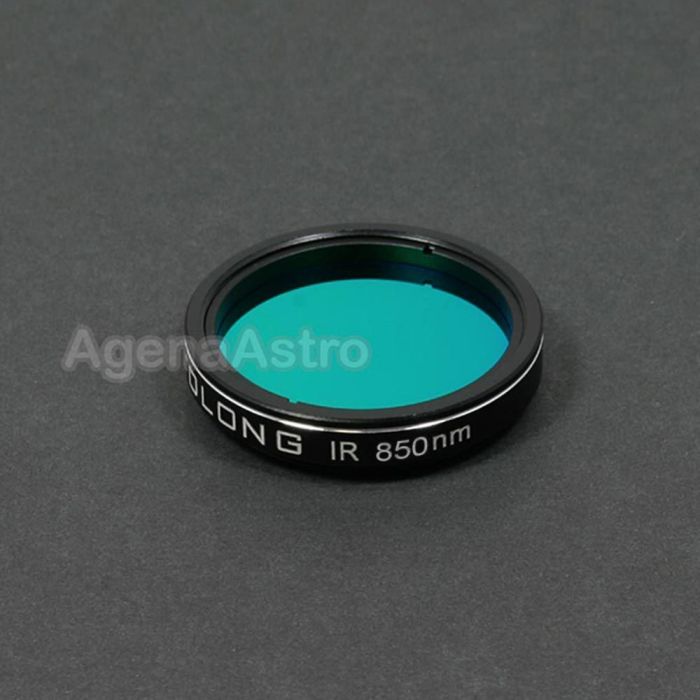
Optolong IR Pass (850nm) Filter - 1.25"
This item is discontinued by the manufacturer and is no longer available.
Stock count is accurate & shown in real time.
- This item is out of stock.
- Sign up for back-in-stock alerts to be notified when this item becomes available (account login required).
- This item is out of stock.
- Sign up for back-in-stock alerts to be notified when this item becomes available (account login required).
Optolong IR Pass 685nm filter is designed to block wavelengths below 670nm and can be used in IR-LRGB imaging to produce a sharper luminance image for the best planetary contrast as atmospheric seeing and distortion is much reduced at longer IR wavelengths.
The sensor of CCD or CMOS cameras is capable of detecting light in the 350-1100nm range including infrared wavelengths. Thus RGB planetary images taken with IR as the luminance channel have visible-enhanced contrast and surface detail than standard LRGB images.
- Substrate: B270
- Thickness: 1.85mm
- Tave: T>90%
- Blocking range: 350-1050nm
- Blocking depth: light pollution line blocking >99%
- Surface quality: 60/40
- Transmitted Wavefront RMS: λ/4
- Parallelism: 30s
Useful Resources
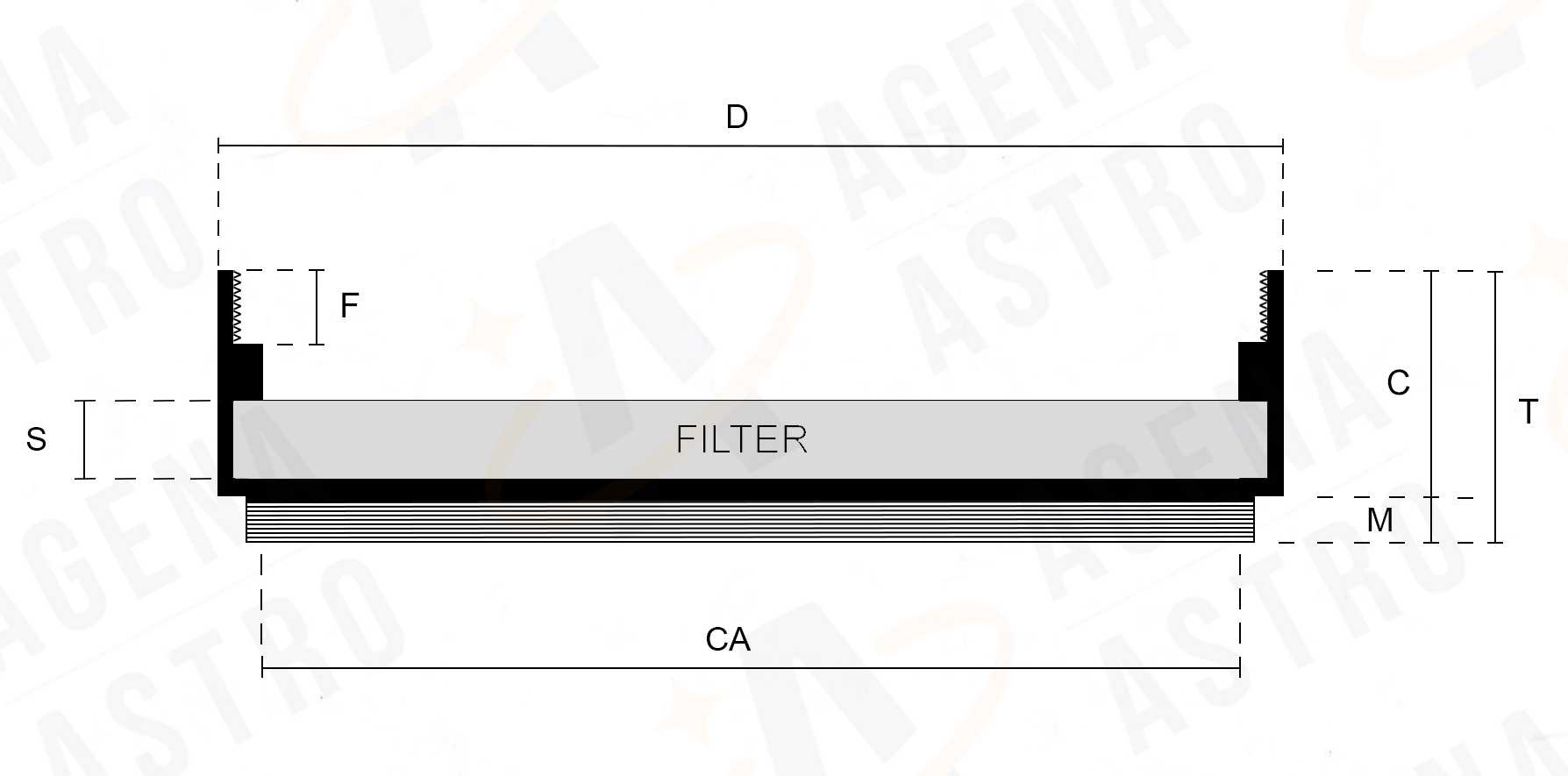
Filter Cell Specifications
D = Filter Cell Diameter = 31.3 mm / 1.23 in
T = Total Filter Height = 6.8 mm / 0.26 in
C = Filter Cell Height (Excluding Male Thread) = 4.8 mm / 0.18 in
M = Male Thread Length = 2.0 mm / 0.07 in
F = USABLE Female Filter Thread Length = Not threaded, so you cannot stack additional filters
S = Glass Substrate Thickness = 2 mm / 0.07 in
CA = Clear Aperture = 26.1 mm / 1.02 in
Other Information
- Country of Manufacture: China
Optolong IR Pass 685nm filter is designed to block wavelengths below 670nm and can be used in IR-LRGB imaging to produce a sharper luminance image for the best planetary contrast as atmospheric seeing and distortion is much reduced at longer IR wavelengths.
The sensor of CCD or CMOS cameras is capable of detecting light in the 350-1100nm range including infrared wavelengths. Thus RGB planetary images taken with IR as the luminance channel have visible-enhanced contrast and surface detail than standard LRGB images.
- Substrate: B270
- Thickness: 1.85mm
- Tave: T>90%
- Blocking range: 350-1050nm
- Blocking depth: light pollution line blocking >99%
- Surface quality: 60/40
- Transmitted Wavefront RMS: λ/4
- Parallelism: 30s
Optolong IR Pass 685nm filter is designed to block wavelengths below 670nm and can be used in IR-LRGB imaging to produce a sharper luminance image for the best planetary contrast as atmospheric seeing and distortion is much reduced at longer IR wavelengths.
The sensor of CCD or CMOS cameras is capable of detecting light in the 350-1100nm range including infrared wavelengths. Thus RGB planetary images taken with IR as the luminance channel have visible-enhanced contrast and surface detail than standard LRGB images.
- Substrate: B270
- Thickness: 1.85mm
- Tave: T>90%
- Blocking range: 350-1050nm
- Blocking depth: light pollution line blocking >99%
- Surface quality: 60/40
- Transmitted Wavefront RMS: λ/4
- Parallelism: 30s
Useful Resources
Filter Cell Specifications
D = Filter Cell Diameter = 31.3 mm / 1.23 in
T = Total Filter Height = 6.8 mm / 0.26 in
C = Filter Cell Height (Excluding Male Thread) = 4.8 mm / 0.18 in
M = Male Thread Length = 2.0 mm / 0.07 in
F = USABLE Female Filter Thread Length = Not threaded, so you cannot stack additional filters
S = Glass Substrate Thickness = 2 mm / 0.07 in
CA = Clear Aperture = 26.1 mm / 1.02 in
Other Information
- Country of Manufacture: China