

Player One Mars-M 2.1 MP USB3.0 CMOS Monochrome Astronomy Camera (Sony IMX290 Sensor)
This item has been discontinued by Agena and we no longer offer this.
Stock count is accurate & shown in real time.
- This item is out of stock.
- Sign up for back-in-stock alerts to be notified when this item becomes available (account login required).
- This item is out of stock.
- Sign up for back-in-stock alerts to be notified when this item becomes available (account login required).
- Mars-M monochrome planetary camera by Player One Astronomy adopts the Sony IMX290 1/2.8″ CMOS with a 1944 x 1096 array of 2.9um pixels and a diagonal of 6.46 mm
- Ideal for rapid capture of sharp planetary, lunar, and solar images and lucky imaging of deep-sky objects
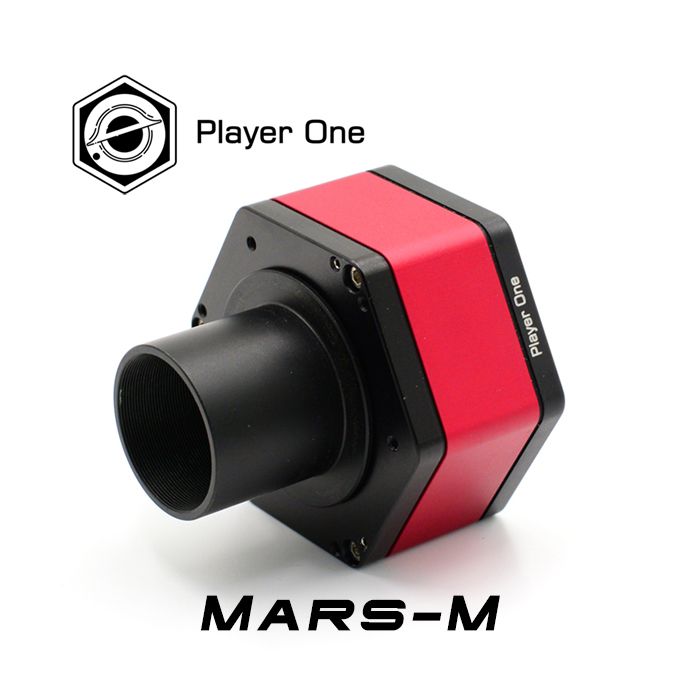
- Attractive red and black anodized hexagonal body with sensor tilt plate to reduce Newton's Rings
- Includes DSP (dead pixel suppression) technology to automatically remove hot and cold pixels from the image
- For MS Windows only. Not compatible with Mac OS or Linux at this time.
The Mars-M monochrome camera from Player One Astronomy adopts the Sony IMX290 1/2.8″ CMOS sensor for fast capture of sharp images of the planets, moon, and sun (with a safe solar filter). With a 1944 x 1096 array of 2.9um pixels on a diagonal of 6.46 mm, the Mars-M features high sensitivity and quantum efficiency and advanced features that make it a premium instrument for solar system imagers.
Player One Astronomy names its cameras after the planets in the solar system beyond Earth: Mercury, Venus, Mars, Jupiter, Saturn, Uranus and Neptune. The size of each planet represents the size of each camera sensor. The 'Saturn' camera has a 1-inch sensor, for example, and the Mars-M uses a ½ inch sensor. All Player One Astronomy camera names are engraved on the housing of the cameras.
1. Mars-M Planetary Camera Highlights
The Mars-M is an monochrome camera with higher overal sensitivity than color cameras, which means it delivers brighter images with shorter exposure times. Since it doesn't include a Bayer filter, the camera also delivers sharper images, so it's suitable for high-resolution planetary imaging and close-ups of the moon and sunspots. It also works well for electronically-assisted astronomy and 'lucky imaging' of faint deep-sky objects and double stars.
With a Player One Filter Wheel (sold separately), you can use the Mars-M camera for color (LRGB) and near-infrared (NIR) imaging. (Filters sold separately.)
The Mars-M camera is easy to connect to a telescope with its included 1.25″ T-Mount, or to a Barlow lens (sold separately) between the camera and telescope to extend the effective focal length and achieve a larger image size.
A CS lens also comes with the Mars-M camera, enabling its use as an all-sky camera or meteor monitoring camera.
2. Mars-M Planetary Camera Features
A. Cutting-edge Design
The planetary cameras developed by Player One Astronomy use a unique and attractive hexagonal body that feature rounded chamfers to achieve both rigidity and flexibility. The striking red anodized body contrasts with its black trim, and a super-fine frosting process makes the entire surface appear luxurious and stylish, unlike any other astronomy camera.
B. Sensor Tilt Plate
The Mars-M camera also includes a sensor tilt plate that makes it easy to eliminate Newton's Rings when imaging with H-alpha solar telescopes. Tilting the sensor slightly also makes it easier to get a flatter and more uniform field when capturing lunar or deep-sky images. The camera also incorporates a built-in high-density shading pad to eliminate light leaks.
C. 256M DDR3 Cache
Player One Astronomy is the first to adopt a 256MB DDR3 cache in all their planetary cameras. This helps stabilize and secure data transmission, effectively avoiding frame dropping and greatly reducing read noise. With the DDR3 cache, the Mars-M camera reduces demands on computing power, ensuring excellent performance even when the camera is connected to a USB 2.0 port.
D. DPS technology
Planetary cameras from Player One Astronomy include DPS (Dead Pixel Suppression) technology to remove hot and cold pixels from the image automatically. The DPS function is turned on automatically during the entire imaging session.
E. Overvoltage and overcurrent protection mechanism
All Player One Astronomy cameras include overvoltage and overcurrent protection mechanisms to make sure the camera stays safe.
F. Fast USB3.0 Data Transfer and ST4 Ports
When the Mars-M is connected to a USB3.0 interface and full-resolution preview is used, it can reach a data transfer rate of 136 FPS in RAW8 mode (12bit ADC) and 64 FPS in RAW16 mode (12bit ADC). Since the actual writing speed will be affected by the writing speed of the hard disk itself, recording may not reach the theoretical data transfer rates. Player One Astronomy recommendeds use of a high-quality solid-state drive to record data to maximize the performance of the camera.
The Mars-M also includes an ST4 guide port and cable to connect the camera to the Auto Guide port of an equatorial mount when the camera is used as an autoguider.
G. Readout Noise
Player One Astronomy tests all their cameras to determine their true read noise. The Mars-M camera features a low readout noise of 0.73e at a gain of 350 and approximately 0.7e at a gain of 400. Users can also use the 'sensor analysis' feature of Sharpcap as a very simple way to test readout noise.
H. HCG Mode
The Mars-M camera has a unique HCG (high gain conversion) mode that automatically turns on when the camera gain setting is ≥60. The HCG mode can greatly reduce the readout noise and retain the same high dynamic range as at low gain.
I. QE Curve
The Mars-M camera features a peak quantum efficiency of about 80%, with very high sensitivity at ultraviolet and infrared wavelengths that are important for planetary imaging.
Other Information
- Country of Manufacture: China
The Mars-M monochrome camera from Player One Astronomy adopts the Sony IMX290 1/2.8″ CMOS sensor for fast capture of sharp images of the planets, moon, and sun (with a safe solar filter). With a 1944 x 1096 array of 2.9um pixels on a diagonal of 6.46 mm, the Mars-M features high sensitivity and quantum efficiency and advanced features that make it a premium instrument for solar system imagers.
Player One Astronomy names its cameras after the planets in the solar system beyond Earth: Mercury, Venus, Mars, Jupiter, Saturn, Uranus and Neptune. The size of each planet represents the size of each camera sensor. The 'Saturn' camera has a 1-inch sensor, for example, and the Mars-M uses a ½ inch sensor. All Player One Astronomy camera names are engraved on the housing of the cameras.
1. Mars-M Planetary Camera Highlights
The Mars-M is an monochrome camera with higher overal sensitivity than color cameras, which means it delivers brighter images with shorter exposure times. Since it doesn't include a Bayer filter, the camera also delivers sharper images, so it's suitable for high-resolution planetary imaging and close-ups of the moon and sunspots. It also works well for electronically-assisted astronomy and 'lucky imaging' of faint deep-sky objects and double stars.
With a Player One Filter Wheel (sold separately), you can use the Mars-M camera for color (LRGB) and near-infrared (NIR) imaging. (Filters sold separately.)
The Mars-M camera is easy to connect to a telescope with its included 1.25″ T-Mount, or to a Barlow lens (sold separately) between the camera and telescope to extend the effective focal length and achieve a larger image size.
A CS lens also comes with the Mars-M camera, enabling its use as an all-sky camera or meteor monitoring camera.
2. Mars-M Planetary Camera Features
A. Cutting-edge Design
The planetary cameras developed by Player One Astronomy use a unique and attractive hexagonal body that feature rounded chamfers to achieve both rigidity and flexibility. The striking red anodized body contrasts with its black trim, and a super-fine frosting process makes the entire surface appear luxurious and stylish, unlike any other astronomy camera.
B. Sensor Tilt Plate
The Mars-M camera also includes a sensor tilt plate that makes it easy to eliminate Newton's Rings when imaging with H-alpha solar telescopes. Tilting the sensor slightly also makes it easier to get a flatter and more uniform field when capturing lunar or deep-sky images. The camera also incorporates a built-in high-density shading pad to eliminate light leaks.
C. 256M DDR3 Cache
Player One Astronomy is the first to adopt a 256MB DDR3 cache in all their planetary cameras. This helps stabilize and secure data transmission, effectively avoiding frame dropping and greatly reducing read noise. With the DDR3 cache, the Mars-M camera reduces demands on computing power, ensuring excellent performance even when the camera is connected to a USB 2.0 port.
D. DPS technology
Planetary cameras from Player One Astronomy include DPS (Dead Pixel Suppression) technology to remove hot and cold pixels from the image automatically. The DPS function is turned on automatically during the entire imaging session.
E. Overvoltage and overcurrent protection mechanism
All Player One Astronomy cameras include overvoltage and overcurrent protection mechanisms to make sure the camera stays safe.
F. Fast USB3.0 Data Transfer and ST4 Ports
When the Mars-M is connected to a USB3.0 interface and full-resolution preview is used, it can reach a data transfer rate of 136 FPS in RAW8 mode (12bit ADC) and 64 FPS in RAW16 mode (12bit ADC). Since the actual writing speed will be affected by the writing speed of the hard disk itself, recording may not reach the theoretical data transfer rates. Player One Astronomy recommendeds use of a high-quality solid-state drive to record data to maximize the performance of the camera.
The Mars-M also includes an ST4 guide port and cable to connect the camera to the Auto Guide port of an equatorial mount when the camera is used as an autoguider.
G. Readout Noise
Player One Astronomy tests all their cameras to determine their true read noise. The Mars-M camera features a low readout noise of 0.73e at a gain of 350 and approximately 0.7e at a gain of 400. Users can also use the 'sensor analysis' feature of Sharpcap as a very simple way to test readout noise.
H. HCG Mode
The Mars-M camera has a unique HCG (high gain conversion) mode that automatically turns on when the camera gain setting is ≥60. The HCG mode can greatly reduce the readout noise and retain the same high dynamic range as at low gain.
I. QE Curve
The Mars-M camera features a peak quantum efficiency of about 80%, with very high sensitivity at ultraviolet and infrared wavelengths that are important for planetary imaging.
| Manufacturer | Player One Astronomy |
|---|
- Sensor: SONY IMX290 1/2.8" CMOS
- Diagonal: 6.5mm
- Total Pixels: 2.1 Mega Pixels
- Max Resolution: 1944×1096
- Pixel Size: 2.9μm
- Chip Size: 5.6mm×3.2mm
- Frame Rate: 136FPS(10bit)
- Shutter: Rolling shutter
- Exposure Range: 32μs-2000s
- Readout Noise: 3.2e~0.98e
- QE Peak: ≈80%
- Full Well: 14.6k e
- ADC: 12 bit
- Data Port:
- USB3.0/USB2.0
- ST4:
- Adapter: 1.25″ / M42X0.75
- Back Focal Length: 12.5mm
- Protective Window: AR coating
- Diameter: 66mm
- Weight: 180g
- Resolution and FPS
- Under USB3.0 mode
- Resolution 12bit ADC 10bit ADC
- 1944×1096 62.5 FPS 136 FP
- 1920×1080 63.5 FPS 138 FPS
- 1280×720 94.1 FPS 205 FP
- 800×600 112.4 FPS 245 FPS
- 640×480 139.3 FPS 304 FPS
- More resolution options could be setup in capture softewares!
- Camera and 1.25" T-Mount
- 2M USB 3.0 Cable
- 2M ST4 Cable
- 1.25" Cover
- Air Blower
- M2 Hexagonal Wrench x 1
- M1.2 Hexagonal Wrench x 3

- Mars-M monochrome planetary camera by Player One Astronomy adopts the Sony IMX290 1/2.8″ CMOS with a 1944 x 1096 array of 2.9um pixels and a diagonal of 6.46 mm
- Ideal for rapid capture of sharp planetary, lunar, and solar images and lucky imaging of deep-sky objects
- Attractive red and black anodized hexagonal body with sensor tilt plate to reduce Newton's Rings
- Includes DSP (dead pixel suppression) technology to automatically remove hot and cold pixels from the image
- For MS Windows only. Not compatible with Mac OS or Linux at this time.
The Mars-M monochrome camera from Player One Astronomy adopts the Sony IMX290 1/2.8″ CMOS sensor for fast capture of sharp images of the planets, moon, and sun (with a safe solar filter). With a 1944 x 1096 array of 2.9um pixels on a diagonal of 6.46 mm, the Mars-M features high sensitivity and quantum efficiency and advanced features that make it a premium instrument for solar system imagers.
Player One Astronomy names its cameras after the planets in the solar system beyond Earth: Mercury, Venus, Mars, Jupiter, Saturn, Uranus and Neptune. The size of each planet represents the size of each camera sensor. The 'Saturn' camera has a 1-inch sensor, for example, and the Mars-M uses a ½ inch sensor. All Player One Astronomy camera names are engraved on the housing of the cameras.
1. Mars-M Planetary Camera Highlights
The Mars-M is an monochrome camera with higher overal sensitivity than color cameras, which means it delivers brighter images with shorter exposure times. Since it doesn't include a Bayer filter, the camera also delivers sharper images, so it's suitable for high-resolution planetary imaging and close-ups of the moon and sunspots. It also works well for electronically-assisted astronomy and 'lucky imaging' of faint deep-sky objects and double stars.
With a Player One Filter Wheel (sold separately), you can use the Mars-M camera for color (LRGB) and near-infrared (NIR) imaging. (Filters sold separately.)
The Mars-M camera is easy to connect to a telescope with its included 1.25″ T-Mount, or to a Barlow lens (sold separately) between the camera and telescope to extend the effective focal length and achieve a larger image size.
A CS lens also comes with the Mars-M camera, enabling its use as an all-sky camera or meteor monitoring camera.
2. Mars-M Planetary Camera Features
A. Cutting-edge Design
The planetary cameras developed by Player One Astronomy use a unique and attractive hexagonal body that feature rounded chamfers to achieve both rigidity and flexibility. The striking red anodized body contrasts with its black trim, and a super-fine frosting process makes the entire surface appear luxurious and stylish, unlike any other astronomy camera.
B. Sensor Tilt Plate
The Mars-M camera also includes a sensor tilt plate that makes it easy to eliminate Newton's Rings when imaging with H-alpha solar telescopes. Tilting the sensor slightly also makes it easier to get a flatter and more uniform field when capturing lunar or deep-sky images. The camera also incorporates a built-in high-density shading pad to eliminate light leaks.
C. 256M DDR3 Cache
Player One Astronomy is the first to adopt a 256MB DDR3 cache in all their planetary cameras. This helps stabilize and secure data transmission, effectively avoiding frame dropping and greatly reducing read noise. With the DDR3 cache, the Mars-M camera reduces demands on computing power, ensuring excellent performance even when the camera is connected to a USB 2.0 port.
D. DPS technology
Planetary cameras from Player One Astronomy include DPS (Dead Pixel Suppression) technology to remove hot and cold pixels from the image automatically. The DPS function is turned on automatically during the entire imaging session.
E. Overvoltage and overcurrent protection mechanism
All Player One Astronomy cameras include overvoltage and overcurrent protection mechanisms to make sure the camera stays safe.
F. Fast USB3.0 Data Transfer and ST4 Ports
When the Mars-M is connected to a USB3.0 interface and full-resolution preview is used, it can reach a data transfer rate of 136 FPS in RAW8 mode (12bit ADC) and 64 FPS in RAW16 mode (12bit ADC). Since the actual writing speed will be affected by the writing speed of the hard disk itself, recording may not reach the theoretical data transfer rates. Player One Astronomy recommendeds use of a high-quality solid-state drive to record data to maximize the performance of the camera.
The Mars-M also includes an ST4 guide port and cable to connect the camera to the Auto Guide port of an equatorial mount when the camera is used as an autoguider.
G. Readout Noise
Player One Astronomy tests all their cameras to determine their true read noise. The Mars-M camera features a low readout noise of 0.73e at a gain of 350 and approximately 0.7e at a gain of 400. Users can also use the 'sensor analysis' feature of Sharpcap as a very simple way to test readout noise.
H. HCG Mode
The Mars-M camera has a unique HCG (high gain conversion) mode that automatically turns on when the camera gain setting is ≥60. The HCG mode can greatly reduce the readout noise and retain the same high dynamic range as at low gain.
I. QE Curve
The Mars-M camera features a peak quantum efficiency of about 80%, with very high sensitivity at ultraviolet and infrared wavelengths that are important for planetary imaging.
Other Information
- Country of Manufacture: China
| Manufacturer | Player One Astronomy |
|---|
- Sensor: SONY IMX290 1/2.8" CMOS
- Diagonal: 6.5mm
- Total Pixels: 2.1 Mega Pixels
- Max Resolution: 1944×1096
- Pixel Size: 2.9μm
- Chip Size: 5.6mm×3.2mm
- Frame Rate: 136FPS(10bit)
- Shutter: Rolling shutter
- Exposure Range: 32μs-2000s
- Readout Noise: 3.2e~0.98e
- QE Peak: ≈80%
- Full Well: 14.6k e
- ADC: 12 bit
- Data Port:
- USB3.0/USB2.0
- ST4:
- Adapter: 1.25″ / M42X0.75
- Back Focal Length: 12.5mm
- Protective Window: AR coating
- Diameter: 66mm
- Weight: 180g
- Resolution and FPS
- Under USB3.0 mode
- Resolution 12bit ADC 10bit ADC
- 1944×1096 62.5 FPS 136 FP
- 1920×1080 63.5 FPS 138 FPS
- 1280×720 94.1 FPS 205 FP
- 800×600 112.4 FPS 245 FPS
- 640×480 139.3 FPS 304 FPS
- More resolution options could be setup in capture softewares!
- Camera and 1.25" T-Mount
- 2M USB 3.0 Cable
- 2M ST4 Cable
- 1.25" Cover
- Air Blower
- M2 Hexagonal Wrench x 1
- M1.2 Hexagonal Wrench x 3