

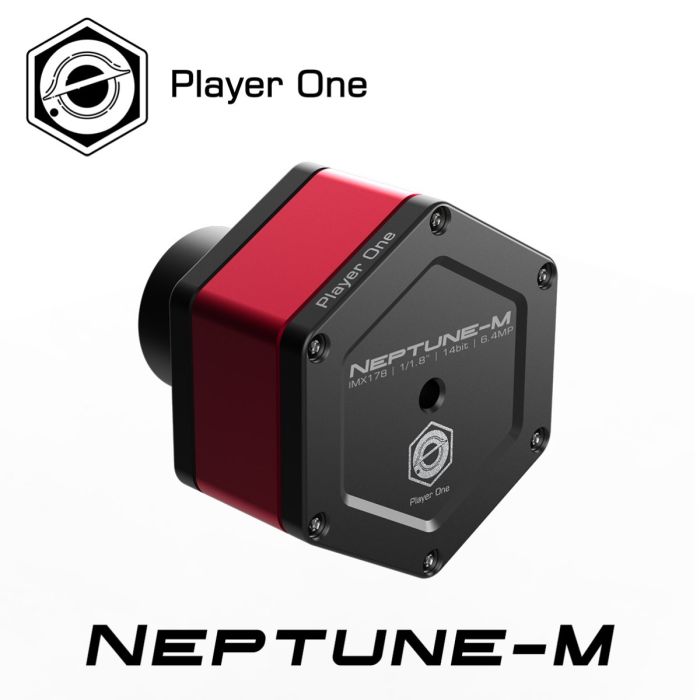
Player One Neptune-M 6.4 MP USB3.0 CMOS Monochrome Astronomy Camera (Sony IMX178 Sensor)
This item has been discontinued by Agena and we no longer offer this.
Stock count is accurate & shown in real time.
- This item is out of stock.
- Sign up for back-in-stock alerts to be notified when this item becomes available (account login required).
- This item is out of stock.
- Sign up for back-in-stock alerts to be notified when this item becomes available (account login required).
- The Neptune series is a 1/2-inch format planetary camera series for the top player. It is larger than 1/3-inch and has a higher resolution, and is more suitable for astronomy enthusiasts.
- For MS Windows only. Not compatible with Mac OS or Linux at this time.
Original Player One description below
Neptune-M is a planetary camera developed by Player One Astronomy, which adopts the Sony IMX178 1/1.8” format sensor. The 2.4um pixel size accommodates a well depth of 15ke with a total of 6.4MP (the resolution is 3096*2078), and the diagonal is 9mm.
We need Neptune-M (IMX178 mono sensor), because IMX464 only has color type. For many enthusiasts, without monochrome camera, a lot of shooting flexibility will be vanished, so Neptune-M is to make up for this.
1. Planetary camera Neptune-M Highlights
With a 1/1.8 inch sensor, the Neptune series are very suitable for sun and moon mosaic photography.
Connecting the Neptune-M camera to a telescope with an 1.25″ T-Mount, or adding a Barlow lens between the camera and a telescope to extend the focal length for more details.
With a CS lens attached on the Neptune-M camera,it can be used as an all-day camera or meteor monitoring camera.
2. Planetary camera Neptune-C Features
A. Cutting-edge Design
The planetary cameras developed by Player One Astronomy use a scientific and technological regular hexagon to construct the main body line, supplemented by round chamfers to achieve both rigidity and flexibility. The positive red, which is like a summer fire, is matched with the low-key and steady black, and the super-fine frosting process on the entire surface makes the camera look luxurious and cool, highlighting the style of high-end players, can’t take my eyes off
B. Sensor Tilt Plate
When taking solar photography with a prominence telescope, the Newton ring is annoying. A smoother solar image without a Newton ring could be taken by adjusting the focal plate. Besides, when you use a planetary camera for deep-sky lucky imaging, if you find the surrounding stars are not perfect, you can adjust the sensor tilt plate to obtain a flatter image field. get a much smaller field curvature of the telescope.
The built-in high-density sponge shading pad can block the light from the side slits without any side leakage.
C. 256M DDR3 Cache
Player One Astronomy cameras are the first ones who adopt the DDR3 cache in all planetary cameras in the world! It helps stabilize and secure data transmission, effectively avoids frame dropping, and greatly reduces read noise.
With the DDR3 cache, the camera does not have high demands on computing needs any longer, it will still have excellent performance even if it is connected to a USB 2.0 port.
D. DPS technology
The planetary cameras from Player One Astronomy have DPS (Dead Pixel Suppression) technology, dead pixels (including both hot pixels and cold pixels) of the image are swept away. DPS function is turned on during your whole imaging session, no need to worry about it!
E. Overvoltage and overcurrent protection mechanism
Player One cameras produced by the number one player ensure the safety of your camera and other equipment through overvoltage and overcurrent protection mechanisms.
F. Data Port
When the camera is connected to the USB3.0 interface and full-resolution preview is used, it can reach 60 FPS in RAW8 mode (10bit ADC). When recording images, since the actual writing speed will be affected by the writing speed of the hard disk itself, when the hard disk writing speed is slow, the recording may not reach the theoretical speed. It is recommended that you use a high-quality solid state drive to record data to give full play to the performance of the camera.
Use the ST4 guide cable to connect the camera and the AUTO GUIDE port of the equatorial mount to do guiding.
G. Readout Noise
Regarding readout noise, we solemnly promise that all values are obtained from actual tests. And for users, you could use Sharpcap 3.3 for testing. SC3.3 has a function called Sensor Analysis, provide a very simple way to test readout noise.
After many rigorous readout noise tests, the Neptune-M camera can reach a low readout noise of 1.34e at a gain of 350.
If you are interested in readout noise testing, you may try it yourself, which is very simple.
H. HCG Mode
The Neptune camera has a unique HCG mode, which will automatically turn on when the camera gain setting is ≥80. The HCG mode can greatly reduce the readout noise and retain the same high dynamic range as the low gain.
Other Information
- Country of Manufacture: China
Original Player One description below
Neptune-M is a planetary camera developed by Player One Astronomy, which adopts the Sony IMX178 1/1.8” format sensor. The 2.4um pixel size accommodates a well depth of 15ke with a total of 6.4MP (the resolution is 3096*2078), and the diagonal is 9mm.
We need Neptune-M (IMX178 mono sensor), because IMX464 only has color type. For many enthusiasts, without monochrome camera, a lot of shooting flexibility will be vanished, so Neptune-M is to make up for this.
1. Planetary camera Neptune-M Highlights
With a 1/1.8 inch sensor, the Neptune series are very suitable for sun and moon mosaic photography.
Connecting the Neptune-M camera to a telescope with an 1.25″ T-Mount, or adding a Barlow lens between the camera and a telescope to extend the focal length for more details.
With a CS lens attached on the Neptune-M camera,it can be used as an all-day camera or meteor monitoring camera.
2. Planetary camera Neptune-C Features
A. Cutting-edge Design
The planetary cameras developed by Player One Astronomy use a scientific and technological regular hexagon to construct the main body line, supplemented by round chamfers to achieve both rigidity and flexibility. The positive red, which is like a summer fire, is matched with the low-key and steady black, and the super-fine frosting process on the entire surface makes the camera look luxurious and cool, highlighting the style of high-end players, can’t take my eyes off
B. Sensor Tilt Plate
When taking solar photography with a prominence telescope, the Newton ring is annoying. A smoother solar image without a Newton ring could be taken by adjusting the focal plate. Besides, when you use a planetary camera for deep-sky lucky imaging, if you find the surrounding stars are not perfect, you can adjust the sensor tilt plate to obtain a flatter image field. get a much smaller field curvature of the telescope.
The built-in high-density sponge shading pad can block the light from the side slits without any side leakage.
C. 256M DDR3 Cache
Player One Astronomy cameras are the first ones who adopt the DDR3 cache in all planetary cameras in the world! It helps stabilize and secure data transmission, effectively avoids frame dropping, and greatly reduces read noise.
With the DDR3 cache, the camera does not have high demands on computing needs any longer, it will still have excellent performance even if it is connected to a USB 2.0 port.
D. DPS technology
The planetary cameras from Player One Astronomy have DPS (Dead Pixel Suppression) technology, dead pixels (including both hot pixels and cold pixels) of the image are swept away. DPS function is turned on during your whole imaging session, no need to worry about it!
E. Overvoltage and overcurrent protection mechanism
Player One cameras produced by the number one player ensure the safety of your camera and other equipment through overvoltage and overcurrent protection mechanisms.
F. Data Port
When the camera is connected to the USB3.0 interface and full-resolution preview is used, it can reach 60 FPS in RAW8 mode (10bit ADC). When recording images, since the actual writing speed will be affected by the writing speed of the hard disk itself, when the hard disk writing speed is slow, the recording may not reach the theoretical speed. It is recommended that you use a high-quality solid state drive to record data to give full play to the performance of the camera.
Use the ST4 guide cable to connect the camera and the AUTO GUIDE port of the equatorial mount to do guiding.
G. Readout Noise
Regarding readout noise, we solemnly promise that all values are obtained from actual tests. And for users, you could use Sharpcap 3.3 for testing. SC3.3 has a function called Sensor Analysis, provide a very simple way to test readout noise.
After many rigorous readout noise tests, the Neptune-M camera can reach a low readout noise of 1.34e at a gain of 350.
If you are interested in readout noise testing, you may try it yourself, which is very simple.
H. HCG Mode
The Neptune camera has a unique HCG mode, which will automatically turn on when the camera gain setting is ≥80. The HCG mode can greatly reduce the readout noise and retain the same high dynamic range as the low gain.
| Manufacturer | Player One Astronomy |
|---|
- Sensor: SONY IMX178 1/1.8" CMOS (mono)
- Diagonal: 9mm
- Total Pixels: 6.4 Mega Pixels
- Max Resolution: 3096×2078
- Pixel Size: 2.4μm
- Chip Size: 7.4mm×5.0mm
- Frame Rate: 60FPS(10bit)
- Shutter: Rolling shutter
- Exposure Range: 32μs-2000s
- Readout Noise: 2.2e~1.3e
- QE Peak: ≈80%
- Full Well: 15k e
- ADC: 14 bit
- Data Port: USB3.0/USB2.0
- Adapter: 1.25″ / M42X0.75
- Back Focal Length: 12.5mm
- Protective Window: UV IR-cut
- Diameter: 66mm
- Weight: 180g
- Resolution and FPS:
- Under USB3.0 mode
- Resolution 10bit AD:
- 3096×2078 60 FPS
- More resolution options could be setup in capture softeware:
- Camera and 1.25" T-Mount
- 2M USB 3.0 Cable
- 2M ST4 Cable
- 1.25" Cover
- Air Blower
- M2 Hexagonal Wrench x 1
- M1.2 Hexagonal Wrench x 3
- The Neptune series is a 1/2-inch format planetary camera series for the top player. It is larger than 1/3-inch and has a higher resolution, and is more suitable for astronomy enthusiasts.
- For MS Windows only. Not compatible with Mac OS or Linux at this time.
Original Player One description below
Neptune-M is a planetary camera developed by Player One Astronomy, which adopts the Sony IMX178 1/1.8” format sensor. The 2.4um pixel size accommodates a well depth of 15ke with a total of 6.4MP (the resolution is 3096*2078), and the diagonal is 9mm.
We need Neptune-M (IMX178 mono sensor), because IMX464 only has color type. For many enthusiasts, without monochrome camera, a lot of shooting flexibility will be vanished, so Neptune-M is to make up for this.
1. Planetary camera Neptune-M Highlights
With a 1/1.8 inch sensor, the Neptune series are very suitable for sun and moon mosaic photography.
Connecting the Neptune-M camera to a telescope with an 1.25″ T-Mount, or adding a Barlow lens between the camera and a telescope to extend the focal length for more details.
With a CS lens attached on the Neptune-M camera,it can be used as an all-day camera or meteor monitoring camera.
2. Planetary camera Neptune-C Features
A. Cutting-edge Design
The planetary cameras developed by Player One Astronomy use a scientific and technological regular hexagon to construct the main body line, supplemented by round chamfers to achieve both rigidity and flexibility. The positive red, which is like a summer fire, is matched with the low-key and steady black, and the super-fine frosting process on the entire surface makes the camera look luxurious and cool, highlighting the style of high-end players, can’t take my eyes off
B. Sensor Tilt Plate
When taking solar photography with a prominence telescope, the Newton ring is annoying. A smoother solar image without a Newton ring could be taken by adjusting the focal plate. Besides, when you use a planetary camera for deep-sky lucky imaging, if you find the surrounding stars are not perfect, you can adjust the sensor tilt plate to obtain a flatter image field. get a much smaller field curvature of the telescope.
The built-in high-density sponge shading pad can block the light from the side slits without any side leakage.
C. 256M DDR3 Cache
Player One Astronomy cameras are the first ones who adopt the DDR3 cache in all planetary cameras in the world! It helps stabilize and secure data transmission, effectively avoids frame dropping, and greatly reduces read noise.
With the DDR3 cache, the camera does not have high demands on computing needs any longer, it will still have excellent performance even if it is connected to a USB 2.0 port.
D. DPS technology
The planetary cameras from Player One Astronomy have DPS (Dead Pixel Suppression) technology, dead pixels (including both hot pixels and cold pixels) of the image are swept away. DPS function is turned on during your whole imaging session, no need to worry about it!
E. Overvoltage and overcurrent protection mechanism
Player One cameras produced by the number one player ensure the safety of your camera and other equipment through overvoltage and overcurrent protection mechanisms.
F. Data Port
When the camera is connected to the USB3.0 interface and full-resolution preview is used, it can reach 60 FPS in RAW8 mode (10bit ADC). When recording images, since the actual writing speed will be affected by the writing speed of the hard disk itself, when the hard disk writing speed is slow, the recording may not reach the theoretical speed. It is recommended that you use a high-quality solid state drive to record data to give full play to the performance of the camera.
Use the ST4 guide cable to connect the camera and the AUTO GUIDE port of the equatorial mount to do guiding.
G. Readout Noise
Regarding readout noise, we solemnly promise that all values are obtained from actual tests. And for users, you could use Sharpcap 3.3 for testing. SC3.3 has a function called Sensor Analysis, provide a very simple way to test readout noise.
After many rigorous readout noise tests, the Neptune-M camera can reach a low readout noise of 1.34e at a gain of 350.
If you are interested in readout noise testing, you may try it yourself, which is very simple.
H. HCG Mode
The Neptune camera has a unique HCG mode, which will automatically turn on when the camera gain setting is ≥80. The HCG mode can greatly reduce the readout noise and retain the same high dynamic range as the low gain.
Other Information
- Country of Manufacture: China
| Manufacturer | Player One Astronomy |
|---|
- Sensor: SONY IMX178 1/1.8" CMOS (mono)
- Diagonal: 9mm
- Total Pixels: 6.4 Mega Pixels
- Max Resolution: 3096×2078
- Pixel Size: 2.4μm
- Chip Size: 7.4mm×5.0mm
- Frame Rate: 60FPS(10bit)
- Shutter: Rolling shutter
- Exposure Range: 32μs-2000s
- Readout Noise: 2.2e~1.3e
- QE Peak: ≈80%
- Full Well: 15k e
- ADC: 14 bit
- Data Port: USB3.0/USB2.0
- Adapter: 1.25″ / M42X0.75
- Back Focal Length: 12.5mm
- Protective Window: UV IR-cut
- Diameter: 66mm
- Weight: 180g
- Resolution and FPS:
- Under USB3.0 mode
- Resolution 10bit AD:
- 3096×2078 60 FPS
- More resolution options could be setup in capture softeware:
- Camera and 1.25" T-Mount
- 2M USB 3.0 Cable
- 2M ST4 Cable
- 1.25" Cover
- Air Blower
- M2 Hexagonal Wrench x 1
- M1.2 Hexagonal Wrench x 3