

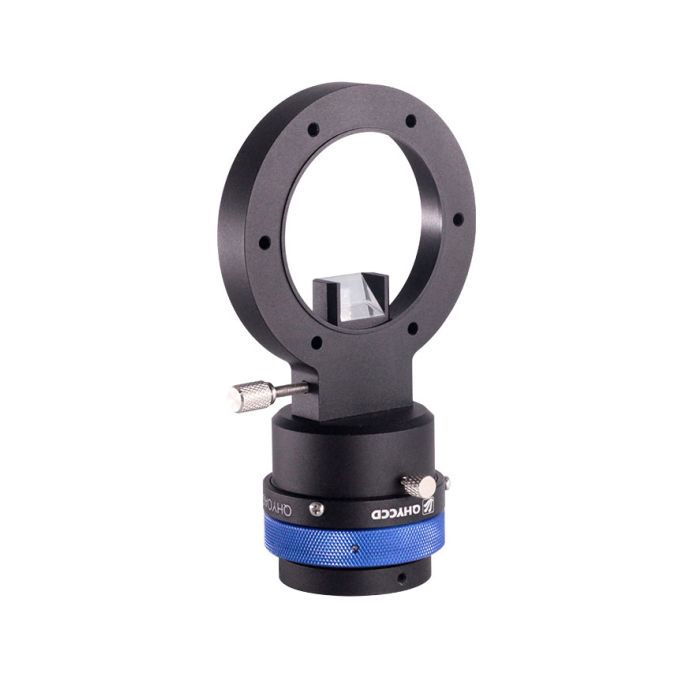
QHY Off-Axis Guider - Medium Pro Version with 10x14mm Prism
Stock count is accurate & shown in real time.
- This item is out of stock.
- Sign up for back-in-stock alerts to be notified when this item becomes available (account login required).
- This item is out of stock.
- Sign up for back-in-stock alerts to be notified when this item becomes available (account login required).
Contiguous US / Lower 48:
Free shipping applies to orders over $50 using our chosen carrier/method. Faster paid options are available at checkout.
Alaska, Hawaii & US Territories:
Free shipping applies to many—but not all—products. Enter your ZIP code in cart or upon checkout to confirm options and costs.
International:
International orders do not qualify for free shipping. Shipping, duties, brokerage, tariffs, and taxes are the customer’s responsibility. Some items may be restricted due to export, size, or manufacturer limitations.
Unlike external guiding arrangements, when using an OAG, the guiding camera and the imaging camera share the field of view of main optical system. If a user's OTA has a long focal length, and the environment is not ideal, there will often be fewer stars suitable for guiding to be found in the FOV. One way to improve the chance of finding a good guide star is to use a guide camera with a larger sensor. For example, guide cameras like the QHY5III174M or the QHY5III585C have a FOV that is 2-4 times larger than that of smaller cameras typically sold as guiders. This larger FOV naturally allows you to capture more stars, essentially solving the issue of no or few stars available to guide the image.
Similar to the QHYOAG-L Pro, the QHY OAG-M Pro has a larger prism to better accommodate guide cameras with larger sensors like the QHY5III174M and QHY5III585C. It also fits the CFW3M and CFW3L filter wheels without the need of additional adapters.
In order for a large-sensor guide camera to fully perform to its potential in an OAG, a prism large enough to allow illumination of the larger sensor is needed to avoid severe vignetting. The new OAG-M Pro uses a new wider prism to better accommodate larger sensor guide cameras. The prism size of the standard QHY OAG-M is about 8 x 8mm. The new QHY OAG-M Pro prism is 10 x 14mm.
When the QHY5III174M is connected to the older version of QHY OAG-M for actual shooting, there is severe vignetting (see Image 1 in second photo above). In contrast, when QHY5III174M is connected to the new QHY OAG-M Pro in the same optical system, there’s only a small amount of darkening occurs at the edges, which won’t affect guiding at night (see Image 2 in second photo above).
The QHYOAG Series directly attaches to the camera or filter wheel with six screws, ensuring a solid, parallel and reliable mechanical connection. At the same time, various standard and optional QHY accessories can be used to realize a variety of structural combinations.
Other Information
- Country of Manufacture: China
Unlike external guiding arrangements, when using an OAG, the guiding camera and the imaging camera share the field of view of main optical system. If a user's OTA has a long focal length, and the environment is not ideal, there will often be fewer stars suitable for guiding to be found in the FOV. One way to improve the chance of finding a good guide star is to use a guide camera with a larger sensor. For example, guide cameras like the QHY5III174M or the QHY5III585C have a FOV that is 2-4 times larger than that of smaller cameras typically sold as guiders. This larger FOV naturally allows you to capture more stars, essentially solving the issue of no or few stars available to guide the image.
Similar to the QHYOAG-L Pro, the QHY OAG-M Pro has a larger prism to better accommodate guide cameras with larger sensors like the QHY5III174M and QHY5III585C. It also fits the CFW3M and CFW3L filter wheels without the need of additional adapters.
In order for a large-sensor guide camera to fully perform to its potential in an OAG, a prism large enough to allow illumination of the larger sensor is needed to avoid severe vignetting. The new OAG-M Pro uses a new wider prism to better accommodate larger sensor guide cameras. The prism size of the standard QHY OAG-M is about 8 x 8mm. The new QHY OAG-M Pro prism is 10 x 14mm.
When the QHY5III174M is connected to the older version of QHY OAG-M for actual shooting, there is severe vignetting (see Image 1 in second photo above). In contrast, when QHY5III174M is connected to the new QHY OAG-M Pro in the same optical system, there’s only a small amount of darkening occurs at the edges, which won’t affect guiding at night (see Image 2 in second photo above).
The QHYOAG Series directly attaches to the camera or filter wheel with six screws, ensuring a solid, parallel and reliable mechanical connection. At the same time, various standard and optional QHY accessories can be used to realize a variety of structural combinations.
- 1x OAG-M Pro
- 1x 5mm M54(F) spacer
- 8x M3x18mm screws
- 3x M3x10 thumb screws + 1mm hexagon keys
- 1x driver download instructions
Unlike external guiding arrangements, when using an OAG, the guiding camera and the imaging camera share the field of view of main optical system. If a user's OTA has a long focal length, and the environment is not ideal, there will often be fewer stars suitable for guiding to be found in the FOV. One way to improve the chance of finding a good guide star is to use a guide camera with a larger sensor. For example, guide cameras like the QHY5III174M or the QHY5III585C have a FOV that is 2-4 times larger than that of smaller cameras typically sold as guiders. This larger FOV naturally allows you to capture more stars, essentially solving the issue of no or few stars available to guide the image.
Similar to the QHYOAG-L Pro, the QHY OAG-M Pro has a larger prism to better accommodate guide cameras with larger sensors like the QHY5III174M and QHY5III585C. It also fits the CFW3M and CFW3L filter wheels without the need of additional adapters.
In order for a large-sensor guide camera to fully perform to its potential in an OAG, a prism large enough to allow illumination of the larger sensor is needed to avoid severe vignetting. The new OAG-M Pro uses a new wider prism to better accommodate larger sensor guide cameras. The prism size of the standard QHY OAG-M is about 8 x 8mm. The new QHY OAG-M Pro prism is 10 x 14mm.
When the QHY5III174M is connected to the older version of QHY OAG-M for actual shooting, there is severe vignetting (see Image 1 in second photo above). In contrast, when QHY5III174M is connected to the new QHY OAG-M Pro in the same optical system, there’s only a small amount of darkening occurs at the edges, which won’t affect guiding at night (see Image 2 in second photo above).
The QHYOAG Series directly attaches to the camera or filter wheel with six screws, ensuring a solid, parallel and reliable mechanical connection. At the same time, various standard and optional QHY accessories can be used to realize a variety of structural combinations.
Other Information
- Country of Manufacture: China
- 1x OAG-M Pro
- 1x 5mm M54(F) spacer
- 8x M3x18mm screws
- 3x M3x10 thumb screws + 1mm hexagon keys
- 1x driver download instructions

QHY Off-Axis Guider - Medium Pro Version with 10x14mm Prism