

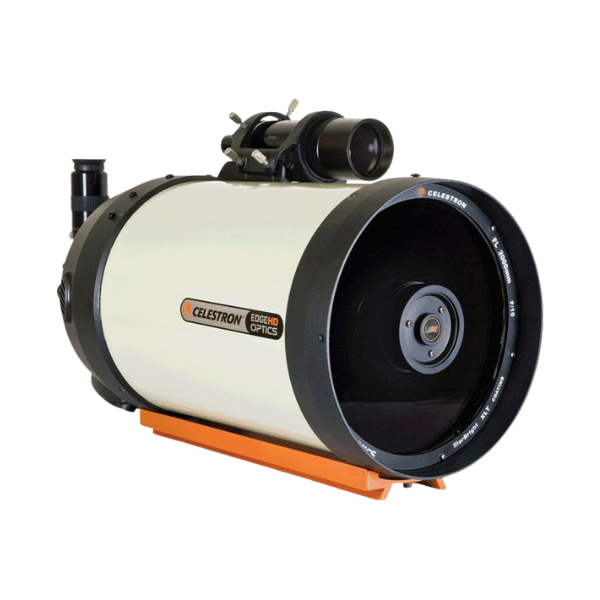
Catadioptric telescopes excel at high magnification views, making them a fantastic choice for viewing or photographing the planets and the Moon. They can also be great for deep sky astrophotography, specifically for smaller targets like distant galaxies or close ups of nebulae.
Catadioptrics combine many of the best features of refracting and reflecting telescopes, resulting in a compact design that suffers from few optical flaws.
About Catadioptric Telescopes
In 1930, Bernhard Schmidt from Germany invented the first catadioptric telescope. The term ‘catadioptric’ refers to the telescope’s folded optical design thanks to internal mirrors. While refractor telescopes use only lenses and reflector telescopes use only mirrors, catadioptrics combine both optical elements to create an image.
Their design eliminates chromatic aberration and reduces coma, resulting in sharp stars across the visual field. Their larger apertures allow you to see faint details more clearly. However, the folded optical design can make the image less bright compared to other telescopes of the same aperture due to a longer focal ratio around f/10.
How Catadioptric Telescopes Work
Catadioptric telescopes feature a primary mirror at the base, a corrector lens, and a smaller secondary mirror at the front. Light passes through the corrector lens to the primary mirror, which reflects it to the secondary mirror. The secondary mirror directs the light to the eyepiece or camera at the back of the telescope. The corrector lens bends incoming light, allowing the telescope to focus on distant objects at infinity.
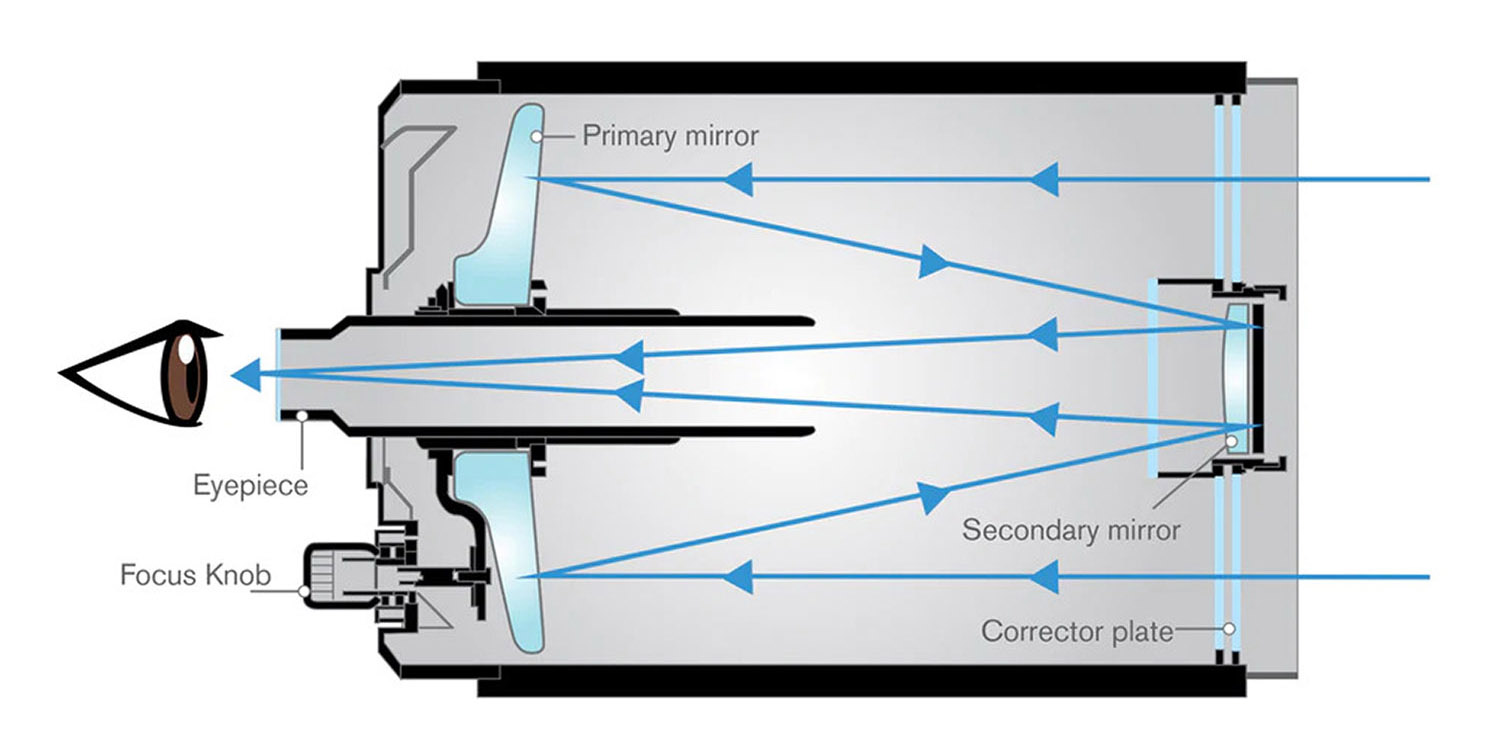
One downside of catadioptric telescopes is field curvature - where the edges of the field appear out of focus. This effect is more noticeable in wide-field photos. Newer models, like the RASA, address this issue, especially for astrophotography, but they tend to be more expensive.
Catadioptric telescopes are ideal for both astrophotography and visual observing. Whether you’re a beginner or have experience using a telescope, they are suitable for all skill levels.
Types of Catadioptric Telescopes
The two main types of catadioptric telescopes are Schmidt-Cassegrain (SCT) and Maksutov-Cassegrain (Mak-Cass). Less common designs, such as the Schmidt-Newtonian and Maksutov-Newtonian, are also available.
Schmidt-Cassegrain Telescopes (SCT)
Best for deep sky astrophotographers and visual observers | $$-$$$$

SCTs use a special thin corrector plate at the front of the telescope to correct spherical aberrations. They are lighter and more compact than other catadioptrics, making them easier to transport and set up. SCTs usually have a faster focal ratio (f/10) than Mak-Cass telescopes.
This makes them better suited for ultra deep sky astrophotography, though most imagers choose to add an optional reducer to get a slightly faster focal ratio around f/7.
The long focal length is unforgiving and requires a very accurate mount, which makes SCTs less ideal for beginner deep sky imagers.
SCTs are an excellent choice for planetary and lunar observers and astrophotographers. Because of their ultra-long focal lengths, usually 2000mm or higher, SCTs can resolve details on planets that most other telescopes can’t, such as the Great Red Spot on Jupiter.
Pros: Shorter cooldown time, and less expensive than other catadioptric systems. Higher image quality, more compact, and portable than other telescopes.
Cons: Higher cost and narrower field of view compared to other types of telescope, such as Newtonians. Longer cooldown time and prone to dew.
RASA (Rowe-Ackermann Schmidt Astrograph)
Best for serious deep sky and wide field astrophotographers | $$-$$$
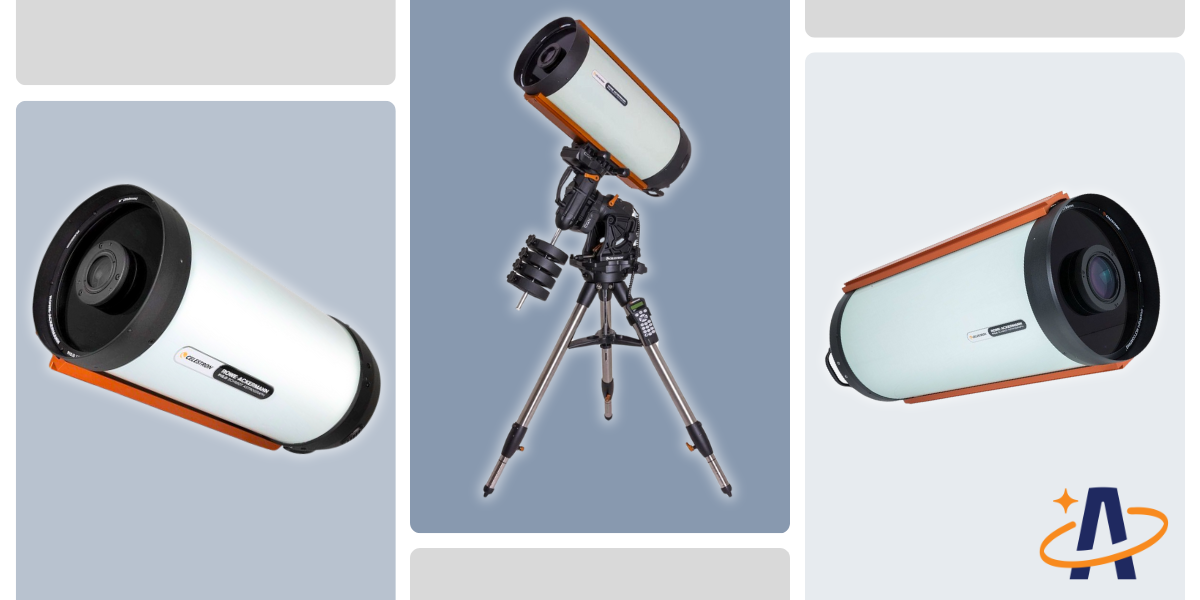
Though most catadioptrics are long focal length telescopes, the Celestron RASA is the exception to the rule. Designed for wide field astrophotography, the RASA combines a Schmidt corrector plate with a short focal length and a blazing fast focal ratio around f/2. Unlike SCTs, the RASA lacks a secondary mirror, requiring the camera to unconventionally mount at the front of the telescope.
RASA’s fast focal ratio allows shorter exposure times and offers a larger image circle and wider field of view.
We do not recommend using a DSLR or mirrorless camera or a camera with a filter wheel attached with a RASA, as large front-mounted cameras will block incoming light.
Despite its advanced features, the RASA remains lightweight and portable. They’re suitable for backyard setups or remote dark-sky locations.
Pros: Fast focal ratio greatly reduces exposure times. Wider field of view. Minimal optical defects like field curvature, coma, astigmatism, and chromatic aberration.
Cons: Needs specialized filters that are suitable for fast optics. They’re more expensive than other catadioptric systems. Not suitable for visual use and prone to dew.
Maksutov-Cassegrain Telescopes
Best for planetary or lunar photography and visual observers | $$-$$$$

Mak-Cass telescopes have a thick, curved corrector lens at the front to correct spherical aberrations, providing excellent image quality. Because of this lens, they are heavier than other catadioptric telescopes.
Maksutovs produce sharper images than Schmidt-Cassegrains. They offer a large viewing aperture, high contrast, and a long focal length in a compact design.
With slower focal ratios (f/12 to f/15) and focal lengths 5-7 times longer than typical Newtonians or refractors, they excel at planetary and lunar observation but are limited in their ability to do much else.
Pros: Superior image quality, low maintenance, more compact than other telescope designs.
Cons: Longer cooldown times because of the thicker corrector lens. Generally more expensive than SCTs of the same aperture. Very long focal ratios make them a poor choice for targets aside from the planets & the Moon. Heavier and prone to dew.
Maksutov-Newtonian Telescopes
Best for planetary and lunar observations and deep-sky astrophotography by intermediate to advanced users | $$-$$$

Maksutov-Newtonian telescopes combine elements of Maksutov-Cassegrain and Newtonian designs. They use a spherical primary mirror and a meniscus corrector lens to deliver sharp images with greater contrast. Their design minimizes optical issues like aberrations, coma, and diffraction spikes without requiring extra corrective optics.
Pros: More portable than traditional Newtonians and easier to collimate. No need for a coma corrector.
Cons: More expensive and heavier than standard Newtonians. Longer cooldown times because of the enclosed design and prone to dew.
Need help?
Our team is always ready to help you choose the perfect catadioptric telescope for your needs. If you have any questions or can't find what you’re looking for, contact us.
Frequently Asked Questions
What Are the Downsides of Catadioptric Telescopes?
Catadioptric telescopes generally have higher focal ratios (e.g., f/10), making them less efficient at collecting light compared to Newtonians and most refractors. This means you will need longer exposure times to create an image of equal brightness. They are often more expensive, need collimation, and larger apertures can be heavy.
Are Catadioptric Telescopes Suitable for Beginners?
Some catadioptric telescopes are suitable for beginners, though models with long focal lengths may be more challenging, particularly for astrophotography.
Beginners might find it harder to use robust mounts and autoguiding systems. Because of its versatility, we recommend Schmidt-Cassegrain telescopes for beginners provided they come with a quality mount, such as Celestron’s NexStar SE series.
How Do Catadioptric Telescopes Compare to Other Telescopes?
Refractors are simple and low maintenance with excellent image quality and minimal chromatic aberration. However, they can be bulky and expensive at larger apertures. They also don’t have as long of a focal length, which make them inferior to catadioptrics for planetary and lunar work.
Reflectors provide large apertures at a lower cost. They're ideal for deep-sky astrophotography, but need frequent collimation and may suffer from coma.
Catadioptrics balance the benefits of both refractors and reflectors, but they can be heavier, take longer to cool down, and cost more.
What Are cCommon Uses for Catadioptric Telescopes?
They are ideal for viewing and photographing planets, the moon, and deep-sky objects like distant galaxies, planetary nebulae, and emission nebulae.
Do Catadioptric Telescopes Need Collimation?
Yes, catadioptrics need to be collimated, but they maintain collimation better than other telescope types like Newtonians so it needs to be done much less frequently (about once or twice per year).
Is Schmidt-Cassegrain Better Than Newtonian?
It depends on your needs. SCTs are more portable, versatile, and user-friendly, while Newtonians offer cost-effective large apertures and wider fields of view.
We recommend SCTs if your primary goal is to have a portable telescope for viewing or photographing the planets and the Moon.
If you can be more stationary, a Newtonian or Dobsonian telescope offers a larger aperture for a lower price.