

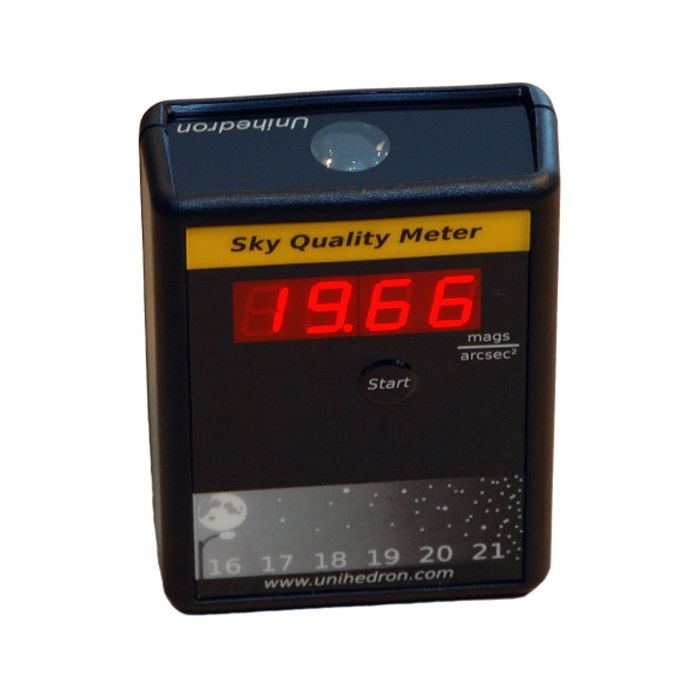
Unihedron Sky Quality Meter with Lens - Narrow Field of View
Stock count is accurate & shown in real time.
- This item is out of stock.
- Sign up for back-in-stock alerts to be notified when this item becomes available (account login required).
- This item is out of stock.
- Sign up for back-in-stock alerts to be notified when this item becomes available (account login required).
Contiguous US / Lower 48:
Free shipping applies to orders over $50 using our chosen carrier/method. Faster paid options are available at checkout.
Alaska, Hawaii & US Territories:
Free shipping applies to many—but not all—products. Enter your ZIP code in cart or upon checkout to confirm options and costs.
International:
International orders do not qualify for free shipping. Shipping, duties, brokerage, tariffs, and taxes are the customer’s responsibility. Some items may be restricted due to export, size, or manufacturer limitations.
An affordable meter for measuring sky brightness for astronomers! The "Sky Quality Meter" measures the brightness of the night sky in magnitudes per square arcsecond. Designed by Dr. Doug Welch and Anthony Tekatch, the Unihedron Sky Quality Meter offers unprecedented sensitivity in a handheld meter.
Uses:
- Find out how good the night or site REALLY is.
- Compare the sky brightness at different sites quantitatively.
- Document the evolution of light pollution in your area.
- Set planetarium dome illumination to mimic the skies people are likely to experience elsewhere in the city.
- Monitor sky brightness through the night, night-to-night, and year-to-year.
- Determine which nights show the greatest promise for finding the 'faintest fuzzies'!
- Calibrate the effect of sky brightness on qualitative measures such as the Bortle Scale.
- Investigate how sky brightness correlates with the solar cycle and month-to-month sunspot activity.
- Help provide local ground truth for future sky brightness prediction with the Clear Sky Clock
- CCD users can make a correlation between the SQM reading and when the background reaches some ADC level.
Features:
- Audible signal while measurement is in progress.
- Sky brightness displayed in visual magnitudes per square arcsecond.
- Infrared blocking filter restricts measurement to visual bandpass.
- Temperature in both Celsius and Fahrenheit as well as model number and serial number can be displayed with different button press sequence.
- Precision readings at even the darkest sites.
- Power-saving features designed in for maximum battery life.
- Reverse battery protection.
Specifications:
- The Half Width Half Maximum (HWHM) of the angular sensitivity is ~10°. The Full Width Half Maximum (FWHM) is then ~20°. The sensitivity to a point source ~19° off-axis is a factor of 10 lower than on-axis. A point source ~20° and ~40° off-axis would register 3.0 and 5.0 magnitudes fainter, respectively. (See photo 2)
- Operates from 9V battery (included).
- Size 3.6 x 2.6 x 1.1 in.
- Maximum light sampling time: 80 seconds.
- Specifications are subject to change without notice.
Useful Resources
- User Manual: SQM-L Instruction Sheet (PDF format)
- Frequently Asked Questions
- SQM Comparison Chart
Other Information
- Country of Manufacture: Canada
An affordable meter for measuring sky brightness for astronomers! The "Sky Quality Meter" measures the brightness of the night sky in magnitudes per square arcsecond. Designed by Dr. Doug Welch and Anthony Tekatch, the Unihedron Sky Quality Meter offers unprecedented sensitivity in a handheld meter.
Uses:
- Find out how good the night or site REALLY is.
- Compare the sky brightness at different sites quantitatively.
- Document the evolution of light pollution in your area.
- Set planetarium dome illumination to mimic the skies people are likely to experience elsewhere in the city.
- Monitor sky brightness through the night, night-to-night, and year-to-year.
- Determine which nights show the greatest promise for finding the 'faintest fuzzies'!
- Calibrate the effect of sky brightness on qualitative measures such as the Bortle Scale.
- Investigate how sky brightness correlates with the solar cycle and month-to-month sunspot activity.
- Help provide local ground truth for future sky brightness prediction with the Clear Sky Clock
- CCD users can make a correlation between the SQM reading and when the background reaches some ADC level.
Features:
- Audible signal while measurement is in progress.
- Sky brightness displayed in visual magnitudes per square arcsecond.
- Infrared blocking filter restricts measurement to visual bandpass.
- Temperature in both Celsius and Fahrenheit as well as model number and serial number can be displayed with different button press sequence.
- Precision readings at even the darkest sites.
- Power-saving features designed in for maximum battery life.
- Reverse battery protection.
Specifications:
- The Half Width Half Maximum (HWHM) of the angular sensitivity is ~10°. The Full Width Half Maximum (FWHM) is then ~20°. The sensitivity to a point source ~19° off-axis is a factor of 10 lower than on-axis. A point source ~20° and ~40° off-axis would register 3.0 and 5.0 magnitudes fainter, respectively. (See photo 2)
- Operates from 9V battery (included).
- Size 3.6 x 2.6 x 1.1 in.
- Maximum light sampling time: 80 seconds.
- Specifications are subject to change without notice.
An affordable meter for measuring sky brightness for astronomers! The "Sky Quality Meter" measures the brightness of the night sky in magnitudes per square arcsecond. Designed by Dr. Doug Welch and Anthony Tekatch, the Unihedron Sky Quality Meter offers unprecedented sensitivity in a handheld meter.
Uses:
- Find out how good the night or site REALLY is.
- Compare the sky brightness at different sites quantitatively.
- Document the evolution of light pollution in your area.
- Set planetarium dome illumination to mimic the skies people are likely to experience elsewhere in the city.
- Monitor sky brightness through the night, night-to-night, and year-to-year.
- Determine which nights show the greatest promise for finding the 'faintest fuzzies'!
- Calibrate the effect of sky brightness on qualitative measures such as the Bortle Scale.
- Investigate how sky brightness correlates with the solar cycle and month-to-month sunspot activity.
- Help provide local ground truth for future sky brightness prediction with the Clear Sky Clock
- CCD users can make a correlation between the SQM reading and when the background reaches some ADC level.
Features:
- Audible signal while measurement is in progress.
- Sky brightness displayed in visual magnitudes per square arcsecond.
- Infrared blocking filter restricts measurement to visual bandpass.
- Temperature in both Celsius and Fahrenheit as well as model number and serial number can be displayed with different button press sequence.
- Precision readings at even the darkest sites.
- Power-saving features designed in for maximum battery life.
- Reverse battery protection.
Specifications:
- The Half Width Half Maximum (HWHM) of the angular sensitivity is ~10°. The Full Width Half Maximum (FWHM) is then ~20°. The sensitivity to a point source ~19° off-axis is a factor of 10 lower than on-axis. A point source ~20° and ~40° off-axis would register 3.0 and 5.0 magnitudes fainter, respectively. (See photo 2)
- Operates from 9V battery (included).
- Size 3.6 x 2.6 x 1.1 in.
- Maximum light sampling time: 80 seconds.
- Specifications are subject to change without notice.
Useful Resources
- User Manual: SQM-L Instruction Sheet (PDF format)
- Frequently Asked Questions
- SQM Comparison Chart
Other Information
- Country of Manufacture: Canada

Unihedron Sky Quality Meter with Lens - Narrow Field of View