

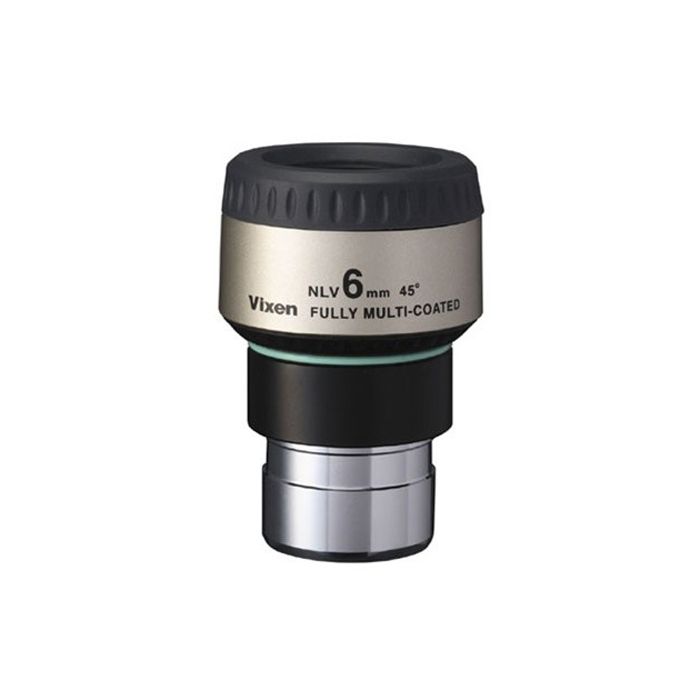
Vixen 1.25" NLV Lanthanum Eyepiece - 6mm
This item is discontinued by the manufacturer and is no longer available.
Stock count is accurate & shown in real time.
- This item is out of stock.
- Sign up for back-in-stock alerts to be notified when this item becomes available (account login required).
- This item is out of stock.
- Sign up for back-in-stock alerts to be notified when this item becomes available (account login required).
The Vixen NLV Series Eyepieces feature comfortable long 20mm eye-relief, simple twist-up eye cups for adjusting the best eye-point and high grade Lanthanum glass for clear and high contrast viewing. All optics are multi coated. Made in Japan.
Important note: Depending on your telescope, this eyepiece may provide magnifications that are too high! While it can be very useful for viewing the Sun, Moon, brighter planets and terrestrial objects, it is not for everyone or for common viewing conditions.
Before buying, please make sure that you are using realistic magnifications with your telescope. A good rule of thumb is that under very good conditions and with a very good telescope, the maximum power you will be able to use is about 50x of magnification per inch of telescope aperture. With average telescopes and/or average conditions, you might be limited to 30x of magnification per inch of telescope aperture. So for example, if you have a 4" telescope, under typical conditions you might typically use 4x30 = 120x of magnification, and 4x50 = 200x of magnification at best. If your telescope has a focal length of, say, 1200mm, then this eyepiece will result in a magnification of 1200 / 5 = 240x which is probably too much for this telescope.
Also, when you magnify an object, its light is spread over a larger area. Since the brightness of the object being viewed hasn't changed, this means that the image you see will be fainter. Double the magnification and the image will get 4 times fainter. This is a basic law of physics, but people often forget this and complain that the "image is not bright enough" when they increase the magnification to very high powers.
Boosting the magnification beyond the recommended maximum for your telescope aperture is not realistic. This is bound to result in image break-down, causing faint, fuzzy images, focusing difficulties, increased color around objects and general disappointment. Use the eyepiece in the right settings and with the correct expectations, and you will enjoy it.
The Vixen NLV Series Eyepieces feature comfortable long 20mm eye-relief, simple twist-up eye cups for adjusting the best eye-point and high grade Lanthanum glass for clear and high contrast viewing. All optics are multi coated. Made in Japan.
Important note: Depending on your telescope, this eyepiece may provide magnifications that are too high! While it can be very useful for viewing the Sun, Moon, brighter planets and terrestrial objects, it is not for everyone or for common viewing conditions.
Before buying, please make sure that you are using realistic magnifications with your telescope. A good rule of thumb is that under very good conditions and with a very good telescope, the maximum power you will be able to use is about 50x of magnification per inch of telescope aperture. With average telescopes and/or average conditions, you might be limited to 30x of magnification per inch of telescope aperture. So for example, if you have a 4" telescope, under typical conditions you might typically use 4x30 = 120x of magnification, and 4x50 = 200x of magnification at best. If your telescope has a focal length of, say, 1200mm, then this eyepiece will result in a magnification of 1200 / 5 = 240x which is probably too much for this telescope.
Also, when you magnify an object, its light is spread over a larger area. Since the brightness of the object being viewed hasn't changed, this means that the image you see will be fainter. Double the magnification and the image will get 4 times fainter. This is a basic law of physics, but people often forget this and complain that the "image is not bright enough" when they increase the magnification to very high powers.
Boosting the magnification beyond the recommended maximum for your telescope aperture is not realistic. This is bound to result in image break-down, causing faint, fuzzy images, focusing difficulties, increased color around objects and general disappointment. Use the eyepiece in the right settings and with the correct expectations, and you will enjoy it.
| Manufacturer | Vixen Optics |
|---|---|
| Eyepiece Series | NLV Lanthanum |
| Focal Length | 6mm |
| Barrel Size | 1.25" (31.7mm) |
| Apparent Field of View (Mfg Specified) | 45° |
| Eye Relief (Designed) | 20mm |
| Filter Threads | Standard 1.25" Filter Thread (M28.5 x 0.6) |
| Coatings | Multi-Coated |
| Lens Elements | 7 |
| Lens Groups | 4 |
| Barrel Type | With safety undercut |
| Protective Storage Container Included | Discontinued Item |
| Protective Plastic Storage Container Size (Sold Separately) | Agena 52x80mm |
| Weight | 5.3 oz (149 g) |
The Vixen NLV Series Eyepieces feature comfortable long 20mm eye-relief, simple twist-up eye cups for adjusting the best eye-point and high grade Lanthanum glass for clear and high contrast viewing. All optics are multi coated. Made in Japan.
Important note: Depending on your telescope, this eyepiece may provide magnifications that are too high! While it can be very useful for viewing the Sun, Moon, brighter planets and terrestrial objects, it is not for everyone or for common viewing conditions.
Before buying, please make sure that you are using realistic magnifications with your telescope. A good rule of thumb is that under very good conditions and with a very good telescope, the maximum power you will be able to use is about 50x of magnification per inch of telescope aperture. With average telescopes and/or average conditions, you might be limited to 30x of magnification per inch of telescope aperture. So for example, if you have a 4" telescope, under typical conditions you might typically use 4x30 = 120x of magnification, and 4x50 = 200x of magnification at best. If your telescope has a focal length of, say, 1200mm, then this eyepiece will result in a magnification of 1200 / 5 = 240x which is probably too much for this telescope.
Also, when you magnify an object, its light is spread over a larger area. Since the brightness of the object being viewed hasn't changed, this means that the image you see will be fainter. Double the magnification and the image will get 4 times fainter. This is a basic law of physics, but people often forget this and complain that the "image is not bright enough" when they increase the magnification to very high powers.
Boosting the magnification beyond the recommended maximum for your telescope aperture is not realistic. This is bound to result in image break-down, causing faint, fuzzy images, focusing difficulties, increased color around objects and general disappointment. Use the eyepiece in the right settings and with the correct expectations, and you will enjoy it.
| Manufacturer | Vixen Optics |
|---|---|
| Eyepiece Series | NLV Lanthanum |
| Focal Length | 6mm |
| Barrel Size | 1.25" (31.7mm) |
| Apparent Field of View (Mfg Specified) | 45° |
| Eye Relief (Designed) | 20mm |
| Filter Threads | Standard 1.25" Filter Thread (M28.5 x 0.6) |
| Coatings | Multi-Coated |
| Lens Elements | 7 |
| Lens Groups | 4 |
| Barrel Type | With safety undercut |
| Protective Storage Container Included | Discontinued Item |
| Protective Plastic Storage Container Size (Sold Separately) | Agena 52x80mm |
| Weight | 5.3 oz (149 g) |