

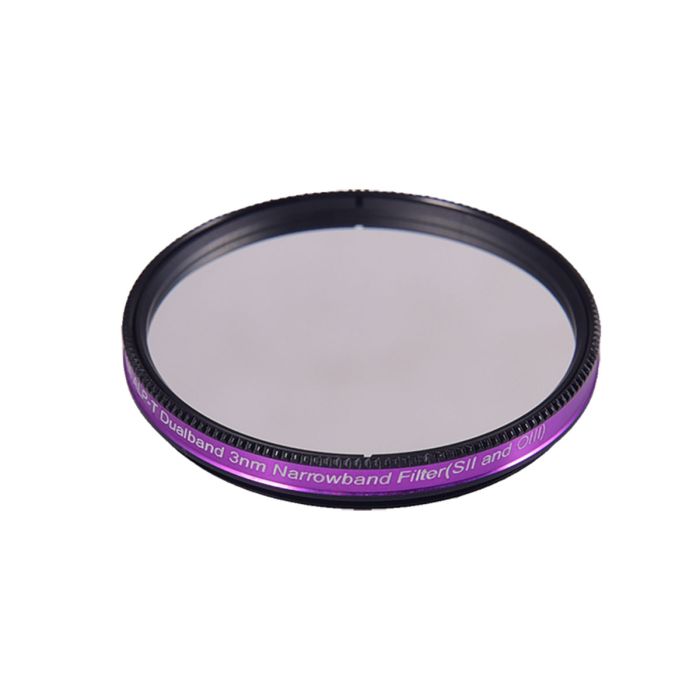
Antlia ALP-T Dual Narrowband 3nm SII & OIII Highspeed Filter for f/2.2 - f/4 Telescopes - 2" Mounted
Stock count is accurate & shown in real time.
- This item is out of stock.
- Sign up for back-in-stock alerts to be notified when this item becomes available (account login required).
- This item is out of stock.
- Sign up for back-in-stock alerts to be notified when this item becomes available (account login required).
Contiguous US / Lower 48:
Free shipping applies to orders over $50 using our chosen carrier/method. Faster paid options are available at checkout.
Alaska, Hawaii & US Territories:
Free shipping applies to many—but not all—products. Enter your ZIP code in cart or upon checkout to confirm options and costs.
International:
International orders do not qualify for free shipping. Shipping, duties, brokerage, tariffs, and taxes are the customer’s responsibility. Some items may be restricted due to export, size, or manufacturer limitations.
PLEASE NOTE: Antlia is making a running change to their packaging. They are transitioning from 2-piece magnetic plastic cases to a smaller 1-piece non-magnetic design. Depending on the item(s) you order, you may randomly get one case type or the other or a mix of the two. We cannot entertain requests for any specific case type.
IMPORTANT: Please read this important note below before buying Antlia narrowband filters. No returns will be accepted for Antlia narrowband filters exhibiting halos around bright stars as disclosed below.
Please note that some users may see halos around bright stars in images made with this filter. Such halos have been observed with filters from other leading manufacturers and in the previous generation of Antlia narrowband filters as well. These halos can be caused and/or made worse by other optical accessories in the imaging train, their relative positions, telescope design/optics, camera, software, or a combination thereof. In general, OIII filters seem to have a higher propensity to show halos compared to H-alpha or S-II filters, but in rare cases the latter filters can also exhibit faint halos around bright stars.
Antlia has made great strides in their coatings to minimize haloing of bright stars, but you may still observe this effect to some degree. See the sample OIII image below of Alnitak (magnitude 1.74) and IC434 in Orion (SkyRover 155mm Apo, ZWO 6200MM-P Camera, 20 min exposure) provided by Antlia. In most cases, haloing will not affect your image unless you have very bright stars in the field of view.
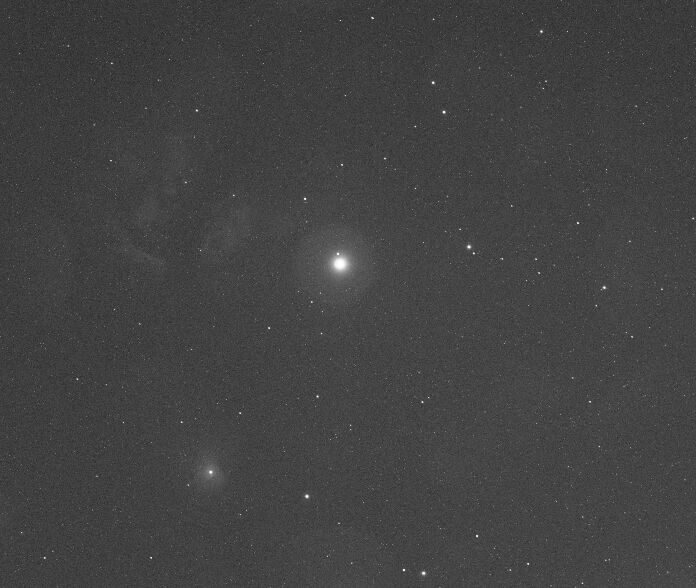
Please note we are unable to accept returns of any Antlia narrowband filters if you do observe this haloing effect in your images.
If you must ensure there are no detectable halos in your images, you may want to consider Astrodon or Chroma narrowband filters instead. These filters, however, cost two to three times as much as Antlia 3nm filters do. Antlia is being honest and upfront. They are the ones telling us about these halos, that their filters are great for the money but still not as good as Astrodon/Chroma, and pointing out that with this full disclosure, they will not accept returns. They are leaving it up to the customer to decide if this is good enough for them or not. We believe that for most imaging applications, Antlia filters continue to offer excellent value for astrophotographers and these continue to be among our top sellers.
Antlia ALP-T dualband 3nm SII&OIII Filter
ALP-T Dual Band 3nm Highspeed Filters are further optimized to work with high-speed imaging systems by shifting the passband and center wavelength slightly. Using these highspeed filters with optics between f/2.2 and f/3.6 shows much stronger signal and more contrast in nebulae imaging compared to the standard version.
For f-ratios slower than f/3.6, the standard ALP-T Dual Band 5nm filters are highly recommended. Meanwhile, if you seek the best possible performance with any optics faster than f/3.6, the highspeed version is the best choice.
But keep in mind, the blue shift data by computer simulation indicates narrowband filter shifts its bandwidth to shorter wavelengths with optics faster than f/2, and transmission at the emission wavelength may decrease by perhaps 15%-20%. Although the Antlia ALP-T highspeed filter has a similar transmission rate reduction when the filter is used on fast optics, it is evident that the filter still has the high performance of increase in emission nebula contrast and minimized halo.
The highspeed version price is the same as the standard filters and added benefits for the high-speed optics users. Worth mentioning is that Antlia inspects and measures each unit with a professional spectrophotometer, allowing them to provide highly reliable and consistent products.
The ALP-T dual band 3nm SII&OIII filter is a dual narrowband filter, which lets the deep red Sulfur-II 672.4nm and the blue-green OIII (500.7nm) lines through and is primarily engineered for color cameras to assist astrophotographers taking deep sky images with superior SNR(Signal to Noise Ratio). With an FWHM half-bandwidth designed at 3nm and achieving an optical density (OD) of 4.5 on unwanted wavelengths, it works strongly in blocking light pollution, moonlight, and airglow, leading to enhanced contrast in nebulae images by effectively passing the SII and OIII emission lines signal only.
It is a significant addition to the popular Antlia ALP-T dual-band Ha&OIII filter and enables false-color images and narrow-band nebula images using OSC. When capturing data with this filter, the nebulae are recorded with high signal-to-noise ratios and greater contrast than without it.
Main features and application:
-
Designed especially for fast astronomy optics, in particular f-ratios f/2.2 to f/3.6
-
Passes SII 672.4nm and OIII 500.7nm lines
-
Capturing of the two main emission wavebands in the deep red and blue-green at the same time
-
Ultra FWHM 3nm design allows for increasing exposure time and capturing detailed nebulae signal
-
Designed to be used primarily with color cameras to capture cleaner data or used as Luminance filter mono cameras to save imaging time
-
Suppression of optical density (OD)4.5 on unwanted wavelengths improves SNR( signal-to-noise)
-
Near IR (NIR) is blocked up to 1100nm
-
Ideal flat-top and moderate bandpass reducing spectrum downshifts
-
Ion Gun Assisted Deposition of double-sided multi-layer coating technology on the double-sided polished substrate making it the most consistent and accurate light pollution suppression filter
-
Halo suppression anti-reflective coating is used to minimize halo and internal reflections
-
Designed to suppress artificial lighting from Bortle scale 1 to Bortle scale 8
-
Blackened edges of unmounted sizes to minimize internal reflections
-
Antlia's ever-trusted coating technology makes filter durability very reliable
-
Recommended to be used with ALP-T Dual Band Ha&OIII filter to create images with better SNR( signal-to-noise) and better isolation between the channels
-
While primarily designed for use with color cameras, the filter is also highly effective with monochrome cameras to save imaging time
Technical Specifications:
| Sulfur-II | Oxygen III | |
| FWHM | 3nm +0.5/-0.5nm | 3nm +0.5/-0.5nm |
| CWL (Central Wavelength) | 672.4nm | 500.7nm |
| Peak Transmission | 90% | 85% |
| Blocking | ≥OD4.5 @ 300-1100nm | ≥OD4.5 @ 300-1100nm |
| Filter Thickness | 2mm+/-0.05mm | 2mm+/-0.05mm |
| Basic Substrate | Optical, Single / Non-glued substrate | Optical, Single / Non-glued substrate |
| Surface Quality | S/D (scratch/dig)= 60/40 (Refer to MIL-O-13830 | S/D (scratch/dig)= 60/40 (Refer to MIL-O-13830 |
| Transmitted Wavefront | Lambda/4 or better. | Lambda/4 or better. |
| Parallelism | less than 30 arcsec | less than 30 arcsec |
| Filter Ring | 2’’ (M48*0.75) | 2’’ (M48*0.75) |
The advanced multi-coatings on Antlia ALP-T dual-band series filters effectively isolate the red, Ha line, blue-green, OIII line, and deep red SII lines from emission nebulae, with almost total suppression of optical density (OD)4.5 on unwanted wavelengths from light pollution, moonlight, and airglow.
The ALP-T dual band Ha&OIII version, SII&OIII version and SII&H-beta create a superior signal-to-noise ratio and better contrast in your OSC images whether used in urban or rural areas, making them excellent choices for astrophotographers aiming to capture high-quality and more detailed celestial images.
Filter Ring:
- 2’’ Mounted (M48*0.75 thread)
- Ultra-thin filter cell to minimize vignetting by maximizing possible clear aperture
- Black Anodized Finish
- Laser Engraving, No Fading
Not Recommended:
- Solar Observing and imaging
- Night visual observation
Not Permitted:
- DO NOT LOOK AT THE SUN WITH THIS FILTER DIRECTLY
- Serious eye damage will result if you fail to observe the warning.
Useful Resources
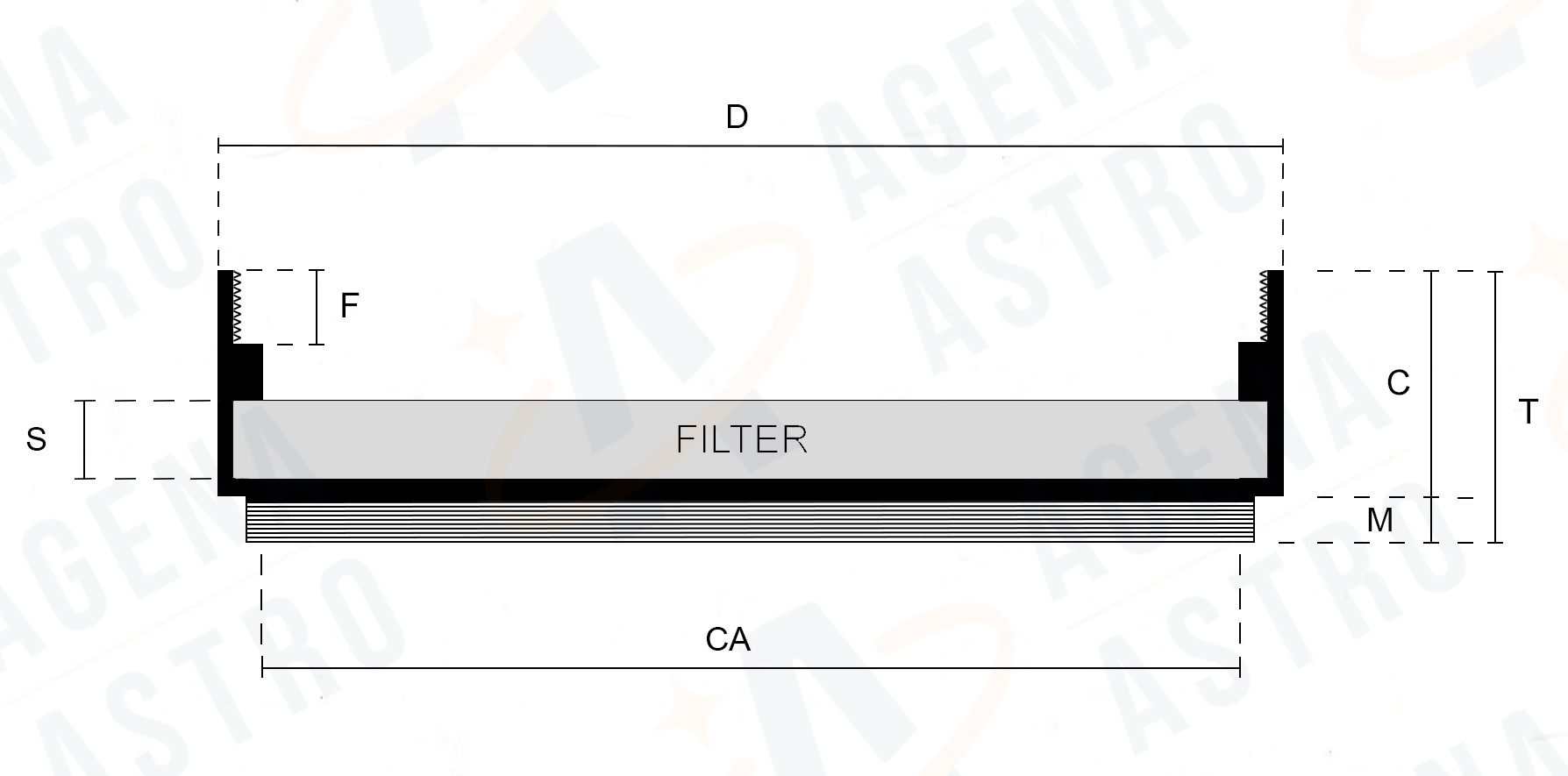
Filter Cell Specifications
D = Filter Cell Diameter = 50.3 mm / 2.0 in
T = Total Filter Height = 7.3 mm / 0.28 in
C = Filter Cell Height (Excluding Male Thread) = 4.9 mm / 0.19 in
M = Male Thread Length = 2.5 mm / 0.09 in
F = USABLE Female Filter Thread Length = Not threaded, so you cannot stack additional filters
S = Glass Substrate Thickness = 2 mm / 0.07 in
CA = Clear Aperture = 45 mm / 1.77 in
Other Information
- Country of Manufacture: China
Antlia ALP-T dualband 3nm SII&OIII Filter
ALP-T Dual Band 3nm Highspeed Filters are further optimized to work with high-speed imaging systems by shifting the passband and center wavelength slightly. Using these highspeed filters with optics between f/2.2 and f/3.6 shows much stronger signal and more contrast in nebulae imaging compared to the standard version.
For f-ratios slower than f/3.6, the standard ALP-T Dual Band 5nm filters are highly recommended. Meanwhile, if you seek the best possible performance with any optics faster than f/3.6, the highspeed version is the best choice.
But keep in mind, the blue shift data by computer simulation indicates narrowband filter shifts its bandwidth to shorter wavelengths with optics faster than f/2, and transmission at the emission wavelength may decrease by perhaps 15%-20%. Although the Antlia ALP-T highspeed filter has a similar transmission rate reduction when the filter is used on fast optics, it is evident that the filter still has the high performance of increase in emission nebula contrast and minimized halo.
The highspeed version price is the same as the standard filters and added benefits for the high-speed optics users. Worth mentioning is that Antlia inspects and measures each unit with a professional spectrophotometer, allowing them to provide highly reliable and consistent products.
The ALP-T dual band 3nm SII&OIII filter is a dual narrowband filter, which lets the deep red Sulfur-II 672.4nm and the blue-green OIII (500.7nm) lines through and is primarily engineered for color cameras to assist astrophotographers taking deep sky images with superior SNR(Signal to Noise Ratio). With an FWHM half-bandwidth designed at 3nm and achieving an optical density (OD) of 4.5 on unwanted wavelengths, it works strongly in blocking light pollution, moonlight, and airglow, leading to enhanced contrast in nebulae images by effectively passing the SII and OIII emission lines signal only.
It is a significant addition to the popular Antlia ALP-T dual-band Ha&OIII filter and enables false-color images and narrow-band nebula images using OSC. When capturing data with this filter, the nebulae are recorded with high signal-to-noise ratios and greater contrast than without it.
Main features and application:
-
Designed especially for fast astronomy optics, in particular f-ratios f/2.2 to f/3.6
-
Passes SII 672.4nm and OIII 500.7nm lines
-
Capturing of the two main emission wavebands in the deep red and blue-green at the same time
-
Ultra FWHM 3nm design allows for increasing exposure time and capturing detailed nebulae signal
-
Designed to be used primarily with color cameras to capture cleaner data or used as Luminance filter mono cameras to save imaging time
-
Suppression of optical density (OD)4.5 on unwanted wavelengths improves SNR( signal-to-noise)
-
Near IR (NIR) is blocked up to 1100nm
-
Ideal flat-top and moderate bandpass reducing spectrum downshifts
-
Ion Gun Assisted Deposition of double-sided multi-layer coating technology on the double-sided polished substrate making it the most consistent and accurate light pollution suppression filter
-
Halo suppression anti-reflective coating is used to minimize halo and internal reflections
-
Designed to suppress artificial lighting from Bortle scale 1 to Bortle scale 8
-
Blackened edges of unmounted sizes to minimize internal reflections
-
Antlia's ever-trusted coating technology makes filter durability very reliable
-
Recommended to be used with ALP-T Dual Band Ha&OIII filter to create images with better SNR( signal-to-noise) and better isolation between the channels
-
While primarily designed for use with color cameras, the filter is also highly effective with monochrome cameras to save imaging time
Technical Specifications:
| Sulfur-II | Oxygen III | |
| FWHM | 3nm +0.5/-0.5nm | 3nm +0.5/-0.5nm |
| CWL (Central Wavelength) | 672.4nm | 500.7nm |
| Peak Transmission | 90% | 85% |
| Blocking | ≥OD4.5 @ 300-1100nm | ≥OD4.5 @ 300-1100nm |
| Filter Thickness | 2mm+/-0.05mm | 2mm+/-0.05mm |
| Basic Substrate | Optical, Single / Non-glued substrate | Optical, Single / Non-glued substrate |
| Surface Quality | S/D (scratch/dig)= 60/40 (Refer to MIL-O-13830 | S/D (scratch/dig)= 60/40 (Refer to MIL-O-13830 |
| Transmitted Wavefront | Lambda/4 or better. | Lambda/4 or better. |
| Parallelism | less than 30 arcsec | less than 30 arcsec |
| Filter Ring | 2’’ (M48*0.75) | 2’’ (M48*0.75) |
The advanced multi-coatings on Antlia ALP-T dual-band series filters effectively isolate the red, Ha line, blue-green, OIII line, and deep red SII lines from emission nebulae, with almost total suppression of optical density (OD)4.5 on unwanted wavelengths from light pollution, moonlight, and airglow.
The ALP-T dual band Ha&OIII version, SII&OIII version and SII&H-beta create a superior signal-to-noise ratio and better contrast in your OSC images whether used in urban or rural areas, making them excellent choices for astrophotographers aiming to capture high-quality and more detailed celestial images.
Filter Ring:
- 2’’ Mounted (M48*0.75 thread)
- Ultra-thin filter cell to minimize vignetting by maximizing possible clear aperture
- Black Anodized Finish
- Laser Engraving, No Fading
Not Recommended:
- Solar Observing and imaging
- Night visual observation
Not Permitted:
- DO NOT LOOK AT THE SUN WITH THIS FILTER DIRECTLY
- Serious eye damage will result if you fail to observe the warning.
PLEASE NOTE: Antlia is making a running change to their packaging. They are transitioning from 2-piece magnetic plastic cases to a smaller 1-piece non-magnetic design. Depending on the item(s) you order, you may randomly get one case type or the other or a mix of the two. We cannot entertain requests for any specific case type.
IMPORTANT: Please read this important note below before buying Antlia narrowband filters. No returns will be accepted for Antlia narrowband filters exhibiting halos around bright stars as disclosed below.
Please note that some users may see halos around bright stars in images made with this filter. Such halos have been observed with filters from other leading manufacturers and in the previous generation of Antlia narrowband filters as well. These halos can be caused and/or made worse by other optical accessories in the imaging train, their relative positions, telescope design/optics, camera, software, or a combination thereof. In general, OIII filters seem to have a higher propensity to show halos compared to H-alpha or S-II filters, but in rare cases the latter filters can also exhibit faint halos around bright stars.
Antlia has made great strides in their coatings to minimize haloing of bright stars, but you may still observe this effect to some degree. See the sample OIII image below of Alnitak (magnitude 1.74) and IC434 in Orion (SkyRover 155mm Apo, ZWO 6200MM-P Camera, 20 min exposure) provided by Antlia. In most cases, haloing will not affect your image unless you have very bright stars in the field of view.
Please note we are unable to accept returns of any Antlia narrowband filters if you do observe this haloing effect in your images.
If you must ensure there are no detectable halos in your images, you may want to consider Astrodon or Chroma narrowband filters instead. These filters, however, cost two to three times as much as Antlia 3nm filters do. Antlia is being honest and upfront. They are the ones telling us about these halos, that their filters are great for the money but still not as good as Astrodon/Chroma, and pointing out that with this full disclosure, they will not accept returns. They are leaving it up to the customer to decide if this is good enough for them or not. We believe that for most imaging applications, Antlia filters continue to offer excellent value for astrophotographers and these continue to be among our top sellers.
Antlia ALP-T dualband 3nm SII&OIII Filter
ALP-T Dual Band 3nm Highspeed Filters are further optimized to work with high-speed imaging systems by shifting the passband and center wavelength slightly. Using these highspeed filters with optics between f/2.2 and f/3.6 shows much stronger signal and more contrast in nebulae imaging compared to the standard version.
For f-ratios slower than f/3.6, the standard ALP-T Dual Band 5nm filters are highly recommended. Meanwhile, if you seek the best possible performance with any optics faster than f/3.6, the highspeed version is the best choice.
But keep in mind, the blue shift data by computer simulation indicates narrowband filter shifts its bandwidth to shorter wavelengths with optics faster than f/2, and transmission at the emission wavelength may decrease by perhaps 15%-20%. Although the Antlia ALP-T highspeed filter has a similar transmission rate reduction when the filter is used on fast optics, it is evident that the filter still has the high performance of increase in emission nebula contrast and minimized halo.
The highspeed version price is the same as the standard filters and added benefits for the high-speed optics users. Worth mentioning is that Antlia inspects and measures each unit with a professional spectrophotometer, allowing them to provide highly reliable and consistent products.
The ALP-T dual band 3nm SII&OIII filter is a dual narrowband filter, which lets the deep red Sulfur-II 672.4nm and the blue-green OIII (500.7nm) lines through and is primarily engineered for color cameras to assist astrophotographers taking deep sky images with superior SNR(Signal to Noise Ratio). With an FWHM half-bandwidth designed at 3nm and achieving an optical density (OD) of 4.5 on unwanted wavelengths, it works strongly in blocking light pollution, moonlight, and airglow, leading to enhanced contrast in nebulae images by effectively passing the SII and OIII emission lines signal only.
It is a significant addition to the popular Antlia ALP-T dual-band Ha&OIII filter and enables false-color images and narrow-band nebula images using OSC. When capturing data with this filter, the nebulae are recorded with high signal-to-noise ratios and greater contrast than without it.
Main features and application:
-
Designed especially for fast astronomy optics, in particular f-ratios f/2.2 to f/3.6
-
Passes SII 672.4nm and OIII 500.7nm lines
-
Capturing of the two main emission wavebands in the deep red and blue-green at the same time
-
Ultra FWHM 3nm design allows for increasing exposure time and capturing detailed nebulae signal
-
Designed to be used primarily with color cameras to capture cleaner data or used as Luminance filter mono cameras to save imaging time
-
Suppression of optical density (OD)4.5 on unwanted wavelengths improves SNR( signal-to-noise)
-
Near IR (NIR) is blocked up to 1100nm
-
Ideal flat-top and moderate bandpass reducing spectrum downshifts
-
Ion Gun Assisted Deposition of double-sided multi-layer coating technology on the double-sided polished substrate making it the most consistent and accurate light pollution suppression filter
-
Halo suppression anti-reflective coating is used to minimize halo and internal reflections
-
Designed to suppress artificial lighting from Bortle scale 1 to Bortle scale 8
-
Blackened edges of unmounted sizes to minimize internal reflections
-
Antlia's ever-trusted coating technology makes filter durability very reliable
-
Recommended to be used with ALP-T Dual Band Ha&OIII filter to create images with better SNR( signal-to-noise) and better isolation between the channels
-
While primarily designed for use with color cameras, the filter is also highly effective with monochrome cameras to save imaging time
Technical Specifications:
| Sulfur-II | Oxygen III | |
| FWHM | 3nm +0.5/-0.5nm | 3nm +0.5/-0.5nm |
| CWL (Central Wavelength) | 672.4nm | 500.7nm |
| Peak Transmission | 90% | 85% |
| Blocking | ≥OD4.5 @ 300-1100nm | ≥OD4.5 @ 300-1100nm |
| Filter Thickness | 2mm+/-0.05mm | 2mm+/-0.05mm |
| Basic Substrate | Optical, Single / Non-glued substrate | Optical, Single / Non-glued substrate |
| Surface Quality | S/D (scratch/dig)= 60/40 (Refer to MIL-O-13830 | S/D (scratch/dig)= 60/40 (Refer to MIL-O-13830 |
| Transmitted Wavefront | Lambda/4 or better. | Lambda/4 or better. |
| Parallelism | less than 30 arcsec | less than 30 arcsec |
| Filter Ring | 2’’ (M48*0.75) | 2’’ (M48*0.75) |
The advanced multi-coatings on Antlia ALP-T dual-band series filters effectively isolate the red, Ha line, blue-green, OIII line, and deep red SII lines from emission nebulae, with almost total suppression of optical density (OD)4.5 on unwanted wavelengths from light pollution, moonlight, and airglow.
The ALP-T dual band Ha&OIII version, SII&OIII version and SII&H-beta create a superior signal-to-noise ratio and better contrast in your OSC images whether used in urban or rural areas, making them excellent choices for astrophotographers aiming to capture high-quality and more detailed celestial images.
Filter Ring:
- 2’’ Mounted (M48*0.75 thread)
- Ultra-thin filter cell to minimize vignetting by maximizing possible clear aperture
- Black Anodized Finish
- Laser Engraving, No Fading
Not Recommended:
- Solar Observing and imaging
- Night visual observation
Not Permitted:
- DO NOT LOOK AT THE SUN WITH THIS FILTER DIRECTLY
- Serious eye damage will result if you fail to observe the warning.
Useful Resources
Filter Cell Specifications
D = Filter Cell Diameter = 50.3 mm / 2.0 in
T = Total Filter Height = 7.3 mm / 0.28 in
C = Filter Cell Height (Excluding Male Thread) = 4.9 mm / 0.19 in
M = Male Thread Length = 2.5 mm / 0.09 in
F = USABLE Female Filter Thread Length = Not threaded, so you cannot stack additional filters
S = Glass Substrate Thickness = 2 mm / 0.07 in
CA = Clear Aperture = 45 mm / 1.77 in
Other Information
- Country of Manufacture: China

Antlia ALP-T Dual Narrowband 3nm SII & OIII Highspeed Filter for f/2.2 - f/4 Telescopes - 2" Mounted