

Choosing a Color/Planetary Filter
There are many different types of optical filters available today - some are used in photography or video, and others are made specifically for visual use. But in each case, the filter is designed for one purpose: to block certain frequencies of light, while allowing other frequencies to pass. The filter's ability to pass only certain frequencies can greatly enhance the observer's ability to discern small details on some solar system and deep sky objects. Special Light Pollution Reduction (LPR), Broadband, and Narrowband filters are designed for observing DSOs. For observing the Moon, Mercury, Venus, Mars, Jupiter, and Saturn, colored filters are the most useful.
The first colored photographic filters were invented by Fredrick Wratten (1840-1926), and the color numbering system he developed is named after him - Wratten Numbers. Wratten sold his company to Kodak in 1912, which continued to make "Wratten Filters" for decades. Today, colored filters for astronomical observing still use the Wratten numbering system.
One of the most frequent questions about the use of colored filters, is "Which filter should I use on which planet?" There are some general guidelines, but because everyone's eyes are slightly different, and the colors of the planets are subtle and continually changing, each observer will need to discover which filter works best for them in specific situations. Also, many filters can be stacked together so the possibilities are endless.
The table below outlines some suggestions for solar system observing using colored filters. It covers the most popular of the colored filters. Following the table are descriptions of each of the filters, including some more detailed recommendations.
Tip: Consider the aperture of the telescope you will be using with the filter. The smaller the aperture, the lighter the color you should use. As a general rule of thumb, dark colored filters should be reserved for use with apertures of 8" or larger. Also, since filters can be stacked, there are many possible combinations; but again, stacking multiple filters works best with larger apertures.
KEY
| Not Useful | Good | Excellent | Probably the Best |
| Wratten Number and Color | Moon | Mercury | Venus | Mars | Jupiter | Saturn |
| #8 Light Yellow | With small telescopes | Maria, Dust clouds | Belts | |||
| #11 Yellow-Green | Maria | Belts | Cassini Division | |||
| #12 Yellow | Improves contrast | Maria, Atmospheric clouds | Belts, Poles | |||
| #15 Dark Yellow / Amber | Useful | Daylight | Low contrast clouds | Maria, Dust clouds, Polar regions | Belts, Poles, Festoons | |
| #21 Orange | Very useful | Daylight surface | Surface edge detail | Belts, Red spot, Festoons | Bands, poles | |
| #23A Light Red | Daylight, Twilight | Maria and surface, Dust clouds, Polar caps | Blue clouds | Blue clouds | ||
| #25 Red | Daylight, Twilight | Upper clouds | Maria, Polar caps | Improves contrast | ||
| #29 Dark Red | Terminator | Maria, Polar caps | Moon transits | Clouds | ||
| #38A Dark Blue | Upper clouds | Dust storms, Polar caps, Violet clearing | Belts, Red spot | Bands, rings | ||
| #47 Violet | Useful | Upper clouds | Clouds and haze above poles | Ring detail | ||
| #56 Light Green | Useful | Improves contrast | Dust storms, Polar caps | Red Spot | Bands, Poles | |
| #58 Green | Useful | Improves contrast | Dust storms, Polar caps | Belts | White bands, Poles | |
| #80A Blue | Very useful | Twilight surface | Upper clouds | High clouds, Ice caps | Rills, Festoons, Red Spot | Bands, Poles |
| #82A Light Blue | Useful | Twilight surface | Upper clouds | Polar caps, Surface | Belt transition | Band transition |
#8 Light Yellow (83% transmission)
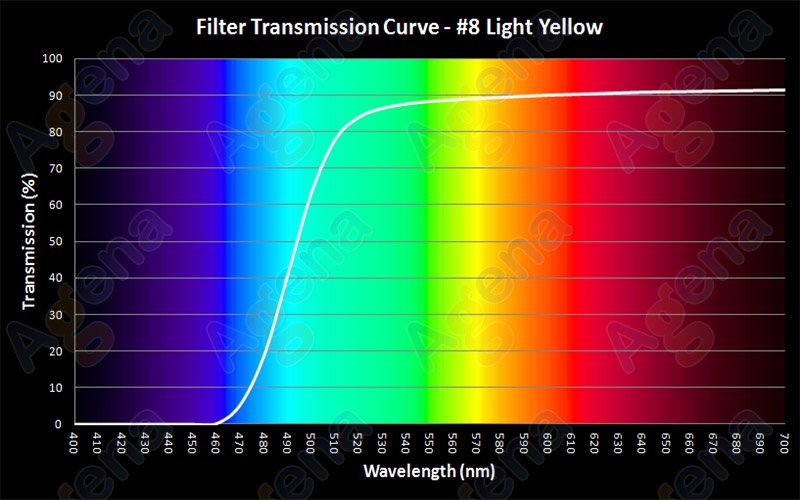
The Light Yellow filter enhances detail of red and orange-colored phenomena in the belts of Jupiter. It increases contrast of the blue-colored Maria on Mars by reducing scattered light from these areas, while allowing passage of more green light thus highlighting yellow dust clouds as well. It provides improved resolution of detail on Uranus and Neptune in large telescopes (over 10"). The light yellow filter is popularly used to enhance lunar features, particularly in small telescopes (below 8"). In comets, it brings out highlights in yellowish dust tails and enhances the coma.
#11 Yellow-Green (40% transmission)

The Yellow-Green color contrasts well with the red and blue characteristics of surface features on Jupiter and, to some degree, Saturn. It darkens the Maria visible on Mars and accentuates the Cassini Division in Saturn's rings. It also improves visual detail on Uranus and Neptune slightly, again in telescopes with 10" or more of aperture.
#12 Yellow (74% transmission)
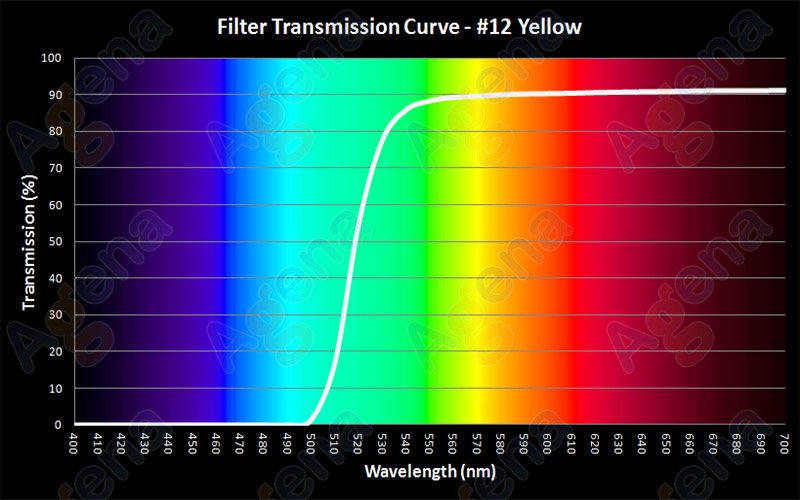
The Yellow Filter increases the contrast of blue and green areas on Mars, thus darkening the Maria, oases and canal markings, while lightening the orange-hued desert regions. It sharpens boundaries of yellow dust clouds and the blue clouds in the Martian atmosphere and is thus a favorite for viewing the red planet.
The yellow filter contrasts strongly with blue-colored features on Jupiter and Saturn, thus enhancing red and orange features of the belts and the zones. It darkens atmospheric currents containing low-hue blue tones and may be used for studies of the polar regions on these planets. Like the other yellow-tinged filters, it improves detail in larger telescopes in Uranus and Neptune while with Venus it reveals otherwise low-contrast features. This filter also enhances definition in comet tails and is useful in increasing the contrast of lunar features in telescopes of 6" aperture and larger.
#15 Dark Yellow/Amber (66% light transmission)
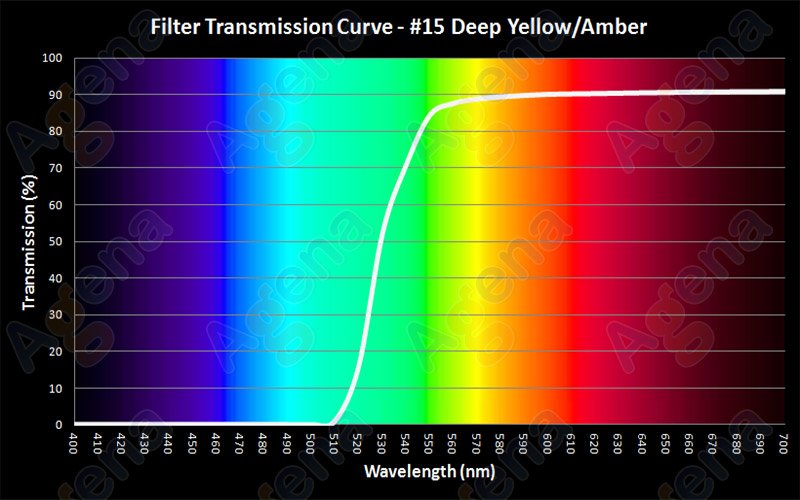
The Dark Yellow filter is used to bring out Martian surface features and the polar ice caps. It darkens Maria, lightens orange-hued desert regions and sharpens boundaries of yellow dust clouds. Used on Jupiter and Saturn, it penetrates and darkens atmospheric currents containing low-hue blue tones and is useful for polar-region studies. It can also be used to enhance the orange and red features (bands and festoons) on these planets and for low-contrast cloud detail on Venus. For Uranus and Neptune the filter improves detail in larger telescopes (11" aperture and larger). For comets, it enhances tail definition.
Try it also on lunar surfaces as well as for daylight observation of Venus and Mercury.
#21 Orange (46% transmission)

The #21 Orange Filter reduces or blocks transmission of blue and green wavelengths. It sharpens boundaries between yellow-orange areas and blue-green regions on Mars, resulting in a darkening of edge-detail in the Maria. Use it on Jupiter and Saturn to sharpen contrast and enhance detail in the belts and polar regions and to bring out the Great Red Spot. The filter also enhances viewing of festoons and polar regions. It will also slightly increase surface details on Saturn, particularly highlighting the bands and blue polar regions. This one behaves very similarly to the #15 but gives slightly more contrast.
The filter greatly enhances lunar features. It can be used to reduce sky brightness during daytime observations to improve viewing of Venus and to reveal surface features on Mercury. When used on comets in large telescopes, the orange filter enhances definition of dust tails and comet-heads.
#23A Light Red (25% transmission)

The Light Red Filter is another great filter for use on Mars, Jupiter, and Saturn, but because of lowered light transmission, it may not perform well for 6"; and smaller telescopes. It carries out many of the same functions as the #21 and the #15, but with more contrast, bringing out marginally defined blue-green surface detail.
The filter is ideal for viewing the polar ice caps and surface features of Mars. It brings out yellow dust clouds and darkens Maria, oases and canal markings. On Jupiter and Saturn, this filter is useful for studying blue clouds.
The filter also increases contrast between Mercury and the bright blue sky during daylight observations or during twilight, when the planet is near the horizon. On Venus, it occasionally reveals deformations of the terminator. For comets the filter improves definition of the dust tail.
#25 Red (14% transmission)

The #25A Red filter strongly blocks blue and green wavelengths, resulting in very sharply defined contrast between the blue-tinted cloud formations and the lighter-toned surface features on Jupiter. This filter is also quite useful for definition of the Martian polar ice caps and Maria. However, because of the reduced light transmission, the #25A can only be used on larger telescopes with over 8" of aperture. Try this one on Venus. Not only does it reduce the light glare, it really does some interesting things to the clouded Venusian atmosphere.
Like the light red, this filter enables observations of Mercury at twilight when the planet is near the horizon, and of Venus during daylight, reducing brightness of the blue sky to enhance surface features of the planets.
#29 Dark Red (6% transmission)
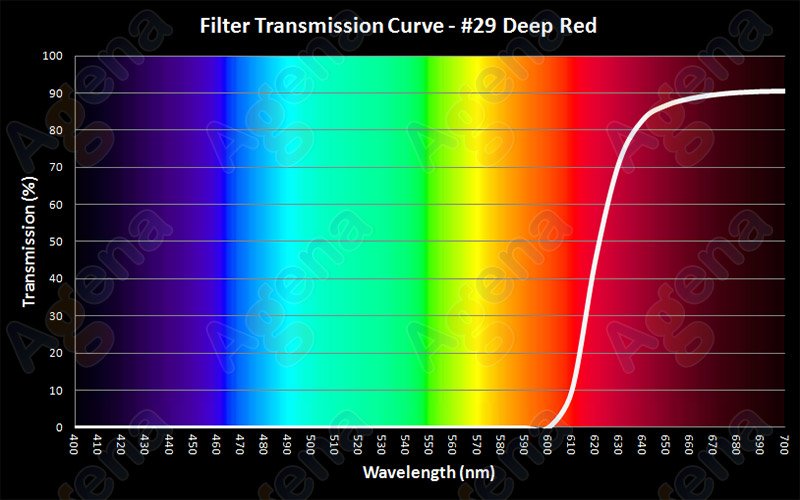
The #29 Dark/Deep Red filter functions much like the #25 Red, helping with daylight observation of Mercury and Venus (particularly the Venusian Terminator), the Martian Maria and polar caps, Jovian Belts and for Saturn's clouds. It has also been reported to be handy for observing the transits of Jupiter's moons across its disk. However, because of the reduced light transmission, the #29 can only be used on larger telescopes with over 8"-10" of aperture.
#38A Dark Blue (17% transmission)

The #38A Dark Blue Filter is a popular choice for the study of Jupiter's disc because it strongly rejects red and orange wavelengths in the belts, thus enhancing the boundaries between the reddish belts and the adjacent bright zones. It is useful for viewing the Great Red Spot. The filter works well on Martian surface phenomena like dust storms, and is very useful during the violet clearing and for polar caps.
The dark Blue filter also increases the contrast in the rings of Saturn and in low-contrast features between the zones. This is a good one to use on Venus, the low transmission increasing the contrast of dark shadings in the upper clouds. The #38A should only be used on telescopes of 8" of aperture or more, because of the reduced light transmission.
This filter is the best one to bring out the gas tails in comets.
#47 Violet (3% transmission)
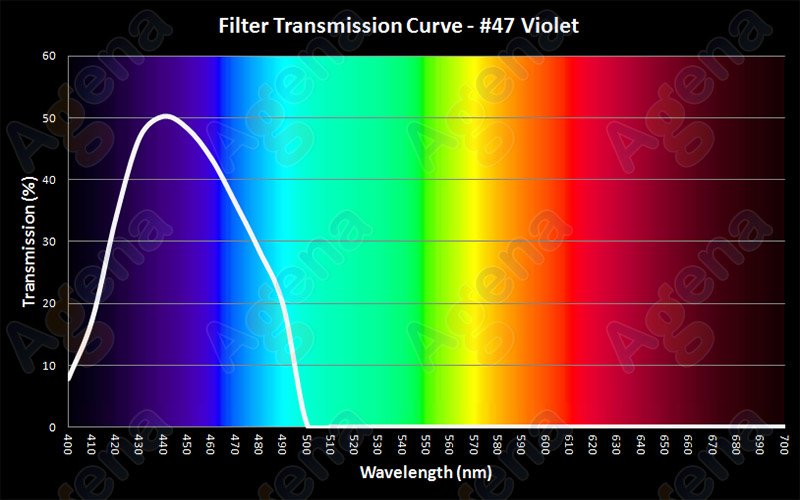
The Violet Filter stops red, yellow, and green colors. It is useful for detecting high clouds and haze in the Martian polar cap regions and during the violet clearing. It is most useful in observing Venus because of its ability to reveal dark shading in the upper atmosphere. It also helps to view the ring-structure of Saturn. The filter is great for enhancing lunar detail too. Its low transmittance makes it suitable only for larger telescopes above 8" of aperture.
#56 Light Green (53% transmission)
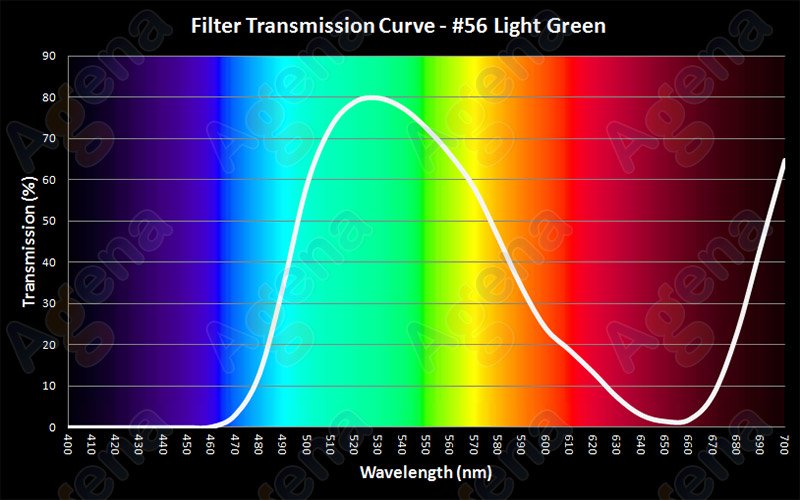
This filter is excellent for the observation of Martian polar ice caps and for the dust storms on the planet's surface, strongly increasing their contrast. It also brings out the red and blue regions such as the Great Red Spot on Jupiter in contrast to the lighter portions. It is useful for observing the low-contrast hues of blue and red in the Jovian atmosphere. The filter enhances Saturn's cloud belts and polar regions and increases contrast of cloud patterns on Venus. This filter is good for lunar observing as well. The filter may not yield good results on small telescopes.
#58 Green (24% transmission)

This filter is marvelous for increasing the contrast in Mars' polar ice caps as well as yellow-tinted Martian dust storms. It also does a reasonable job of increasing the contrast of cloud patterns on Venus. This filter strongly rejects red and blue wavelengths and increases the contrast of these regions in Jupiter's atmosphere as well as in the cloud belts. It can also enhance the white portions of Saturn's cloud belts and polar regions. The green filter is useful for enhancing lunar detail. It also reduces blue-sky brightness here on Earth. This filter should be used only on large (over 8") scopes.
#80A Blue (29% transmission)
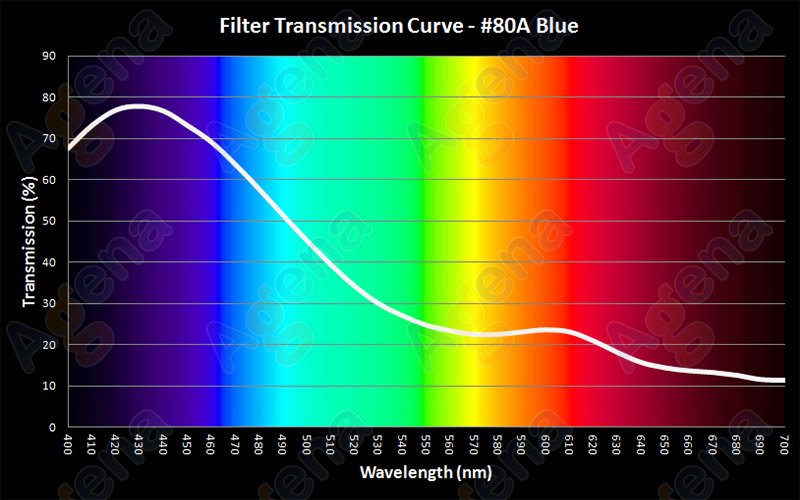
The Blue Filter is one of the most commonly used filters amongst the entire spectrum of filters. It is perhaps the best filter for the study of detail on Jupiter and Saturn. It enhances the contrast of rills and festoons in Jupiter's cloud belts, as well as details of the Great Red Spot. It brings out detail in Saturn's belts and polar features. The filter is very useful on Mars - showing the high clouds and ice caps, and is especially useful during the violet clearing.
When used on Mercury around twilight, it improves the surface markings, whereas for Venus it shows dark shadings in the upper clouds. You can even use it on double stars - try it on Antares, for example. It is also a very useful filter for the Moon. The blue filter also brings out gas tails of comets.
#82A Light Blue (73% transmission)
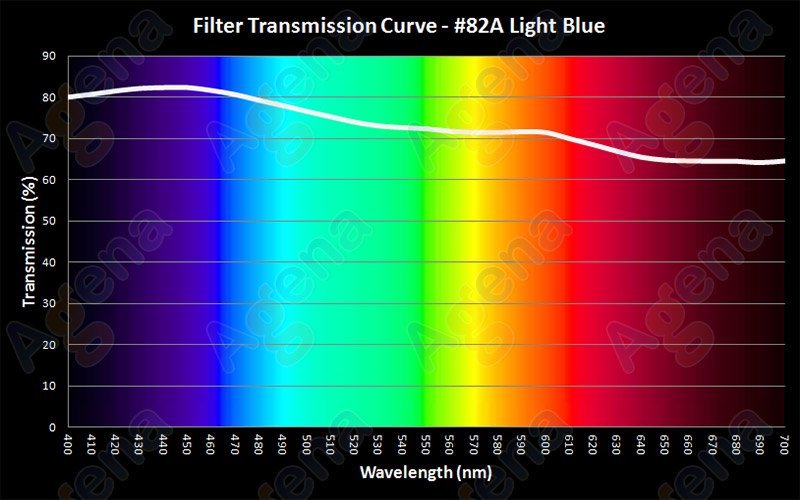
The #82A Light Blue enhances areas of low contrast while avoiding reduction of the overall brightness at the same time. It thus rivals the #80A Blue in popularity, being useful on the Moon, Mars, Jupiter, and Saturn. On the Moon it brings out surface detail; on Mars it is very useful during the violet clearing for studying the polar caps and the surface, while on Jupiter and Saturn it emphasizes the transitions between the various belts. Its use on Mercury and Venus gives results similar to #80A.
It has even been reported useful for bright galaxies, particularly face-on spirals such as the M51. The galactic structure, such as detail in the spiral arms, is more pronounced with the filter. Also, try this one to split binaries. It also enables viewing of cometary gas tails. The light blue filter is also a useful filter to stack along with other filters.


About the Author
Manish Panjwani has been an active amateur astronomer since before Halley's Comet last flew by our neighborhood. A former wireless communications consulting engineer and management consultant to various Fortune 500 companies, Manish started Agena AstroProducts in 2003. Since then, Agena has become one of the leading online retailers of telescopes and astronomical accessories worldwide. Besides observing from his heavily light polluted backyard in Los Angeles, Manish enjoys conducting astronomy outreach programs in local schools. Manish holds a Master's degree in Electrical Engineering from Virginia Tech and an MBA from the Kellogg School of Management at Northwestern University.
Article copyright Agena AstroProducts, 2006. Reproduction without permission prohibited.
I do a mentor program for our RASC Winnipeg chapter in the beginner and intermediate observer's groups.
I will counter your current astro filter for planetary article by stating that since engaging in astronomy over 45 years ago, I have been very frustrated with the old think on the astro filters, to be honest, and have NO idea WHY this is still going on.
The Wratten filters were originally used for monochrome photography - when applied to planets these made sense, because the "tricolor" and enhanced black and white films used back in the mid 20th century needed enhancing. Then scroll to around the mid-60s. Wratten filters were the only thing available at that time, and folks promoted their use as you have above. However, smaller apertures do NOT truly benefit at all from their use, because they throw a lot of light away. I know you mention this in the segments, but many astro kits still come with packaged generic Wratten filters that are actually nearly useless unless one enjoys a Red or Blue ball.
Something you may wish to look into is alternates: Of course today, Mars filters can be found form Televue, and a few other companies. When the 2003 Mars apparition happened I tried just about everything. I was using a 4" f/6.9 scope at that time. We were lucky in Edmonton AB Canada that year, since that summer, seeing was exceptional over almost the entire season from April to August. What I found was that the BEST two filters for Mars were an FL-D (fluorescent daylight) filter (Mauve tint, ~15-20% minus green) was THE best filter on Mars, and works wonders in small aperture scopes at high powers even on other planets like Jupiter and Saturn. Greens are the least useful colors for those - red and blue are as can be also seen in your chart for the most part. A minus green filter actually permits concurrent details to be seen better than requiring a fixed color filter. Imagine seeing orographic cloud and subtle tints on Maria at the same time, all the while seeing a hint of dust storms coming up! That is what I am talking about. Unfortunately the FL-D and FL-W (for larger apertures) are film filters and require 46mm or 48mm formats, the 46mm is more available and use of a step down ring is needed for the smaller 46mm format onto a 2" accessory, so it may not be possible for the 1.25" format scopes still available today, unless one puts it on a diagonal reducer or the diagonal if equipped with 48mm astro threads.
The other more easily accessible filter is Baader Neodymium filter - these are also extremely good on planets, esp. Mars and Jupiter, though I usually reserve it for Mars.
Anyway, the bottom line is that I think it timely to put the Wrattens to pasture. They aren't great for digital much these days either for the most part, and except maybe the red #23, or 25 if one wants a low pass for NIR imaging.
Many of the astro filters are float glass and aren't ideal for anything but the cell (for spacers). The better multi-layered dielectrics like the TV bandmates and Baader contrast enhancing types are far superior both optically and in function to the old useless colored ones. I wish we would all just get rid of those things! BTW, even an 81B or 82B is good for warm tones on Jove in near dusk - no one even mentions those, but again, these are film and lens (larger) filters, and unless someone suggests to the manufacturers to stop making these, it'll never happen and my grandkids when my age will still see this in the info propagated ad nauseum in the future. You should have someone do a test and then evaluate this yourselves. I know that is asking a lot, but offering filter advice for planetary is not a good idea if it never changes... There ARE better choices today.
Having said all of this, I'd like to say in general, Agena is my first stop for many of my astronomy needs - you guys do a superb job all around and carry a lot of great products. I send many our newer members to you since they would not know about you unless I mentioned it. Glad to have you supplying great stuff and providing excellent service!
Cheers, be well and safe during this final phase of Covid…
D.Hennig, M.Sc.