

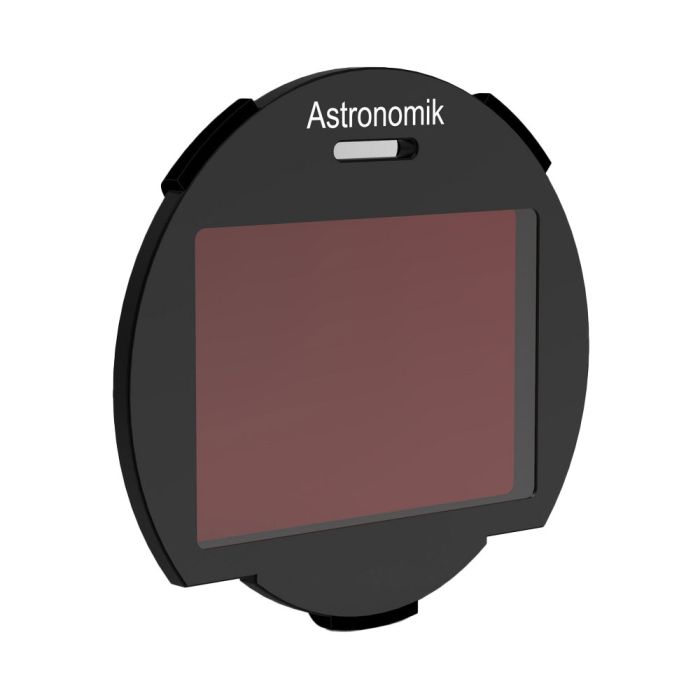
Astronomik H-Alpha 12nm Imaging Filter - Canon EOS R XL Clip Filter
Stock count is accurate & shown in real time.
- This item is out of stock.
- Sign up for back-in-stock alerts to be notified when this item becomes available (account login required).
- This item is out of stock.
- Sign up for back-in-stock alerts to be notified when this item becomes available (account login required).
Contiguous US / Lower 48:
Free shipping applies to orders over $50 using our chosen carrier/method. Faster paid options are available at checkout.
Alaska, Hawaii & US Territories:
Free shipping applies to many—but not all—products. Enter your ZIP code in cart or upon checkout to confirm options and costs.
International:
International orders do not qualify for free shipping. Shipping, duties, brokerage, tariffs, and taxes are the customer’s responsibility. Some items may be restricted due to export, size, or manufacturer limitations.
The Astronomik H-alpha filter is ideal for imaging hydrogen nebulae from both light-polluted and dark observation sites. It significantly enhances the contrast between objects emitting light at 656nm (H-alpha line) and the sky background. The Astronomik H-alpha filter completely filters out the emission lines from high- and low-pressure sodium (Na)- and mercury (Hg)-vapor lamps, as well as all lines of natural airglow and most of the distracting moonlight.
With a narrow bandwidth of either 12nm or 6nm and high transmission rates, the filter effectively blocks all unwanted light from wavelengths other than 656nm from ultraviolet (UV) to infrared (IR).
The Astronomik H-alpha filter MUST NOT BE USED for solar observation!
Difference between Astronomik 12nm and 6nm filters
The choice between 12nm and 6nm Full-Width-Half-Maximum (FWHM) filters depends on your imaging conditions and camera type. There is no universal "best" option - each FWHM serves a specific purpose.
The 12nm Astronomik Narrowband-Emissionline filters are better suited for use with typical DSLR cameras with CMOS sensors and CCD cameras with normal or high dark current or if you are observing from suburban or dark-sky locations. They are also the preferred choice for cameras with an integrated or dual guiding sensor, as they generally show more guiding stars compared to the 6nm filter.
In areas with little light pollution, the background signal in images is usually limited by the sensor's dark current rather than light pollution. Therefore, further suppression of the sky background by reduction of the FWHM does not bring out more details in the object.
Difference between Astronomik MFR and MaxFR coating
Both the Astronomik MFR and MaxFR coatings give you the best out-of-band blocking over the entire wavelength range from UV to IR, extremely high contrast, minimized stray light, no halos and needle-sharp stars.
- 12nm MFR-coated filters can be used in all instruments with aperture ratios from f/3 to f/? without significant performance loss.
Clip-Filters for mirrorless Canon EOS R cameras
Since 2007 we offer our extremely popular Astronomik Clip-Filters. The complete range of Astronomik filters is available as Clip-Filters for the mirrorless Canon EOS R camera series.
The Astronomik Clip-Filters offer a number of practical advantages that make them an ideal choice for astrophotographers:
- Installing and removing the Astronomik Clip-Filter is very quick and easy and requires no extra tools or modifications to the camera body. They can be changed at any time, even at night.
- All lens functions, such as focus, aperture, and image stabilization remain fully functional.
- The Astronomik Clip-Filters are held securely in place without stressing the high-quality glass.
- The Astronomik Clip-Filters are designed and optimized for use with both standard camera lenses and telescopes.
Through the Astronomik Clip-Filters, we were able to solve several common issues faced by astrophotographers:
- Large filters for large camera lenses are very expensive.
- Using a filter holder between the camera body and the lens prevents focusing to infinity.
- For very fast telescopes (low f-number) like the Vixen R200SS or the Takahashi "Epsilon" astrograph, a filter drawer or filter wheel cannot be used because the distance to the corrector lenses would be changed.
- Long exposure times lead to dust settling on the camera's sensor chip.
Additionally, all Astronomik EOS R XL Clip-Filters serve as an excellent dust shield, protecting the sensor during long exposures. If you only need a dust shield without filtering effects, the Astronomik MC-Clear EOS R XL Clip-Filter is the right choice.
Use Astronomik filters for your Canon EOS R camera and enjoy marvelous images with an ultra-light equipment!
Compatible Canon EOS full-frame cameras
| Model | Compatibility |
|---|---|
| Canon EOS R | Yes |
| Canon EOS Ra | Yes* |
| Canon EOS RP | Yes |
| Canon EOS R3 | Yes |
| Canon EOS R5 | Yes |
| Canon EOS R5 Mark II | Yes |
| Canon EOS R6 | Yes |
| Canon EOS R6 Mark II | Yes |
| Canon EOS R8 | Yes |
* Please note: Canon's astro-version "Ra" of the R-series shows strong halos around brighter stars, even without any filter. We highly recommend NOT purchasing the Canon EOS Ra.
Compatible Canon EOS APS-C cameras
| Model | Compatibility |
|---|---|
| Canon EOS R7 | Yes |
| Canon EOS R10 | Yes |
| Canon EOS R50 | Yes |
| Canon EOS R100 | Yes |
Non-compatible Canon lenses
| Model | Compatibility |
|---|---|
| Canon RF 35mm F1.8 IS Macro STM | No |
| Canon RF 85mm F1.2L USM | No |
| Canon Extender RF 2x | No |
| Canon Extender RF 1.4x | No |
Technical Data
- Guaranteed transmission of more than 90% at the H-alpha line (656nm)
- Typical transmission of 96% at the H-alpha line
- Glass thickness: 1mm (except Astronomik OWB Type 3 and XT filters)
- Finely polished optical glass, free of any striae, residual stresses, and bubbles
- Extremely scratch-resistant and durable coating
- Completely resistant against high humidity and aging effects
- Astronomik MFR coating (Astronomik Deep-Sky RGB, UV-IR Block L-1, L-2, L-3, and Narrowband-Emissionline filters)
- Parfocal with other Astronomik filters
- Diffraction-limited
- Optimized spectral windows
- Delivered in a high-quality, long-lasting filter box
Due to the high-precision machining of the carrier substrate, all Astronomik filters are parfocal with wedge errors far below all common tolerances. Astronomik filters are diffraction-limited, ensuring that the optical performance (resolution and contrast) of your telescope is not compromised. Issues concerning focal distances and the exact alignment of images from each color channel are therefore effectively eliminated.
All Astronomik filters are ideal for modern cameras, including both CMOS- and CCD-based models, ensuring you capture the best possible images with your equipment. Sharpness, contrast, and the absence of any reflections and halos are guaranteed. Even with bright stars in the field of view, nebulae and galaxies will be captured with the finest structures. The Astronomik MFR coating is designed for optimal performance across a wide range of focal ratios of the optics used.
Every Astronomik filter undergoes a rigorous quality control process before delivery. Additionally, each Astronomik Narrowband-Emissionline filter is measured using a high-end PerkinElmer Spectrophotometer to ensure it meets the specifications published on our website. On the back of each Narrowband-Emissionline filter box, you will find a label detailing the precise spectral data for that specific filter, including the maximum transmission and the recommended range of focal ratios.
Other Information
- Country of Manufacture: Germany
The Astronomik H-alpha filter is ideal for imaging hydrogen nebulae from both light-polluted and dark observation sites. It significantly enhances the contrast between objects emitting light at 656nm (H-alpha line) and the sky background. The Astronomik H-alpha filter completely filters out the emission lines from high- and low-pressure sodium (Na)- and mercury (Hg)-vapor lamps, as well as all lines of natural airglow and most of the distracting moonlight.
With a narrow bandwidth of either 12nm or 6nm and high transmission rates, the filter effectively blocks all unwanted light from wavelengths other than 656nm from ultraviolet (UV) to infrared (IR).
The Astronomik H-alpha filter MUST NOT BE USED for solar observation!
Difference between Astronomik 12nm and 6nm filters
The choice between 12nm and 6nm Full-Width-Half-Maximum (FWHM) filters depends on your imaging conditions and camera type. There is no universal "best" option - each FWHM serves a specific purpose.
The 12nm Astronomik Narrowband-Emissionline filters are better suited for use with typical DSLR cameras with CMOS sensors and CCD cameras with normal or high dark current or if you are observing from suburban or dark-sky locations. They are also the preferred choice for cameras with an integrated or dual guiding sensor, as they generally show more guiding stars compared to the 6nm filter.
In areas with little light pollution, the background signal in images is usually limited by the sensor's dark current rather than light pollution. Therefore, further suppression of the sky background by reduction of the FWHM does not bring out more details in the object.
Difference between Astronomik MFR and MaxFR coating
Both the Astronomik MFR and MaxFR coatings give you the best out-of-band blocking over the entire wavelength range from UV to IR, extremely high contrast, minimized stray light, no halos and needle-sharp stars.
- 12nm MFR-coated filters can be used in all instruments with aperture ratios from f/3 to f/? without significant performance loss.
Clip-Filters for mirrorless Canon EOS R cameras
Since 2007 we offer our extremely popular Astronomik Clip-Filters. The complete range of Astronomik filters is available as Clip-Filters for the mirrorless Canon EOS R camera series.
The Astronomik Clip-Filters offer a number of practical advantages that make them an ideal choice for astrophotographers:
- Installing and removing the Astronomik Clip-Filter is very quick and easy and requires no extra tools or modifications to the camera body. They can be changed at any time, even at night.
- All lens functions, such as focus, aperture, and image stabilization remain fully functional.
- The Astronomik Clip-Filters are held securely in place without stressing the high-quality glass.
- The Astronomik Clip-Filters are designed and optimized for use with both standard camera lenses and telescopes.
Through the Astronomik Clip-Filters, we were able to solve several common issues faced by astrophotographers:
- Large filters for large camera lenses are very expensive.
- Using a filter holder between the camera body and the lens prevents focusing to infinity.
- For very fast telescopes (low f-number) like the Vixen R200SS or the Takahashi "Epsilon" astrograph, a filter drawer or filter wheel cannot be used because the distance to the corrector lenses would be changed.
- Long exposure times lead to dust settling on the camera's sensor chip.
Additionally, all Astronomik EOS R XL Clip-Filters serve as an excellent dust shield, protecting the sensor during long exposures. If you only need a dust shield without filtering effects, the Astronomik MC-Clear EOS R XL Clip-Filter is the right choice.
Use Astronomik filters for your Canon EOS R camera and enjoy marvelous images with an ultra-light equipment!
Compatible Canon EOS full-frame cameras
| Model | Compatibility |
|---|---|
| Canon EOS R | Yes |
| Canon EOS Ra | Yes* |
| Canon EOS RP | Yes |
| Canon EOS R3 | Yes |
| Canon EOS R5 | Yes |
| Canon EOS R5 Mark II | Yes |
| Canon EOS R6 | Yes |
| Canon EOS R6 Mark II | Yes |
| Canon EOS R8 | Yes |
* Please note: Canon's astro-version "Ra" of the R-series shows strong halos around brighter stars, even without any filter. We highly recommend NOT purchasing the Canon EOS Ra.
Compatible Canon EOS APS-C cameras
| Model | Compatibility |
|---|---|
| Canon EOS R7 | Yes |
| Canon EOS R10 | Yes |
| Canon EOS R50 | Yes |
| Canon EOS R100 | Yes |
Non-compatible Canon lenses
| Model | Compatibility |
|---|---|
| Canon RF 35mm F1.8 IS Macro STM | No |
| Canon RF 85mm F1.2L USM | No |
| Canon Extender RF 2x | No |
| Canon Extender RF 1.4x | No |
Technical Data
- Guaranteed transmission of more than 90% at the H-alpha line (656nm)
- Typical transmission of 96% at the H-alpha line
- Glass thickness: 1mm (except Astronomik OWB Type 3 and XT filters)
- Finely polished optical glass, free of any striae, residual stresses, and bubbles
- Extremely scratch-resistant and durable coating
- Completely resistant against high humidity and aging effects
- Astronomik MFR coating (Astronomik Deep-Sky RGB, UV-IR Block L-1, L-2, L-3, and Narrowband-Emissionline filters)
- Parfocal with other Astronomik filters
- Diffraction-limited
- Optimized spectral windows
- Delivered in a high-quality, long-lasting filter box
Due to the high-precision machining of the carrier substrate, all Astronomik filters are parfocal with wedge errors far below all common tolerances. Astronomik filters are diffraction-limited, ensuring that the optical performance (resolution and contrast) of your telescope is not compromised. Issues concerning focal distances and the exact alignment of images from each color channel are therefore effectively eliminated.
All Astronomik filters are ideal for modern cameras, including both CMOS- and CCD-based models, ensuring you capture the best possible images with your equipment. Sharpness, contrast, and the absence of any reflections and halos are guaranteed. Even with bright stars in the field of view, nebulae and galaxies will be captured with the finest structures. The Astronomik MFR coating is designed for optimal performance across a wide range of focal ratios of the optics used.
Every Astronomik filter undergoes a rigorous quality control process before delivery. Additionally, each Astronomik Narrowband-Emissionline filter is measured using a high-end PerkinElmer Spectrophotometer to ensure it meets the specifications published on our website. On the back of each Narrowband-Emissionline filter box, you will find a label detailing the precise spectral data for that specific filter, including the maximum transmission and the recommended range of focal ratios.
The Astronomik H-alpha filter is ideal for imaging hydrogen nebulae from both light-polluted and dark observation sites. It significantly enhances the contrast between objects emitting light at 656nm (H-alpha line) and the sky background. The Astronomik H-alpha filter completely filters out the emission lines from high- and low-pressure sodium (Na)- and mercury (Hg)-vapor lamps, as well as all lines of natural airglow and most of the distracting moonlight.
With a narrow bandwidth of either 12nm or 6nm and high transmission rates, the filter effectively blocks all unwanted light from wavelengths other than 656nm from ultraviolet (UV) to infrared (IR).
The Astronomik H-alpha filter MUST NOT BE USED for solar observation!
Difference between Astronomik 12nm and 6nm filters
The choice between 12nm and 6nm Full-Width-Half-Maximum (FWHM) filters depends on your imaging conditions and camera type. There is no universal "best" option - each FWHM serves a specific purpose.
The 12nm Astronomik Narrowband-Emissionline filters are better suited for use with typical DSLR cameras with CMOS sensors and CCD cameras with normal or high dark current or if you are observing from suburban or dark-sky locations. They are also the preferred choice for cameras with an integrated or dual guiding sensor, as they generally show more guiding stars compared to the 6nm filter.
In areas with little light pollution, the background signal in images is usually limited by the sensor's dark current rather than light pollution. Therefore, further suppression of the sky background by reduction of the FWHM does not bring out more details in the object.
Difference between Astronomik MFR and MaxFR coating
Both the Astronomik MFR and MaxFR coatings give you the best out-of-band blocking over the entire wavelength range from UV to IR, extremely high contrast, minimized stray light, no halos and needle-sharp stars.
- 12nm MFR-coated filters can be used in all instruments with aperture ratios from f/3 to f/? without significant performance loss.
Clip-Filters for mirrorless Canon EOS R cameras
Since 2007 we offer our extremely popular Astronomik Clip-Filters. The complete range of Astronomik filters is available as Clip-Filters for the mirrorless Canon EOS R camera series.
The Astronomik Clip-Filters offer a number of practical advantages that make them an ideal choice for astrophotographers:
- Installing and removing the Astronomik Clip-Filter is very quick and easy and requires no extra tools or modifications to the camera body. They can be changed at any time, even at night.
- All lens functions, such as focus, aperture, and image stabilization remain fully functional.
- The Astronomik Clip-Filters are held securely in place without stressing the high-quality glass.
- The Astronomik Clip-Filters are designed and optimized for use with both standard camera lenses and telescopes.
Through the Astronomik Clip-Filters, we were able to solve several common issues faced by astrophotographers:
- Large filters for large camera lenses are very expensive.
- Using a filter holder between the camera body and the lens prevents focusing to infinity.
- For very fast telescopes (low f-number) like the Vixen R200SS or the Takahashi "Epsilon" astrograph, a filter drawer or filter wheel cannot be used because the distance to the corrector lenses would be changed.
- Long exposure times lead to dust settling on the camera's sensor chip.
Additionally, all Astronomik EOS R XL Clip-Filters serve as an excellent dust shield, protecting the sensor during long exposures. If you only need a dust shield without filtering effects, the Astronomik MC-Clear EOS R XL Clip-Filter is the right choice.
Use Astronomik filters for your Canon EOS R camera and enjoy marvelous images with an ultra-light equipment!
Compatible Canon EOS full-frame cameras
| Model | Compatibility |
|---|---|
| Canon EOS R | Yes |
| Canon EOS Ra | Yes* |
| Canon EOS RP | Yes |
| Canon EOS R3 | Yes |
| Canon EOS R5 | Yes |
| Canon EOS R5 Mark II | Yes |
| Canon EOS R6 | Yes |
| Canon EOS R6 Mark II | Yes |
| Canon EOS R8 | Yes |
* Please note: Canon's astro-version "Ra" of the R-series shows strong halos around brighter stars, even without any filter. We highly recommend NOT purchasing the Canon EOS Ra.
Compatible Canon EOS APS-C cameras
| Model | Compatibility |
|---|---|
| Canon EOS R7 | Yes |
| Canon EOS R10 | Yes |
| Canon EOS R50 | Yes |
| Canon EOS R100 | Yes |
Non-compatible Canon lenses
| Model | Compatibility |
|---|---|
| Canon RF 35mm F1.8 IS Macro STM | No |
| Canon RF 85mm F1.2L USM | No |
| Canon Extender RF 2x | No |
| Canon Extender RF 1.4x | No |
Technical Data
- Guaranteed transmission of more than 90% at the H-alpha line (656nm)
- Typical transmission of 96% at the H-alpha line
- Glass thickness: 1mm (except Astronomik OWB Type 3 and XT filters)
- Finely polished optical glass, free of any striae, residual stresses, and bubbles
- Extremely scratch-resistant and durable coating
- Completely resistant against high humidity and aging effects
- Astronomik MFR coating (Astronomik Deep-Sky RGB, UV-IR Block L-1, L-2, L-3, and Narrowband-Emissionline filters)
- Parfocal with other Astronomik filters
- Diffraction-limited
- Optimized spectral windows
- Delivered in a high-quality, long-lasting filter box
Due to the high-precision machining of the carrier substrate, all Astronomik filters are parfocal with wedge errors far below all common tolerances. Astronomik filters are diffraction-limited, ensuring that the optical performance (resolution and contrast) of your telescope is not compromised. Issues concerning focal distances and the exact alignment of images from each color channel are therefore effectively eliminated.
All Astronomik filters are ideal for modern cameras, including both CMOS- and CCD-based models, ensuring you capture the best possible images with your equipment. Sharpness, contrast, and the absence of any reflections and halos are guaranteed. Even with bright stars in the field of view, nebulae and galaxies will be captured with the finest structures. The Astronomik MFR coating is designed for optimal performance across a wide range of focal ratios of the optics used.
Every Astronomik filter undergoes a rigorous quality control process before delivery. Additionally, each Astronomik Narrowband-Emissionline filter is measured using a high-end PerkinElmer Spectrophotometer to ensure it meets the specifications published on our website. On the back of each Narrowband-Emissionline filter box, you will find a label detailing the precise spectral data for that specific filter, including the maximum transmission and the recommended range of focal ratios.
Other Information
- Country of Manufacture: Germany

Astronomik H-Alpha 12nm Imaging Filter - Canon EOS R XL Clip Filter