

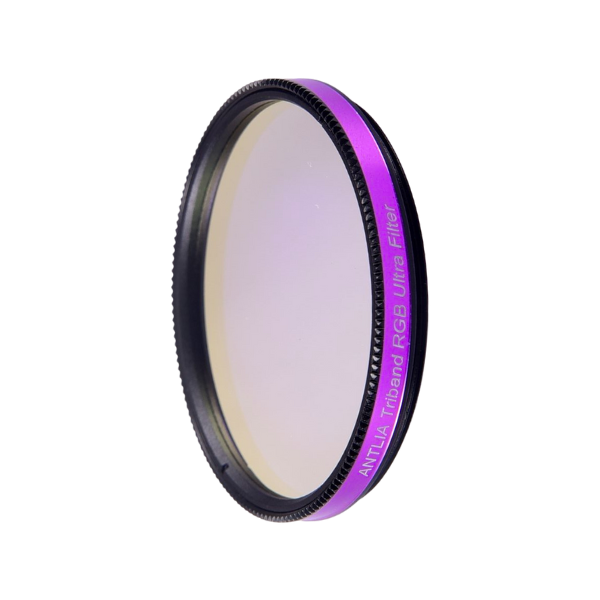


How Astrophotography Filters Work
Filters are essential in astrophotography for capturing detailed and vibrant images of nebulae, planets, and more. They function by allowing only specific wavelengths of light to pass through, blocking unwanted light like light pollution. This enhances contrast, reduces noise, and sharpens images — all great things for astrophotography.
Astrophotography filters are placed in the optical path of a telescope, right in front of your camera’s sensor. You can attach them directly onto your camera using a threaded adapter (generally included with your camera). You can also use a filter wheel or filter drawer for quick filter changes. Filter wheels are best for monochrome cameras, as you need to change filters often.
Types of Astrophotography Filters
Astrophotography filters fall into three main categories:
- Broadband filters: These allow a wide range of light to pass and are ideal for targets like galaxies, star clusters, dark and reflection nebulae. They're best for darker skies, but some are designed to reduce light pollution in brighter environments.
- Narrowband filters: Designed for monochrome cameras, these allow only narrow wavelengths of light, isolating specific emission lines from common gases found in space like hydrogen and oxygen. They are best for photographing emission and planetary nebulae, supernova remnants, and the Sun (with special filters). Narrowband filters work great for light-polluted areas, but can be used anywhere.
- Multiband filters: These filters are essentially narrowband filters designed for color cameras. They target light from two, three or four wavelengths, most commonly hydrogen, sulfur, and oxygen. Triband and Dualband filters fall into this category. They work well with color cameras to add contrast to nebulae while minimizing the effects of light pollution.
Light Pollution Filters
Best for color cameras and people living in urban areas | $-$$
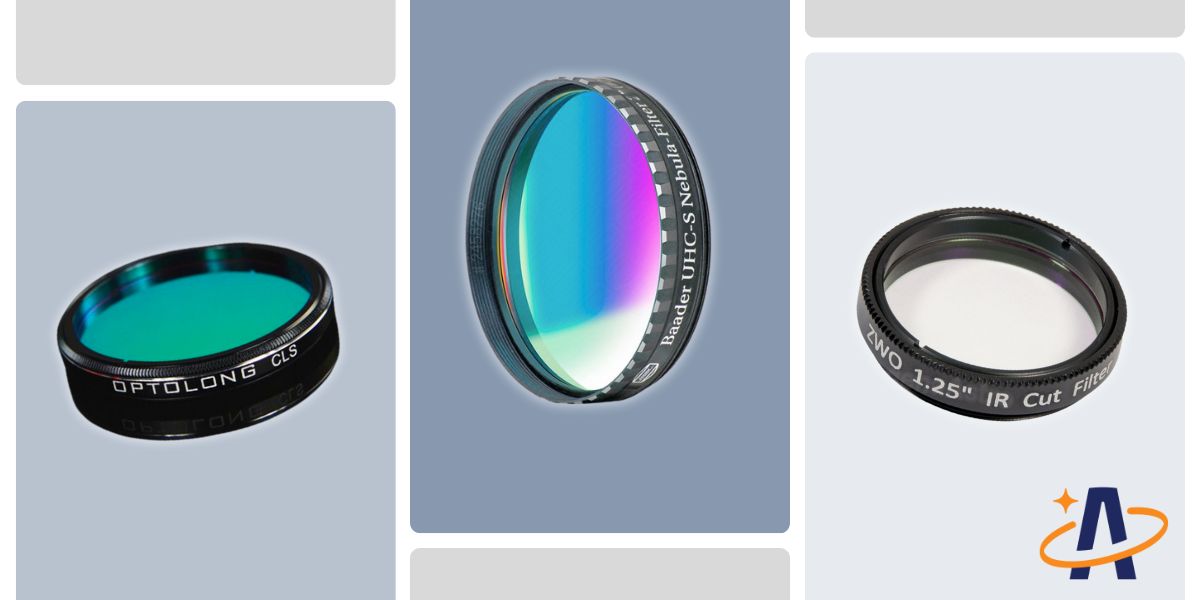

Light pollution filters block artificial light from sources like sodium and mercury vapor streetlights, improving image contrast and clarity. Common types include:
- City Light Suppression (CLS) filters: Block light pollution and work well in urban settings.
- Ultra High Contrast (UHC) filters: More selective than CLS, enhancing contrast in deep-sky objects.
- UV/IR Cut filters: Block ultraviolet and infrared light, preventing chromatic aberration (color fringing on bright objects) and star bloating in refractor telescopes.
Learn more about light pollution filters.
Pros: Improves contrast and sharpness, reduces false colors and overexposure.
Cons: May introduce color casts or alter color balance.
Narrowband Filters
Best for monochrome cameras, imaging during a full moon or in urban areas | $$-$$$
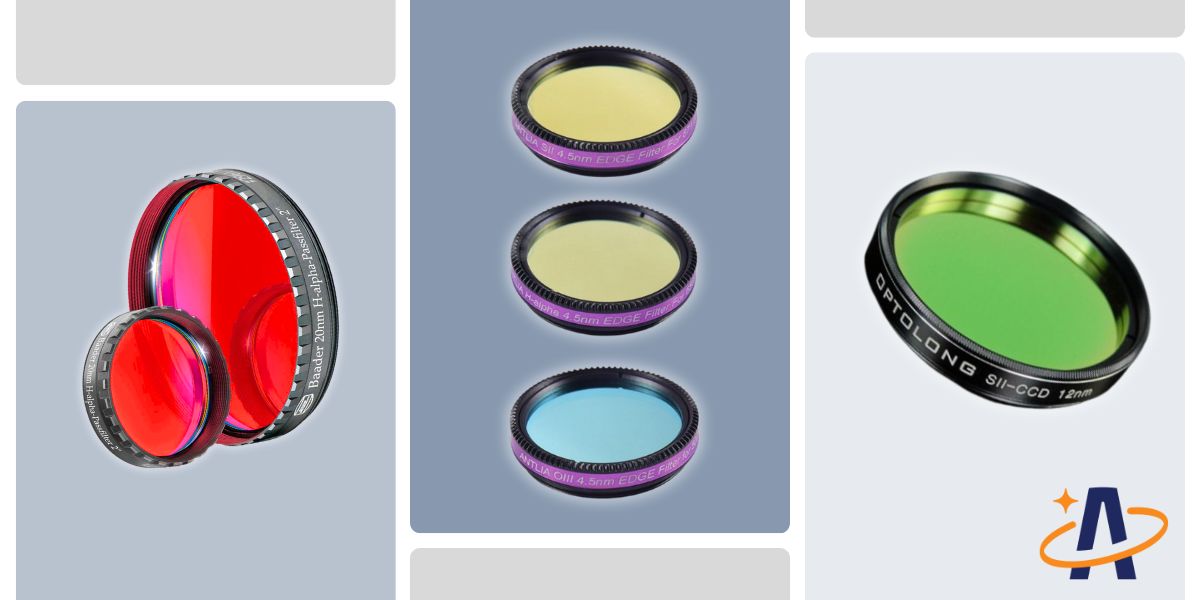

Narrowband filters isolate specific light emissions from nebulae and other deep-sky objects. They excel in heavy light-polluted areas and when imaging during a full moon.
- H-alpha (656.3 nm): Captures hydrogen emissions in nebulae.
- Oxygen-III (500.7 nm): Highlights planetary nebulae and supernova remnants.
- Sulfur-II (672.4 nm): Captures sulfur emissions in nebulae.
Pros: Ideal for light-polluted areas, increases contrast in nebula images.
Cons: Expensive, requires longer exposures, not ideal for broadband targets like galaxies
Planetary Filters
Best for: Achieving detailed images of planets | $-$$


Planetary filters enhance specific details of planets, such as Mars' ice caps or Jupiter's cloud bands. Filters are categorized by the wavelength of light they allow:
- Violet: Great for Saturn's rings and Venus' clouds.
- Dark Blue: Improves detail of Jupiter and Saturn’s cloud bands.
- Yellow-Green: Boosts contrast of the Moon's Maria and Jupiter’s belts.
- Orange: Helps bring out surface detail on Mars, Jupiter, and Saturn’s poles.
- Methane (CH4): Great for imaging gas giants' atmospheres.
Learn more about planetary filters.
Pros: Enhances specific planetary features, reduces atmospheric interference.
Cons: May produce unnatural colors, not versatile across different targets.
Solar Filters
Best for safe viewing and imaging of the Sun | $$-$$$$
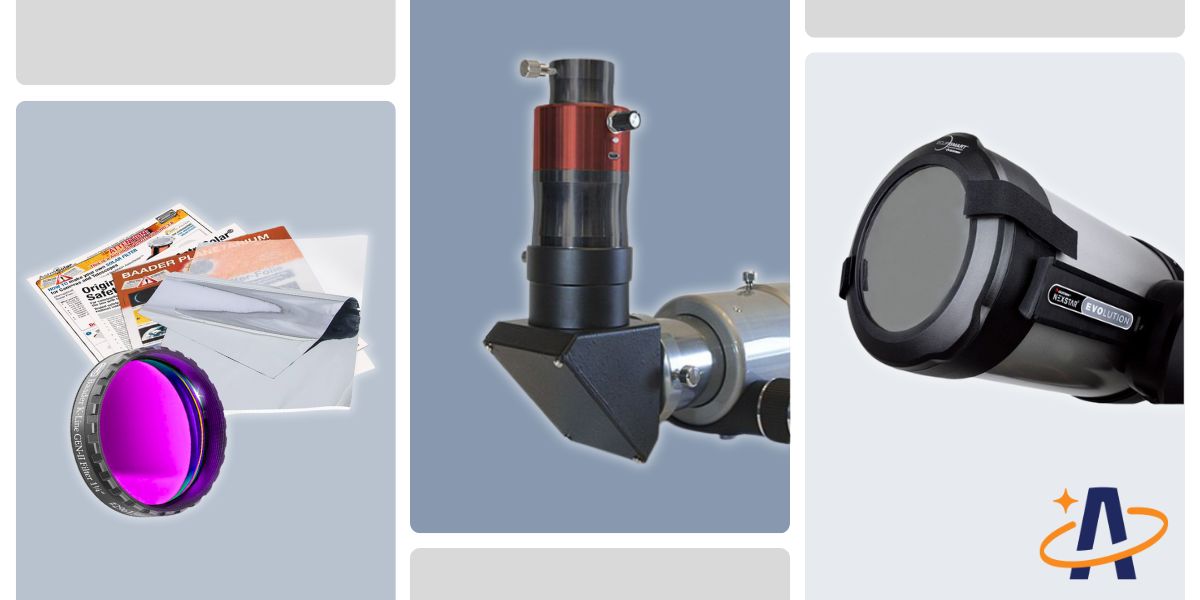
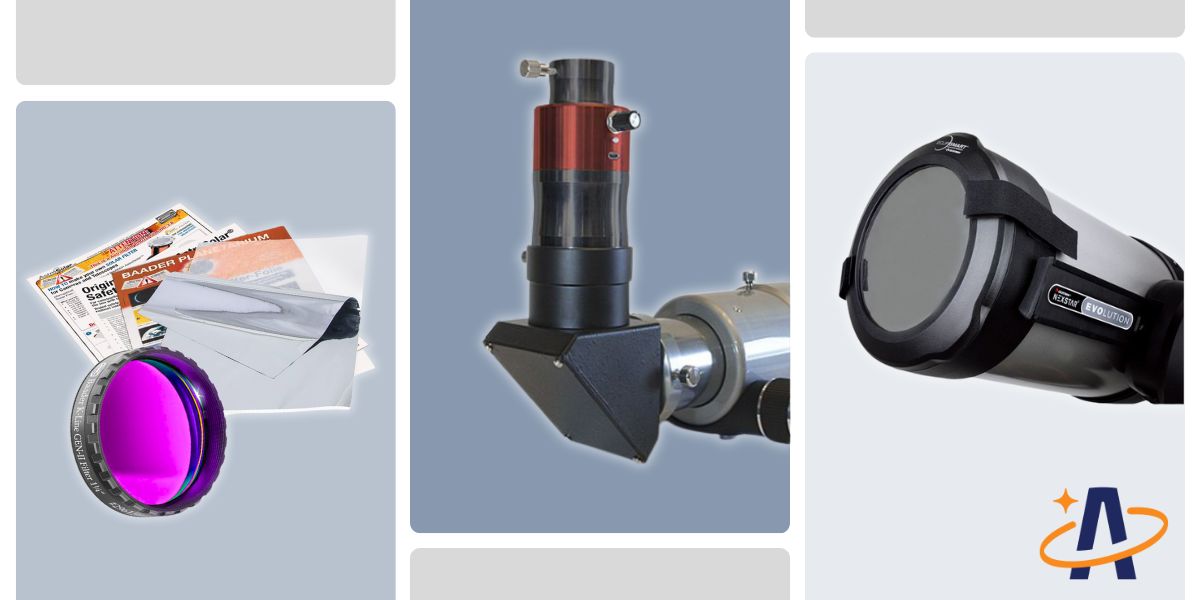
Solar filters protect your equipment while capturing images of the Sun’s surface and solar phenomena.
- White light filters: Block 99.99% of sunlight, allowing detailed images of sunspots.
- Hydrogen-alpha (Ha): Isolate wavelengths emitted by hydrogen, ideal for solar prominences.
- Calcium H and K: Focus on violet light, revealing solar surface features.
Pros: Budget-friendly options available, easy to use.
Cons: Hydrogen-alpha filters are expensive, suitable only for solar imaging.
Filters Wheels & Filter Drawers
Best for monochrome cameras | $-$$$
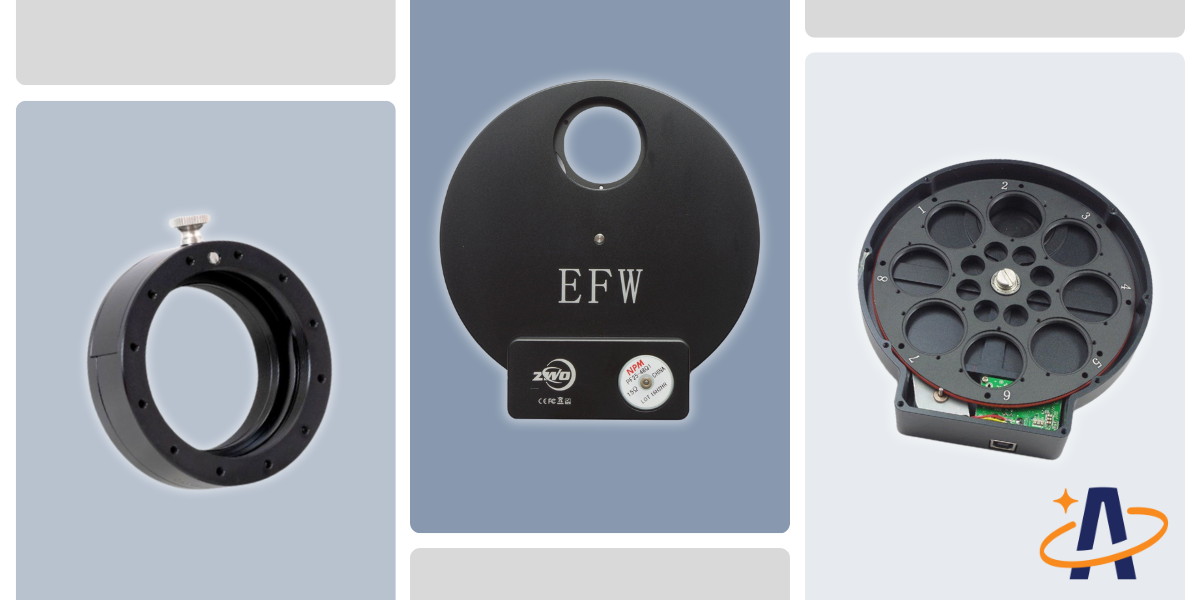
Filter wheels and drawers simplify switching between filters without removing your camera. This is preferred when imaging the same target with different filters.
Filter wheels hold multiple filters and are usually motorized, while filter drawers hold a single filter.
Pros: Quick filter changes without dismounting the camera, which can automate sessions. A filter wheel is essentially a requirement for monochrome camera users.
Cons: Filters can be expensive and add complexity to your setup.
Need help?
Our team is always on standby to help you choose the perfect filter to meet your needs. If you have any questions, or can't find what you’re looking for, contact us.
Frequently Asked Questions
What Filters are Best for Astrophotography?
The best filters depend on what you're trying to capture. Light pollution filters are great for improving contrast in urban areas, while narrowband filters are perfect for capturing specific wavelengths and enhancing nebula details.
What Filters are Best for One-Shot-Color (OSC) Cameras?
Filters for OSC cameras block light pollution, like streetlights, while enhancing contrast and targeting specific wavelengths for detailed nebula images. Here are the main types:
Broadband filters: Include CLS, UV/IR cut, and light pollution filters. These allow a range of light to pass through to your camera’s sensor, while blocking some unwanted wavelengths.
Multiband filters: Allow two to four wavelengths, often focusing on H-alpha and OIII emissions, commonly found in nebulae. They are also known as Triband, Dualband and Quadband filters.
What Filters are Best for Monochrome Cameras?
Monochrome cameras are highly sensitive and capture finer details than OSC cameras. To create color images, you'll need two main filter sets:
- LRGB filters: Capture luminance, red, green, and blue wavelengths for broad-spectrum imaging.
- Narrowband filters: Focus on specific emission lines like H-alpha, SII, and OIII for deep-sky objects.
- Luminance filters: Allow all visible light (400-700nm) while blocking UV and IR light.
- RGB filters: Capture specific color ranges: blue (400-500nm), green (500-600nm), and red (600-700nm).
Astrophotographers often use both sets, combining RGB for stars and narrowband for nebulae.
How Do Astrophotography Filters Work?
Astrophotography filters work by selectively permitting certain wavelengths of light to reach your telescope's sensor, while blocking or reducing others. Each type of filter operates differently and will yield varying results based on the wavelengths it permits to pass through.
Are Neutral Density (ND) Filters Good for Astrophotography?
No, Neutral Density (ND) filters are meant for daytime photography to reduce the Sun’s light intensity. At night, the sky is already dark, so ND filters aren't needed.
Do I Need to use an IR Cut Filter for Astrophotography?
Yes, if your camera doesn’t have a built-in UV/IR filter, an IR cut filter can help reduce star bloating and improve color accuracy.
What is the Difference Between RGB and Narrowband?
RGB filters allow a wide range (about 100nm) of light, like blue filters passing 400-500nm. Narrowband filters are more selective, allowing only 3-12nm of light to pass through, which helps block unwanted light pollution and moonlight.
Which Filter Size is Best for Astrophotography?
Your camera’s sensor determines the filter size. You typically use 1.25" filters for smaller sensors and 2" filters for larger ones. These filters have a threaded metal or plastic outer ring, so you can screw them onto your camera or filter wheel.
You also have 31mm and 36mm filters, which don’t have an outer ring or thread. You can use these with filter wheels, but installing them can be tricky.
What is the Best Filter to Image Galaxies?
Galaxies emit light across a broad spectrum. If you’re using an OSC camera, a broadband filter works best to capture their dynamic range.
For monochrome cameras, you will need to use luminance, red, green, and blue filters to create a full color image. You can even use a H-alpha filter to highlight regions of gas in galaxy arms.
What Filter Works Best for Imaging Comets?
When imaging comets, Comet Filters are particularly useful as they are designed to transmit the green/blue light emitted by fluorescing C2 (acetylene di-radical) in the comet's coma, enhancing the visibility of the gas tail
Another helpful filter is a deep blue filter, which improves the contrast of the comet's tail against the dark sky.
Additionally, UHC-E (or CLS) filters can reduce light pollution, making it easier to capture clearer images of the comet.