

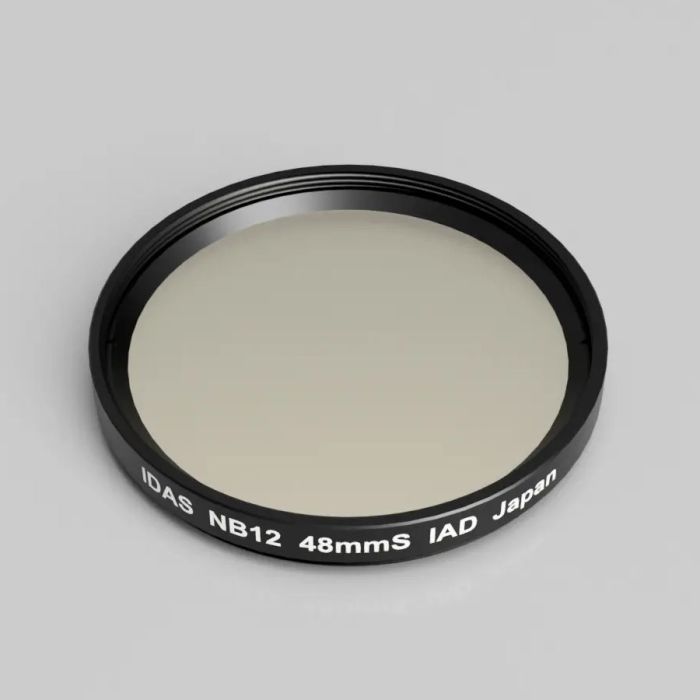
IDAS NB12 12nm H-a & OIII Dual Band High Speed Narrowband Filter - 2" Mounted
This item is discontinued by the manufacturer and is no longer available.
Stock count is accurate & shown in real time.
- This item is out of stock.
- Sign up for back-in-stock alerts to be notified when this item becomes available (account login required).
- This item is out of stock.
- Sign up for back-in-stock alerts to be notified when this item becomes available (account login required).
Closeout - All sales final!
A dual band nebula booster filter that transfers OIII and H-alpha emission lines - the band width of each band is ca. 12nm (+/- 0.4nm). As far as used between the telescope (lens) and the camera, the NB12 can cover the F value of the optical systems ranging from 1.8 to infinity.
This filter MUST be used in combination with an UV/IR cut filter such as IDAS HEUIB-II, LPS-D3 or any other UV/IR cut filter. However, many newer astronomy cameras such as the ZWO ASI2600MC Pro, ASI2400MC Pro, and ASI6200MC Pro have a UV/IR cut filter built in, so a separate filter is not needed.
IDAS NB12 Overview
The NB12 is a dual band nebula booster filter that passes OIII and H-alpha emission lines at a bandpass of 12nm (+/-0.4nm). It is the exact same filter as the well-known IDAS NBZ series filters with the exception that the NB12 lets in UV & IR light. However, many cameras these days (including newer cooled astronomy cameras, stock DSLRs, and mirrorless cameras) already have a UV/IR cut filter built in. This means you can get the same performance of the famed NBZ filter for a fraction of the price.
IDAS NB12 Review
Agena Astro affiliate AstroBlender reviewed the IDAS NB12 in this video review:
Comparing the IDAS NB12 to Other Dual Band Filters
You may have already noticed that the half value band width (12nm) of the NB12 is a little wider than that of competitive narrow band filters claiming the half value band width of 7nm. It should be noted, however, that this wider band width has a great advantage. The transmittance curve of interference filters will naturally shift towards the shorter wave length side against oblique light incidence, and this tendency will be more noticeable as the inncidence angle becomes higher at fast focal ratios.
Some of the competitive 7nm filters will decrease in transmittance by 50% or more when used after the fast optical system (around F2), while the NB12 retains 85% or more of the transmittance under the same conditions. This means that you can shorten the exposure time to 2/3 to a half (and moreover you can gain the same or better contrast) with the use of the NB12 when compared with the competitive 7nm filters.
Coating Technology
The NB12 filter utilizes the IGAD (ion-Gun AssistDeposition) coating technology which has been applied to our regular filters such as the LPS-D3 and NBZ series. The IGAD technology densifies the multi-layers - the heart of interference filters - resulting in the physical properties that cannot be obtained from the conventional multi-layers.
• Highly durable thin layers of which hardness equals to quartz glasses. Tremendously improved adherence between the substrate and the multi-layers set.
• Absolutely almost no aging variation in optical spectral characteristics due to temperature and humidity change as far as used in the regular human living environments.
Other Information
- Country of Manufacture: Japan
IDAS NB12 Overview
The NB12 is a dual band nebula booster filter that passes OIII and H-alpha emission lines at a bandpass of 12nm (+/-0.4nm). It is the exact same filter as the well-known IDAS NBZ series filters with the exception that the NB12 lets in UV & IR light. However, many cameras these days (including newer cooled astronomy cameras, stock DSLRs, and mirrorless cameras) already have a UV/IR cut filter built in. This means you can get the same performance of the famed NBZ filter for a fraction of the price.
IDAS NB12 Review
Agena Astro affiliate AstroBlender reviewed the IDAS NB12 in this video review:
Comparing the IDAS NB12 to Other Dual Band Filters
You may have already noticed that the half value band width (12nm) of the NB12 is a little wider than that of competitive narrow band filters claiming the half value band width of 7nm. It should be noted, however, that this wider band width has a great advantage. The transmittance curve of interference filters will naturally shift towards the shorter wave length side against oblique light incidence, and this tendency will be more noticeable as the inncidence angle becomes higher at fast focal ratios.
Some of the competitive 7nm filters will decrease in transmittance by 50% or more when used after the fast optical system (around F2), while the NB12 retains 85% or more of the transmittance under the same conditions. This means that you can shorten the exposure time to 2/3 to a half (and moreover you can gain the same or better contrast) with the use of the NB12 when compared with the competitive 7nm filters.
Coating Technology
The NB12 filter utilizes the IGAD (ion-Gun AssistDeposition) coating technology which has been applied to our regular filters such as the LPS-D3 and NBZ series. The IGAD technology densifies the multi-layers - the heart of interference filters - resulting in the physical properties that cannot be obtained from the conventional multi-layers.
• Highly durable thin layers of which hardness equals to quartz glasses. Tremendously improved adherence between the substrate and the multi-layers set.
• Absolutely almost no aging variation in optical spectral characteristics due to temperature and humidity change as far as used in the regular human living environments.
Closeout - All sales final!
A dual band nebula booster filter that transfers OIII and H-alpha emission lines - the band width of each band is ca. 12nm (+/- 0.4nm). As far as used between the telescope (lens) and the camera, the NB12 can cover the F value of the optical systems ranging from 1.8 to infinity.
This filter MUST be used in combination with an UV/IR cut filter such as IDAS HEUIB-II, LPS-D3 or any other UV/IR cut filter. However, many newer astronomy cameras such as the ZWO ASI2600MC Pro, ASI2400MC Pro, and ASI6200MC Pro have a UV/IR cut filter built in, so a separate filter is not needed.
IDAS NB12 Overview
The NB12 is a dual band nebula booster filter that passes OIII and H-alpha emission lines at a bandpass of 12nm (+/-0.4nm). It is the exact same filter as the well-known IDAS NBZ series filters with the exception that the NB12 lets in UV & IR light. However, many cameras these days (including newer cooled astronomy cameras, stock DSLRs, and mirrorless cameras) already have a UV/IR cut filter built in. This means you can get the same performance of the famed NBZ filter for a fraction of the price.
IDAS NB12 Review
Agena Astro affiliate AstroBlender reviewed the IDAS NB12 in this video review:
Comparing the IDAS NB12 to Other Dual Band Filters
You may have already noticed that the half value band width (12nm) of the NB12 is a little wider than that of competitive narrow band filters claiming the half value band width of 7nm. It should be noted, however, that this wider band width has a great advantage. The transmittance curve of interference filters will naturally shift towards the shorter wave length side against oblique light incidence, and this tendency will be more noticeable as the inncidence angle becomes higher at fast focal ratios.
Some of the competitive 7nm filters will decrease in transmittance by 50% or more when used after the fast optical system (around F2), while the NB12 retains 85% or more of the transmittance under the same conditions. This means that you can shorten the exposure time to 2/3 to a half (and moreover you can gain the same or better contrast) with the use of the NB12 when compared with the competitive 7nm filters.
Coating Technology
The NB12 filter utilizes the IGAD (ion-Gun AssistDeposition) coating technology which has been applied to our regular filters such as the LPS-D3 and NBZ series. The IGAD technology densifies the multi-layers - the heart of interference filters - resulting in the physical properties that cannot be obtained from the conventional multi-layers.
• Highly durable thin layers of which hardness equals to quartz glasses. Tremendously improved adherence between the substrate and the multi-layers set.
• Absolutely almost no aging variation in optical spectral characteristics due to temperature and humidity change as far as used in the regular human living environments.
Other Information
- Country of Manufacture: Japan