

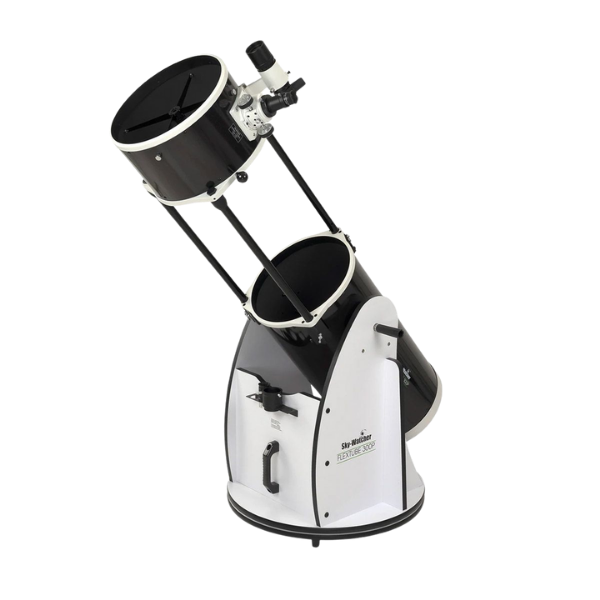
Dobsonian Telescopes: Affordable Powerhouses for Clear, Crisp Night Sky Views
Dobsonian telescopes are an excellent choice for both beginners and experienced stargazers. Thanks to their swiveling base and large aperture, Dobsonian telescopes are easy to use, very affordable, and provide phenomenal visual views. They're particularly suitable for families and are a great first telescope for kids. Even on a budget, you can find quality Dobsonians for under $500.
John Dobson invented the Dobsonian telescope by putting a Newtonian telescope on a simple swivel mount in the 1960s. His invention reshaped amateur astronomy by making large, powerful telescopes accessible to all.
Often seen at star parties, their ease of use and low price points make them a great way to explore the night sky. They provide stunning views of bright nebulae, star clusters, the Moon, and planets. They come in many sizes and varieties. The 8-inch Dobsonian telescope is a popular choice because it collects four times more light than smaller tabletop Dobsonians.
The box often includes eyepieces, allowing you to start stargazing straight away. But, you may wish to buy higher-quality ones to reduce eye strain and provide greater clarity.
Complete your setup by exploring our full range of eyepieces and telescope accessories.
About Dobsonian Telescopes and How They Work
A Dobsonian telescope is a type of reflector telescope mounted on a simple swivel base. It uses a primary mirror at the base to collect light. A secondary mirror directs the light to the eyepiece. As they do not use lenses, Dobsonians are free from color distortion (chromatic aberration).
Their alt-azimuth base allows for up-and-down and side-to-side movement, making it easy to track objects across the sky. With no electronics or motors, setup and use are hassle-free - simply point and observe! However, if you're seeking more automation, you can choose models with motorized tracking and GoTo features. These models will move to the celestial object and keep it centered in view as they move across the night sky.
While Dobsonians excel at visual observing, they're not ideal for deep sky astrophotography. Their alt-azimuth mount can cause field rotation, resulting in blurry images during long exposures. However, Dobsonians can be an excellent, affordable option for solar system imaging of the planets and the Moon when paired with a high frame rate planetary camera.
Dobsonian telescopes come in a variety of shapes and sizes. Some smaller Dobsonians can be used on a table top, making them easy grab-and-go scopes. Many Dobsonian users opt for a larger aperture model, such as 8 inches or more, which is when the views begin to really astound you. Dobsonians do require some light maintenance: you will need to collimate your telescope to maintain proper mirror alignment, especially if you move it often. This process becomes quick and straightforward with practice.
Types of Dobsonian Telescopes
Dobsonian telescopes are available in various styles to cater to different needs, including:
- Traditional or Classic Dobsonian
- Collapsible Dobsonian
- Tabletop Dobsonian
- Truss Tube Dobsonian
- Motorized/GoTo Dobsonian
Read on to learn more about each model.
Classic Dobsonian
Best for visual observing, beginners, and users on a budget | Price: $-$$

Classic Dobsonians are popular for their low cost and ease of use. With common focal lengths between 1,000 mm and 1,500 mm, they'll provide stunning views of the Moon, Andromeda Galaxy, Pleiades, and more.
These telescopes feature a solid tube Newtonian reflector mounted on an alt-azimuth base. They don't have motors or GoTo functionality. This means you'll need to find celestial objects and move the telescope to keep them in view.
Pros: Affordable with large apertures, simple setup, excellent for deep-sky observing.
Cons: Requires manual tracking and collimation. Larger models can be bulkier and less portable. They're not ideal for deep sky astrophotography.
Collapsible Dobsonian
Best for visual observing, beginners, or users with limited space | Price: $-$$

The Collapsible Dobsonian is perfect for stargazers who want the power of a large telescope but also need it to be portable and easy to store. They maintain the high performance of a Classic Dobsonian but feature a collapsible tube, reducing their size by half when not in use. This makes them ideal for those who travel to darker skies or have limited space.
Pros: Portable and compact with excellent image quality.
Cons: More complex to set up compared to solid tube Dobsonians. Not ideal for deep sky astrophotography and needs collimation.
Tabletop Dobsonian
Best for visual observing, kids, beginners, and those with limited space | Price: $-$$
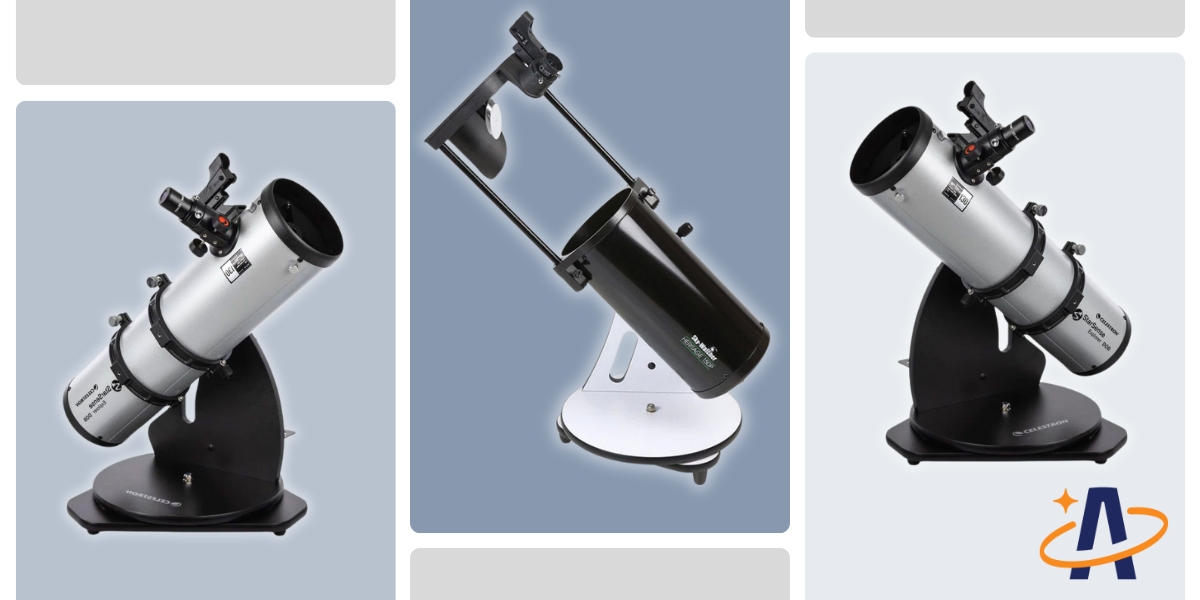
The Tabletop Dobsonian is a compact, beginner-friendly telescope, perfect for kids. Like the Classic Dobsonians, but much smaller, they are great for casual stargazing. Place them on a sturdy surface at the right height, and you’re ready to explore the night sky.
While Tabletop Dobsonians are easier to transport and set up, they don't offer the same performance as larger Dobsonians. Their smaller mirrors mean they gather less light, providing less detailed views of celestial objects. With focal lengths around 400 mm to 600 mm, they are best for observing brighter celestial objects like planets and the Moon.
Despite this, they are a great choice if you're looking for ease-of-use and portability. They are also the most budget-friendly option, with prices starting around $300. Some models let you use your mobile phone's camera to help position the telescope, making it easier to find objects.
Pros: Compact, portable, and perfect for beginners or kids.
Cons: Limited aperture may reduce image clarity on deep-sky objects. Not ideal for deep sky astrophotography and needs collimation.
Truss Tube Dobsonian
Best for experienced visual observers | Price: $$-$$$
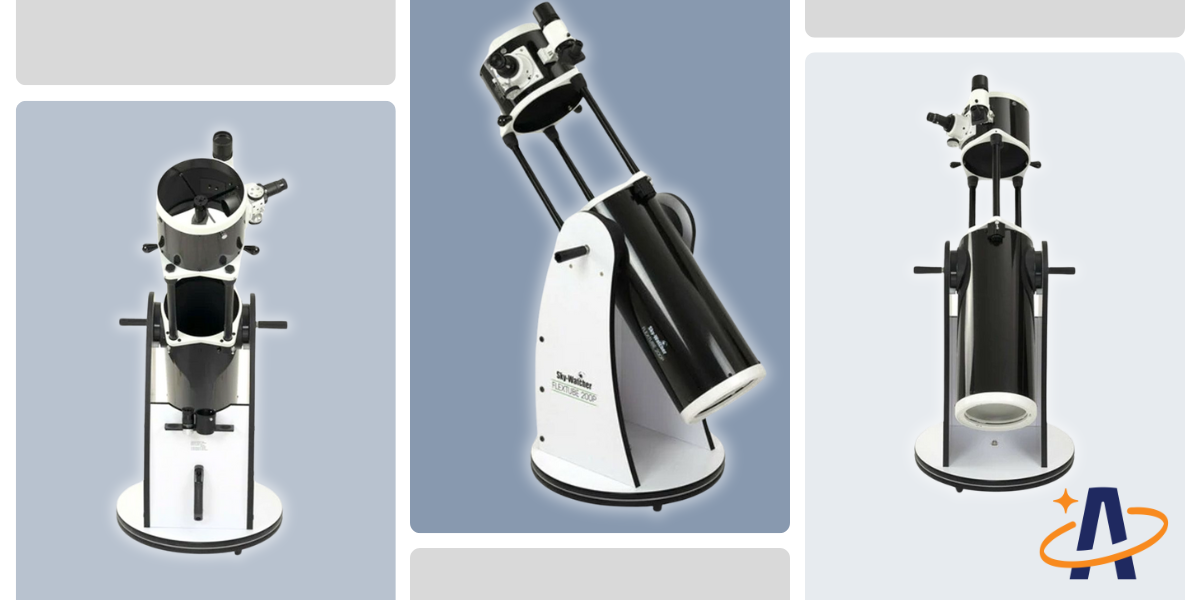
The Truss Tube Dobsonian has an open truss design that reduces weight while maintaining stability. This allows for larger mirrors without the bulk of a solid tube. Many models are collapsible, breaking down into manageable pieces for transport. However, collapsible designs need assembly and may expose mirrors to dust.
An optional light shroud can cover the open truss structure. This improves contrast and clarity, and protects the mirrors. Truss Tube Dobsonians give large-aperture performance in a lightweight form. They're perfect for stargazers on the go.
Pros: Great for deep-sky observation with a large aperture. More portable than solid tube Dobsonians.
Cons: Requires assembly and can be prone to dust. Not ideal for deep sky astrophotography and needs collimation.
Motorized/GoTo Dobsonian
Best for beginners and those seeking automated tracking | Price: $$-$$$

A GoTo motorized Dobsonian is a reflector telescope on a motorized base with a computerized GoTo system. They're perfect for both amateur and experienced astronomers.
One of the biggest benefits is the automatic object location. GoTo systems can find and track celestial objects from a large database or even allow you to input your own coordinates. They keep the object in view as the Earth rotates, making stargazing hassle-free. Just select an object, like the Moon or a distant nebula, and the telescope moves to it.
These telescopes are ideal for families and beginners because of their user-friendly nature. The variety of models, including Truss Tube or Collapsible, ensures portability and easy storage. While they are generally more expensive because of the added technology, the convenience they offer often outweighs the cost.
Setup can be more complex than other models, as you will need to perform an alignment routine. This involves pointing the telescope at a few stars so that it can calculate its position. The alignment process might take time to learn. You will also need a reliable power source to operate the motors and GoTo system.
Despite these drawbacks, GoTo Dobsonians are a fantastic choice for anyone wanting to enjoy the night sky with minimal fuss.
Pros: Ideal for beginners. Access to a large database of celestial objects and automated tracking.
Cons: Higher price point and needs a power source. They're heavier than manual Dobsonians. Needs alignment, which is a small learning curve. Not ideal for deep sky astrophotography and needs collimation.
Whichever telescope you choose, you will receive a powerful instrument at exceptional value. Their simple design delivers beautiful views, making them a top choice for any stargazer and a great telescope for kids. Explore our collection to find the best Dobsonian telescopes to meet your needs.
Need Help?
Our team is always ready to assist you in selecting the perfect Dobsonian to meet your needs. If you have any questions or cannot find what you’re looking for, contact us.
Frequently Asked Questions
What is the best size for a Dobsonian telescope?
Most users find an 8-inch Dobsonian to be a solid choice. Sizes from 6 to 10 inches are effective, depending on your available space, budget, and observing objectives. Common sizes range from 8 to 12 inches, with focal lengths usually between 1,200 mm and 1,500 mm or more. Larger telescopes are better at gathering light for brighter, clearer views, but are less portable.
Are Dobsonian telescopes suitable for observing galaxies?
Yes, Dobsonian telescopes are perfect for viewing galaxies! They're also great for viewing nebulae, and other deep-sky objects under optimal conditions and dark skies.
Can I photograph planets with a Dobsonian telescope?
Yes, you can take basic photographs of planets using a Dobsonian telescope. You will get better results with a motorized/GoTo Dobsonian, as the image will be more stable and you can use a technique called lucky imaging. Lucky imaging involves taking a short video and using software to extract and stack the best frames to make an image.
Are all Dobsonian telescopes tabletop models?
No, Dobsonian telescopes are not limited to tabletop designs. While there are tabletop versions available, larger Dobsonians sit on the ground.
Do Dobsonian telescopes use tripods?
No, Dobsonian telescopes do not use tripods. Instead, they mount on a base, allowing easy movement and stability during observation.
Why does the image appear upside down in my telescope?
The image may appear upside down because of the way lenses or mirrors bend light. This orientation is normal for telescopes and does not affect your stargazing experience. For observing terrestrial objects, such as birds or landscapes, you can use an "erecting prism" to correct the orientation.
Are Dobsonian telescopes suitable for deep-sky astrophotography?
Dobsonian telescopes are not ideal for deep-sky astrophotography. Their alt-azimuth mounts allow basic up-and-down and side-to-side movement. However, they do not track the sky smoothly for long exposures. This can result in "field rotation," causing blurry images during long-exposure photography, especially for distant objects like galaxies and nebulae. A better choice for deep sky astrophotography would be a refractor telescope on an equatorial mount.
Does aperture size matter?
Yes, the aperture refers to the diameter of the telescope's primary lens or mirror. A larger aperture means the telescope can gather more light. This means faint celestial objects, such as distant galaxies, appear brighter and clearer.
Are Dobsonian telescopes collimated upon arrival?
Most Dobsonian telescopes arrive collimated. It is best to double-check collimation before each use, especially after moving or transporting the telescope. Environmental factors, such as temperature changes and vibrations, can affect collimation over time. If you aren’t experienced with collimation, we recommend a 1.25” laser collimator.
Is collimating a Dobsonian telescope difficult?
Collimating a Dobsonian telescope can be challenging for beginners, but it becomes easier with practice. Tools like a laser collimator or a simple collimation cap can simplify the process. Once you become familiar with collimation techniques, the procedure becomes quick and straightforward.
Why are Dobsonian telescopes so popular?
Dobsonian telescopes are popular because of their low cost, ease of use, and minimal maintenance requirements. Their excellent light-gathering capabilities make them ideal for observing faint celestial objects.