

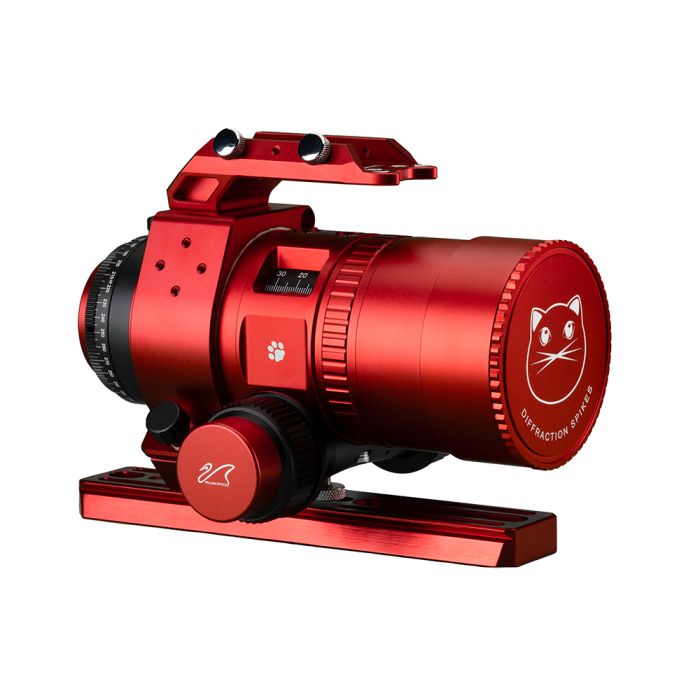
William Optics MiniCat 51 WIFD f/3.5 Petzval Refractor Telescope - Red
Stock count is accurate & shown in real time.
- This item is out of stock.
- Sign up for back-in-stock alerts to be notified when this item becomes available (account login required).
- This item is out of stock.
- Sign up for back-in-stock alerts to be notified when this item becomes available (account login required).
Contiguous US / Lower 48:
Free shipping applies to orders over $50 using our chosen carrier/method. Faster paid options are available at checkout.
Alaska, Hawaii & US Territories:
Free shipping applies to many—but not all—products. Enter your ZIP code in cart or upon checkout to confirm options and costs.
International:
International orders do not qualify for free shipping. Shipping, duties, brokerage, tariffs, and taxes are the customer’s responsibility. Some items may be restricted due to export, size, or manufacturer limitations.
- 51mm aperture, 178mm focal length, f/3.5 focal ratio
- 6-element Petzval design with 2 Super ED and lanthanum lens elements
- No field flattener required
- WIFD internal focuser with EAF compatibility out of the box
- Built-in sensor tilt adjuster, 360-degree camera angle rotator, and bahtinov mask
- Dual Vixen-style and Arca-Swiss dovetail plate included
William Optics MiniCat 51: the Perfect Wide-Field Astrophotography Telescope
The William Optics MiniCat 51 WIFD is a compact wide-field astrograph built around a 6-element Petzval optical design with an f/3.5 focal ratio and 178mm focal length. That fast focal ratio collects light roughly twice as quickly as an f/4.9 system, which means shorter exposures for the same depth on nebulae, star clusters, and other wide targets. Despite the small 210mm tube length and total weight of just over 5 lbs, the MiniCat produces a 43.2mm image circle that covers full frame sensors. The WIFD internal focusing system, integrated Bahtinov mask, sensor tilt adjuster, and camera angle rotator are all built in, so the scope is ready for serious imaging work without add-ons.
Small Scope, Serious Imaging Power
Premium Portability
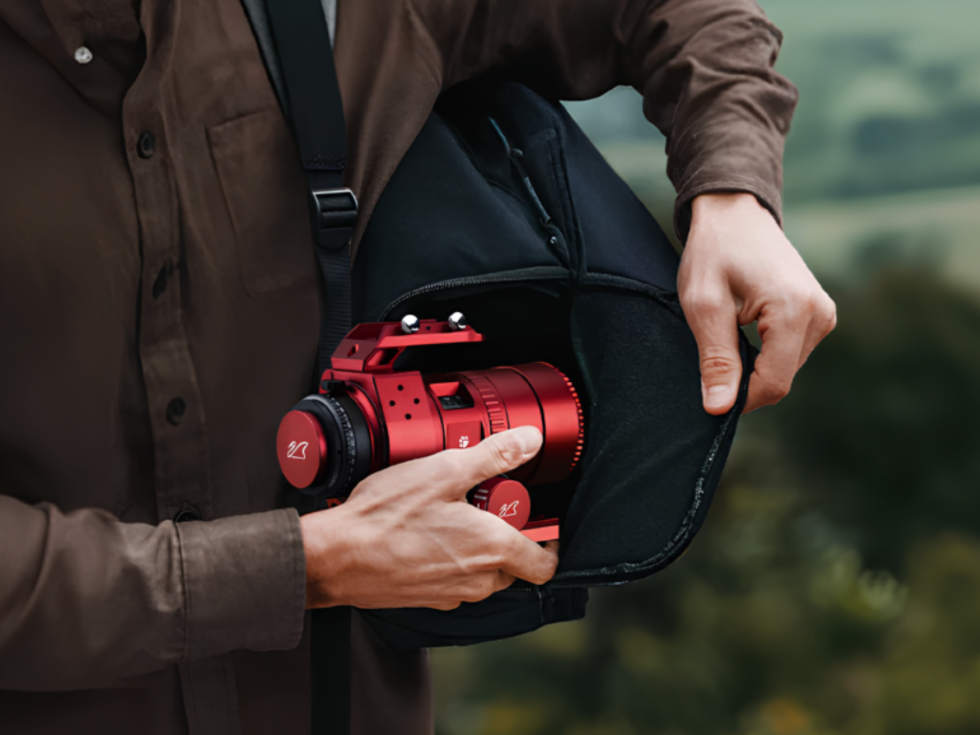
At 210mm long and 2.29 kg total, the MiniCat 51 packs telescope-grade optics into a body small enough for a backpack or carry-on bag.
Ultra-Wide Fields of View
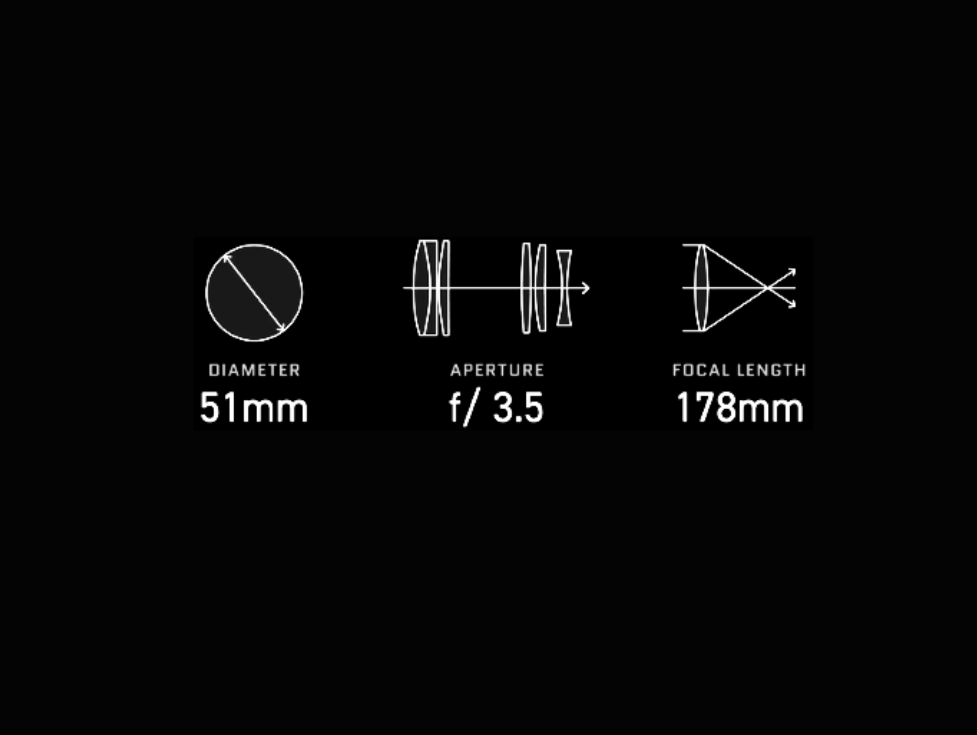
The f/3.5 focal ratio and 178mm focal length gather light roughly twice as fast as an f/4.9 system, ideal for capturing large star fields, nebulae, and Milky Way scenes in shorter exposure times.
Large Image Circle
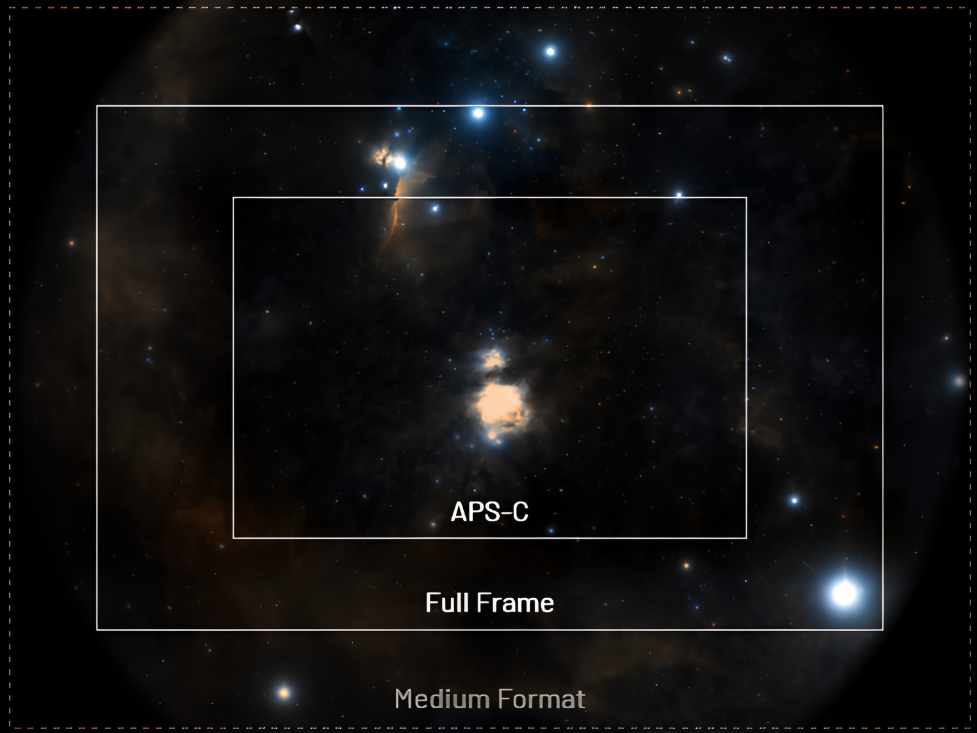
The 43.2mm image circle covers full frame sensors, with APS-C recommended for the cleanest corner performance without extra correction.
Petzval Optical Design
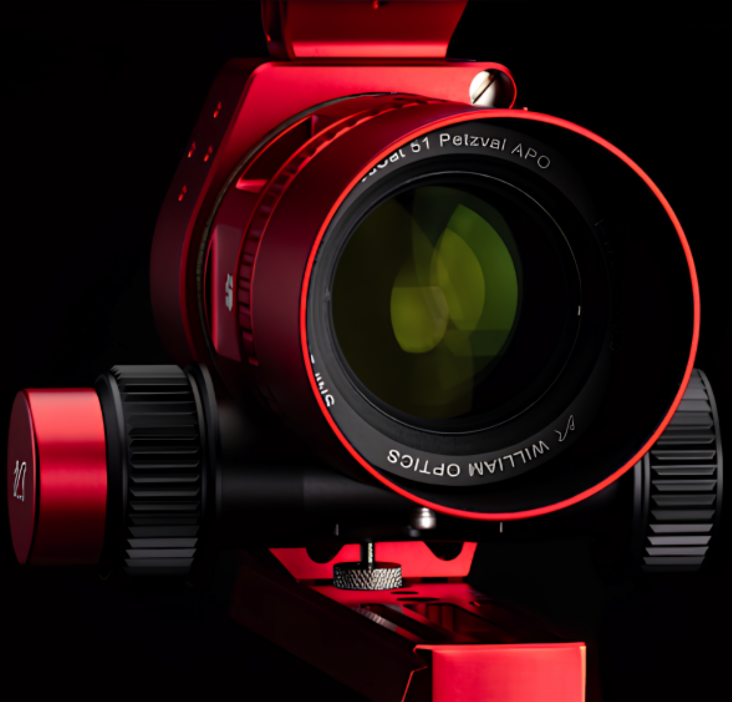
A Petzval telescope uses a specific arrangement of lens groups that naturally corrects field curvature across a wide image circle. The MiniCat 51 uses six elements in this layout, including two Super ED glass elements and lanthanum lens elements that work together to control chromatic aberration across the full 43.2mm image circle.
Because the Petzval design handles field flattening as part of its optical formula, no external field flattener is needed. The result is a sharp, color-corrected image from center to edge, particularly on APS-C sensors. Full frame shooters may want to apply aberration correction software for the best corner performance, since the fast f/3.5 aperture does produce some edge star elongation that responds well to software correction such as BlurXTerminator.
WIFD Focuser
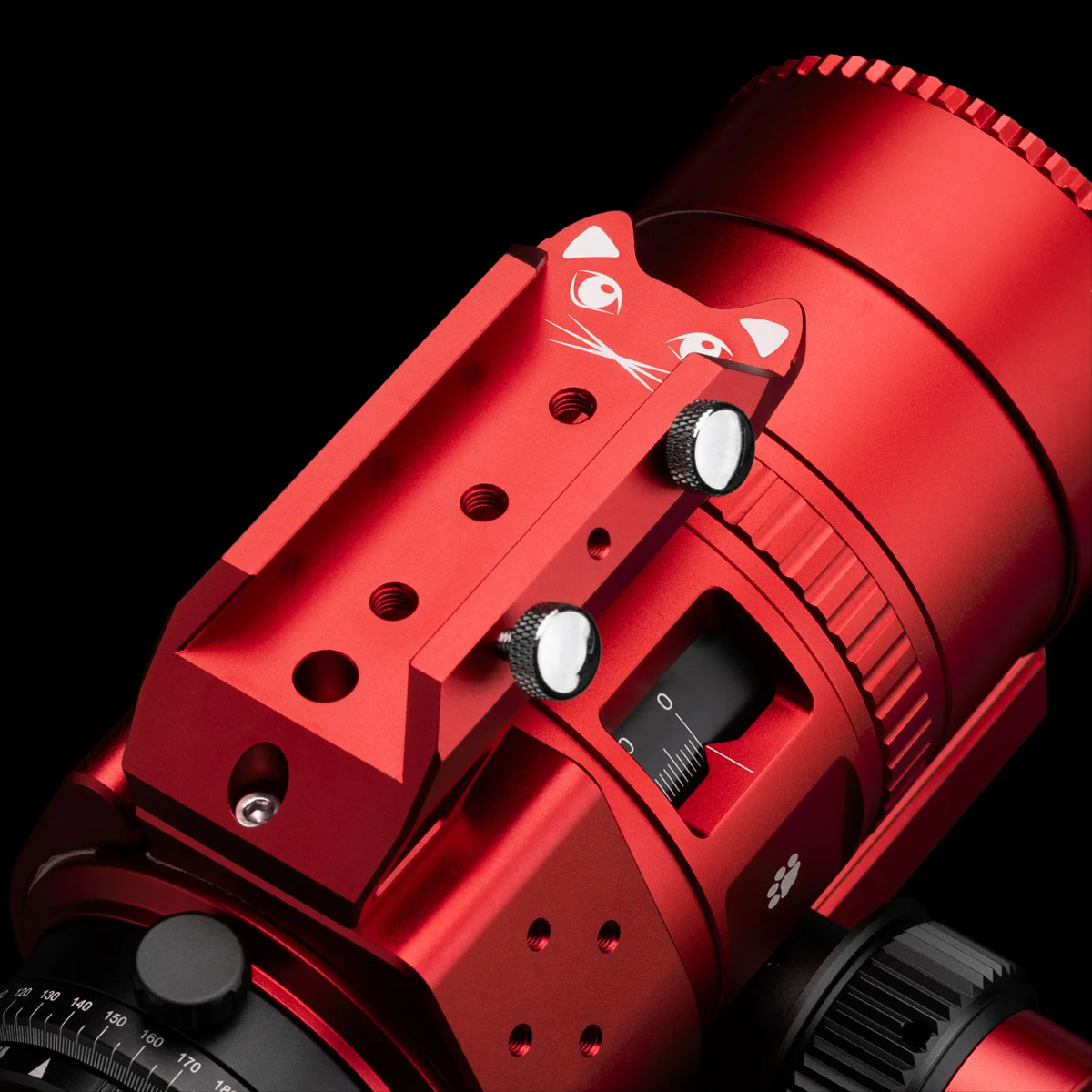
The WIFD (William Optics Internal Focus Design) focuser moves the lens elements internally to reach focus, rather than extending a drawtube. This keeps the camera in a fixed, centered position and removes the tube tilt that heavier rear-mounted equipment can cause on traditional focusers. Travel is 0 to 28mm, with a 10:1 fine-speed knob for precise adjustments. Reaching focus requires a back spacing between 30mm and 58mm, with 55mm plus or minus 3mm recommended to limit drawtube extension and reduce the chance of light leakage. Because the camera stays in a fixed position, the focuser accepts the ZWO EAF directly with no additional mounting bracket.
Imaging Adjustment Tools
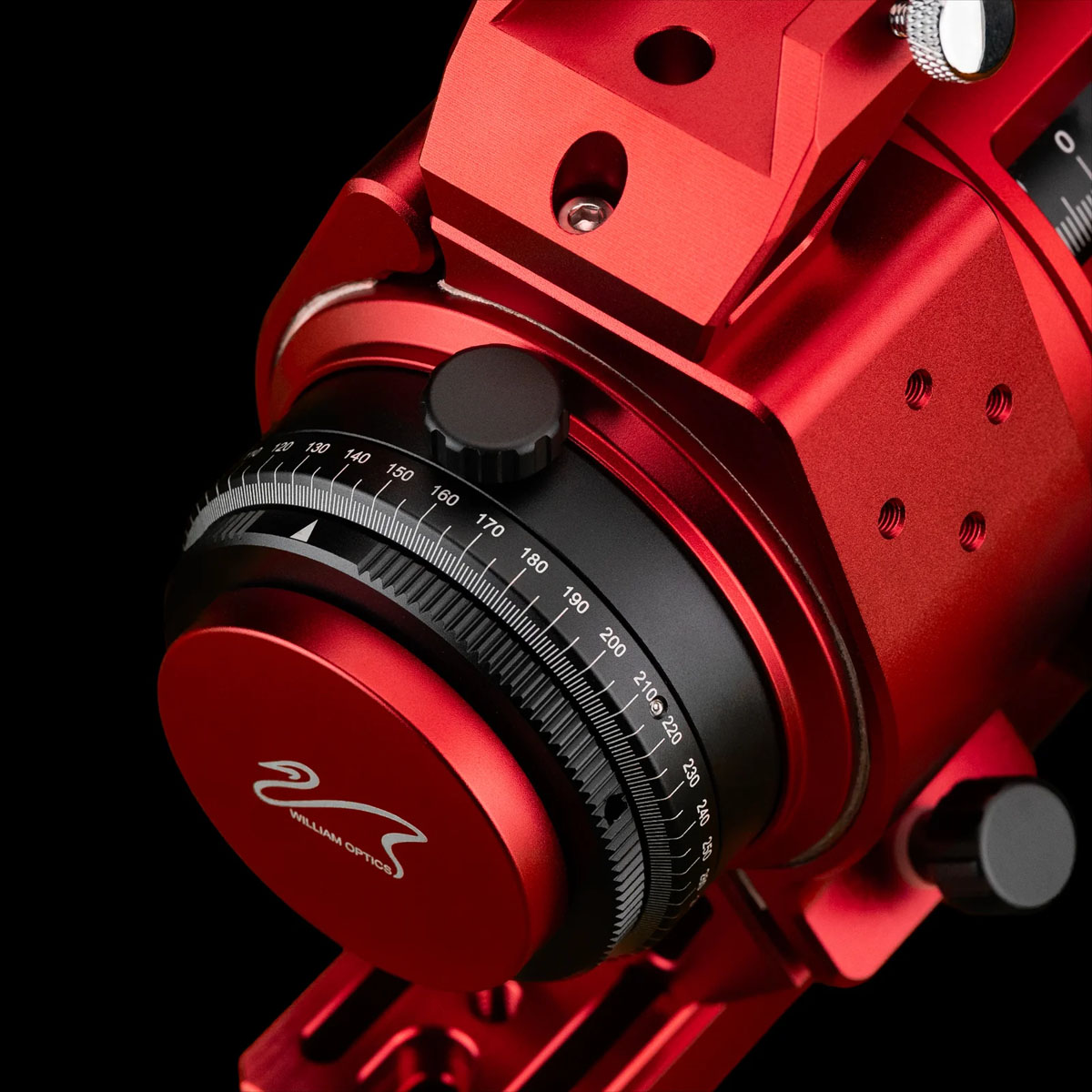
The sensor tilt adjuster sits between the focuser and the camera rotator. Small turns of its screws bring the camera sensor into a plane parallel with the optical axis, correcting cases where stars on one side of the frame are softer or more elongated than the opposite side. The camera angle rotator allows full 360-degree adjustment of camera orientation for framing, without loosening any mounting hardware. A laser-engraved Bahtinov mask built into the front lens cap provides a clear diffraction pattern for fast, accurate manual focus.
Specifications
Optical Specifications
- Lens Type: 6-Element Petzval Design
- Lens Elements: 2x Super ED glass, lanthanum elements
- Lens Coating: Fully multi-coated
- Focal Length: 178mm
- Aperture (Diameter): 51mm
- Focal Ratio: f/3.5
- Image Circle: 43.2mm
- Optional Flattener: None required
- Camera Format: Full Frame (compatible), APS-C (recommended), M4/3
Mechanical Specifications
- Focuser Type: WIFD R&P (Internal Focus Design)
- Focuser Travel: 0-28mm
- Back Spacing Range: 30-58mm
- Ideal Back Spacing: 55mm ±3mm
- EAF Compatible: Yes
- Adapters Included: Tilt Adjuster, Camera Angle Rotator, M54 to M48 adapter
- Optical Tube Weight: 1.67 kg / 3.68 lbs
- Tube Length: 210mm
- Dovetail Type: Dual Vixen-style and Arca-Swiss
- Mounting Rings: 2.29 kg / 5.05 lbs
Observational Info
- Dawes Limit: 1.52
- Rayleigh Limit: 1.84
- Limiting Magnitude: 11.88
- Minimum Magnification: 7x
- Maximum Magnification: 150x
- Magnification w/ Included Eyepiece: 32x
- Intended Use: Visual and Photographic
Frequently Asked Questions
Can the MiniCat 51 be used as a guide scope?
The MiniCat 51 is built as an imaging telescope rather than a guide scope, and its compact size and weight make it a better fit as the primary instrument in a setup. For guiding, William Optics' UniGuide 32mm pairs well with the MiniCat and attaches to the included handle bar's accessory rail, giving the main scope a dedicated guide camera without adding bulk to the setup.
Can the MiniCat 51 be used for visual astronomy?
The MiniCat 51 is designed and optimized for astrophotography rather than visual observing. Its fast f/3.5 focal ratio and short 178mm focal length are built around capturing wide fields of sky on a camera sensor, not for use with eyepieces. While it's technically possible to attach a diagonal and eyepiece with the right adapters, the low magnification and imaging-focused design make it a poor match for visual use compared to a dedicated visual refractor.
What flattener or reducer can I use with the MiniCat 51?
None is needed. The MiniCat 51's 6-element Petzval optical design flattens the field internally, so no external flattener or reducer is required or recommended. Adding one would change the optical path and is not part of the supported setup for this telescope.
Can I use a D-series (Losmandy-style) dovetail with the MiniCat 51?
The MiniCat 51 ships with a dual-format dovetail plate built for Vixen-style and Arca-Swiss saddles, not D-series. To mount it on a D-series saddle the included dovetail should be removed and replaced with a new model in the size of your choosing (sold separately).
Other Information
- Country of Manufacture: Taiwan
William Optics MiniCat 51: the Perfect Wide-Field Astrophotography Telescope
The William Optics MiniCat 51 WIFD is a compact wide-field astrograph built around a 6-element Petzval optical design with an f/3.5 focal ratio and 178mm focal length. That fast focal ratio collects light roughly twice as quickly as an f/4.9 system, which means shorter exposures for the same depth on nebulae, star clusters, and other wide targets. Despite the small 210mm tube length and total weight of just over 5 lbs, the MiniCat produces a 43.2mm image circle that covers full frame sensors. The WIFD internal focusing system, integrated Bahtinov mask, sensor tilt adjuster, and camera angle rotator are all built in, so the scope is ready for serious imaging work without add-ons.
Small Scope, Serious Imaging Power
Premium Portability
At 210mm long and 2.29 kg total, the MiniCat 51 packs telescope-grade optics into a body small enough for a backpack or carry-on bag.
Ultra-Wide Fields of View
The f/3.5 focal ratio and 178mm focal length gather light roughly twice as fast as an f/4.9 system, ideal for capturing large star fields, nebulae, and Milky Way scenes in shorter exposure times.
Large Image Circle
The 43.2mm image circle covers full frame sensors, with APS-C recommended for the cleanest corner performance without extra correction.
Petzval Optical Design
A Petzval telescope uses a specific arrangement of lens groups that naturally corrects field curvature across a wide image circle. The MiniCat 51 uses six elements in this layout, including two Super ED glass elements and lanthanum lens elements that work together to control chromatic aberration across the full 43.2mm image circle.
Because the Petzval design handles field flattening as part of its optical formula, no external field flattener is needed. The result is a sharp, color-corrected image from center to edge, particularly on APS-C sensors. Full frame shooters may want to apply aberration correction software for the best corner performance, since the fast f/3.5 aperture does produce some edge star elongation that responds well to software correction such as BlurXTerminator.
WIFD Focuser
The WIFD (William Optics Internal Focus Design) focuser moves the lens elements internally to reach focus, rather than extending a drawtube. This keeps the camera in a fixed, centered position and removes the tube tilt that heavier rear-mounted equipment can cause on traditional focusers. Travel is 0 to 28mm, with a 10:1 fine-speed knob for precise adjustments. Reaching focus requires a back spacing between 30mm and 58mm, with 55mm plus or minus 3mm recommended to limit drawtube extension and reduce the chance of light leakage. Because the camera stays in a fixed position, the focuser accepts the ZWO EAF directly with no additional mounting bracket.
Imaging Adjustment Tools
The sensor tilt adjuster sits between the focuser and the camera rotator. Small turns of its screws bring the camera sensor into a plane parallel with the optical axis, correcting cases where stars on one side of the frame are softer or more elongated than the opposite side. The camera angle rotator allows full 360-degree adjustment of camera orientation for framing, without loosening any mounting hardware. A laser-engraved Bahtinov mask built into the front lens cap provides a clear diffraction pattern for fast, accurate manual focus.
Specifications
Optical Specifications
- Lens Type: 6-Element Petzval Design
- Lens Elements: 2x Super ED glass, lanthanum elements
- Lens Coating: Fully multi-coated
- Focal Length: 178mm
- Aperture (Diameter): 51mm
- Focal Ratio: f/3.5
- Image Circle: 43.2mm
- Optional Flattener: None required
- Camera Format: Full Frame (compatible), APS-C (recommended), M4/3
Mechanical Specifications
- Focuser Type: WIFD R&P (Internal Focus Design)
- Focuser Travel: 0-28mm
- Back Spacing Range: 30-58mm
- Ideal Back Spacing: 55mm ±3mm
- EAF Compatible: Yes
- Adapters Included: Tilt Adjuster, Camera Angle Rotator, M54 to M48 adapter
- Optical Tube Weight: 1.67 kg / 3.68 lbs
- Tube Length: 210mm
- Dovetail Type: Dual Vixen-style and Arca-Swiss
- Mounting Rings: 2.29 kg / 5.05 lbs
Observational Info
- Dawes Limit: 1.52
- Rayleigh Limit: 1.84
- Limiting Magnitude: 11.88
- Minimum Magnification: 7x
- Maximum Magnification: 150x
- Magnification w/ Included Eyepiece: 32x
- Intended Use: Visual and Photographic
Frequently Asked Questions
Can the MiniCat 51 be used as a guide scope?
The MiniCat 51 is built as an imaging telescope rather than a guide scope, and its compact size and weight make it a better fit as the primary instrument in a setup. For guiding, William Optics' UniGuide 32mm pairs well with the MiniCat and attaches to the included handle bar's accessory rail, giving the main scope a dedicated guide camera without adding bulk to the setup.
Can the MiniCat 51 be used for visual astronomy?
The MiniCat 51 is designed and optimized for astrophotography rather than visual observing. Its fast f/3.5 focal ratio and short 178mm focal length are built around capturing wide fields of sky on a camera sensor, not for use with eyepieces. While it's technically possible to attach a diagonal and eyepiece with the right adapters, the low magnification and imaging-focused design make it a poor match for visual use compared to a dedicated visual refractor.
What flattener or reducer can I use with the MiniCat 51?
None is needed. The MiniCat 51's 6-element Petzval optical design flattens the field internally, so no external flattener or reducer is required or recommended. Adding one would change the optical path and is not part of the supported setup for this telescope.
Can I use a D-series (Losmandy-style) dovetail with the MiniCat 51?
The MiniCat 51 ships with a dual-format dovetail plate built for Vixen-style and Arca-Swiss saddles, not D-series. To mount it on a D-series saddle the included dovetail should be removed and replaced with a new model in the size of your choosing (sold separately).
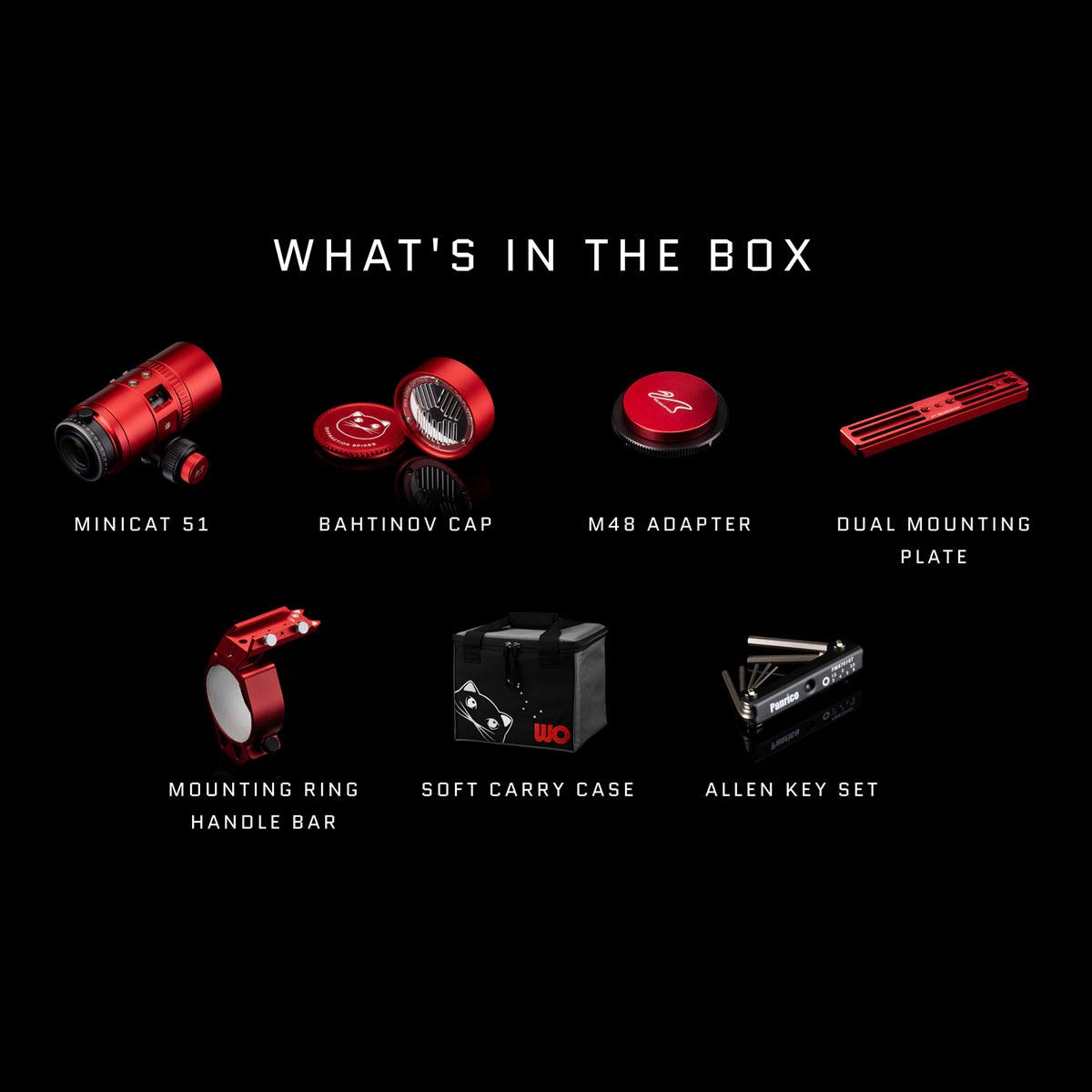
- 1x MiniCat 51 optical tube assembly
- 1x Mounting ring and handle bar
- 1x 210mm dual-type dovetail plate (Vixen-style and Arca-Swiss)
- 1x M48 camera adapter
- 1x Sensor tilt adjuster
- 1x Camera angle rotator
- 1x M54 to M48 adapter
- 1x Bahtinov cap
- 1x Soft carry case
- 1x Allen key set


- 51mm aperture, 178mm focal length, f/3.5 focal ratio
- 6-element Petzval design with 2 Super ED and lanthanum lens elements
- No field flattener required
- WIFD internal focuser with EAF compatibility out of the box
- Built-in sensor tilt adjuster, 360-degree camera angle rotator, and bahtinov mask
- Dual Vixen-style and Arca-Swiss dovetail plate included
William Optics MiniCat 51: the Perfect Wide-Field Astrophotography Telescope
The William Optics MiniCat 51 WIFD is a compact wide-field astrograph built around a 6-element Petzval optical design with an f/3.5 focal ratio and 178mm focal length. That fast focal ratio collects light roughly twice as quickly as an f/4.9 system, which means shorter exposures for the same depth on nebulae, star clusters, and other wide targets. Despite the small 210mm tube length and total weight of just over 5 lbs, the MiniCat produces a 43.2mm image circle that covers full frame sensors. The WIFD internal focusing system, integrated Bahtinov mask, sensor tilt adjuster, and camera angle rotator are all built in, so the scope is ready for serious imaging work without add-ons.
Small Scope, Serious Imaging Power
Premium Portability
At 210mm long and 2.29 kg total, the MiniCat 51 packs telescope-grade optics into a body small enough for a backpack or carry-on bag.
Ultra-Wide Fields of View
The f/3.5 focal ratio and 178mm focal length gather light roughly twice as fast as an f/4.9 system, ideal for capturing large star fields, nebulae, and Milky Way scenes in shorter exposure times.
Large Image Circle
The 43.2mm image circle covers full frame sensors, with APS-C recommended for the cleanest corner performance without extra correction.
Petzval Optical Design
A Petzval telescope uses a specific arrangement of lens groups that naturally corrects field curvature across a wide image circle. The MiniCat 51 uses six elements in this layout, including two Super ED glass elements and lanthanum lens elements that work together to control chromatic aberration across the full 43.2mm image circle.
Because the Petzval design handles field flattening as part of its optical formula, no external field flattener is needed. The result is a sharp, color-corrected image from center to edge, particularly on APS-C sensors. Full frame shooters may want to apply aberration correction software for the best corner performance, since the fast f/3.5 aperture does produce some edge star elongation that responds well to software correction such as BlurXTerminator.
WIFD Focuser
The WIFD (William Optics Internal Focus Design) focuser moves the lens elements internally to reach focus, rather than extending a drawtube. This keeps the camera in a fixed, centered position and removes the tube tilt that heavier rear-mounted equipment can cause on traditional focusers. Travel is 0 to 28mm, with a 10:1 fine-speed knob for precise adjustments. Reaching focus requires a back spacing between 30mm and 58mm, with 55mm plus or minus 3mm recommended to limit drawtube extension and reduce the chance of light leakage. Because the camera stays in a fixed position, the focuser accepts the ZWO EAF directly with no additional mounting bracket.
Imaging Adjustment Tools
The sensor tilt adjuster sits between the focuser and the camera rotator. Small turns of its screws bring the camera sensor into a plane parallel with the optical axis, correcting cases where stars on one side of the frame are softer or more elongated than the opposite side. The camera angle rotator allows full 360-degree adjustment of camera orientation for framing, without loosening any mounting hardware. A laser-engraved Bahtinov mask built into the front lens cap provides a clear diffraction pattern for fast, accurate manual focus.
Specifications
Optical Specifications
- Lens Type: 6-Element Petzval Design
- Lens Elements: 2x Super ED glass, lanthanum elements
- Lens Coating: Fully multi-coated
- Focal Length: 178mm
- Aperture (Diameter): 51mm
- Focal Ratio: f/3.5
- Image Circle: 43.2mm
- Optional Flattener: None required
- Camera Format: Full Frame (compatible), APS-C (recommended), M4/3
Mechanical Specifications
- Focuser Type: WIFD R&P (Internal Focus Design)
- Focuser Travel: 0-28mm
- Back Spacing Range: 30-58mm
- Ideal Back Spacing: 55mm ±3mm
- EAF Compatible: Yes
- Adapters Included: Tilt Adjuster, Camera Angle Rotator, M54 to M48 adapter
- Optical Tube Weight: 1.67 kg / 3.68 lbs
- Tube Length: 210mm
- Dovetail Type: Dual Vixen-style and Arca-Swiss
- Mounting Rings: 2.29 kg / 5.05 lbs
Observational Info
- Dawes Limit: 1.52
- Rayleigh Limit: 1.84
- Limiting Magnitude: 11.88
- Minimum Magnification: 7x
- Maximum Magnification: 150x
- Magnification w/ Included Eyepiece: 32x
- Intended Use: Visual and Photographic
Frequently Asked Questions
Can the MiniCat 51 be used as a guide scope?
The MiniCat 51 is built as an imaging telescope rather than a guide scope, and its compact size and weight make it a better fit as the primary instrument in a setup. For guiding, William Optics' UniGuide 32mm pairs well with the MiniCat and attaches to the included handle bar's accessory rail, giving the main scope a dedicated guide camera without adding bulk to the setup.
Can the MiniCat 51 be used for visual astronomy?
The MiniCat 51 is designed and optimized for astrophotography rather than visual observing. Its fast f/3.5 focal ratio and short 178mm focal length are built around capturing wide fields of sky on a camera sensor, not for use with eyepieces. While it's technically possible to attach a diagonal and eyepiece with the right adapters, the low magnification and imaging-focused design make it a poor match for visual use compared to a dedicated visual refractor.
What flattener or reducer can I use with the MiniCat 51?
None is needed. The MiniCat 51's 6-element Petzval optical design flattens the field internally, so no external flattener or reducer is required or recommended. Adding one would change the optical path and is not part of the supported setup for this telescope.
Can I use a D-series (Losmandy-style) dovetail with the MiniCat 51?
The MiniCat 51 ships with a dual-format dovetail plate built for Vixen-style and Arca-Swiss saddles, not D-series. To mount it on a D-series saddle the included dovetail should be removed and replaced with a new model in the size of your choosing (sold separately).
Other Information
- Country of Manufacture: Taiwan
| Telescope Focal Length | Up to 300mm |
|---|
- 1x MiniCat 51 optical tube assembly
- 1x Mounting ring and handle bar
- 1x 210mm dual-type dovetail plate (Vixen-style and Arca-Swiss)
- 1x M48 camera adapter
- 1x Sensor tilt adjuster
- 1x Camera angle rotator
- 1x M54 to M48 adapter
- 1x Bahtinov cap
- 1x Soft carry case
- 1x Allen key set

William Optics MiniCat 51 WIFD f/3.5 Petzval Refractor Telescope - Red