

A Guide to Lunar Observing Filters

Figure 1 – A lunar observing filter helps reduce the glare when observing the moon visually with a telescope. Image credit: Flickr/Longhorndave.
1. Overview
Precise scientific measurements show the moon reflects, on average, about 12% of the sunlight that falls upon it. That makes it, on average, about as reflective as an asphalt driveway. But if you’ve ever looked at a thickening gibbous moon through even a moderately-sized telescope, it can appear uncomfortably bright to the dark-adapted eye. That’s why many visual lunar observers and lunar imagers consider filters to reduce the brightness and glare of the moon so they can see finer detail during a long observing session.
Moon filters are useful for scopes of as little as 80mm aperture, and they are essential for 100mm scopes or larger. Fortunately, moon filters are simpler than light-pollution filters or narrow-band filters, and they are much more affordable. And like other types of astronomy filters, moon filters come in threaded cells of 1.25” (M28.5x0.6) and 2” (M48x0.75) sizes that easily attach to an eyepiece barrel or diagonal.
There are a few different options for moon filters, and this article describes how each works to help you choose which type of filter works best for you.
2. Neutral Density Filters
A neutral density (ND) filter, the simplest filter for lunar observation, reduces the brightness at all visible wavelengths equally. ND filters preserve the subtle lunar colors while making it easier and more comfortable to detect low-contrast details. Visual observers enjoy reduced glare and brightness, while imagers use ND filters to prevent saturating (over-exposing) the camera.
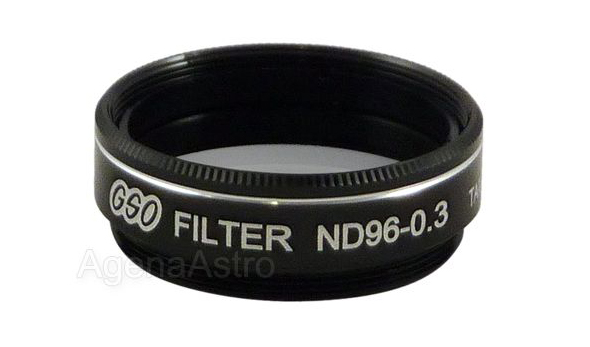
Figure 2 – A 1.25” ND0.3 neutral density filter, which passes 50% of light incident upon it. Image credit: Agena AstroProducts.
ND filters for astronomy and photography are often labelled as ND96. The “96” designation refers to the standard ‘Wratten’ number for gray (i.e. neutral) optical filters that reduce the transmission of visible light evenly at all wavelengths. It does not describe how much light is transmitted by the filter.
The filter transmission is described by another number, the optical density (OD). A filter with an optical density of N attenuates visible wavelengths by a factor of 10-N. For example, an ND filter with an optical density of 0.9 is called an ND0.9, ND9, or ND96-0.9 filter. Such a filter reduces the light transmitted through the filter by a factor of 10-0.9=0.125, that is, it passes 12.5% of the light incident upon it. In photographic terms, that’s a factor of 8, or three stops. An ND6 filter reduces transmission by 10-0.6=0.25 and transmits 25% of incident light. And an ND0.3 filter passes 10-0.3=0.50 or half the incident light. These three levels of attenuation are the most common for lunar neutral density filters.
While the transmission values of these filters are fixed, ND filters can be stacked to achieve a wider range of transmission to match telescope aperture and moon phase. So, for example, stacking a filter with 50% transmission with a filter with 25% transmission yields an effective transmission of approximately 12.5%.
Which ND filter transmission is the most useful? It depends on the aperture of the telescope, of course, and also to a large extent on the phase of the moon when you observe it. But in general:
- ND0.3 filters (50% transmission) are useful for small telescopes of <80mm aperture, or for observing a crescent moon with larger telescopes. They’re also useful for attenuating the brightness of planets such as Venus and Jupiter when using larger telescopes
- ND0.6 (25% transmission) are a good match with telescopes of 80mm to 150mm aperture
- ND0.9 (12.5% transmission) are a good bet with telescopes of >150mm aperture, especially when observing a moon that’s more than half illuminated ND filters are inexpensive and effective for lunar observation, and they conserve the subtle lunar colors for visual observation and imaging. They’re also the optically simplest filter and can, in principle, deliver the best image quality.
ND filters are inexpensive and effective for lunar observation, and they conserve the subtle lunar colors for visual observation and imaging. They’re also the optically simplest filter and can, in principle, deliver the best image quality.
3. Variable Polarizing Filters
For observers looking for more flexibility in a single component, variable polarizing filters offer a solution.
Variable polarizing filters consist of two linear polarizers that can be rotated with respect to each other. The first polarizer reduces transmission of the mostly unpolarized light from the moon by about 50%. The second filter transmits light from the first filter in proportion to the angle between the two polarizers.
For example, if the second polarizing filter is aligned to the same direction as the first filter, it will pass all of the light and act, in principle, as a 100% transmitting element. That is, it passes 100% of the light from the first filter, which passes 50% of the light from the moon.
If the second polarizer is oriented at right angles to the first filter it will pass, in principle, no light at all. And if it’s oriented at an angle between these two extremes, it will transmit some value in between 0% and 100% of the light from the first filter (which passes 50% of the unpolarized light from the moon.
In practice, because the polarizers are not perfect and because of small reflections from the glass substrate, the true range of transmission of a pair of polarizing filters is between about 5% and 40% rather than 0% to 50%. All wavelengths of visual light have the same transmission through a variable polarizer, at least in principle.
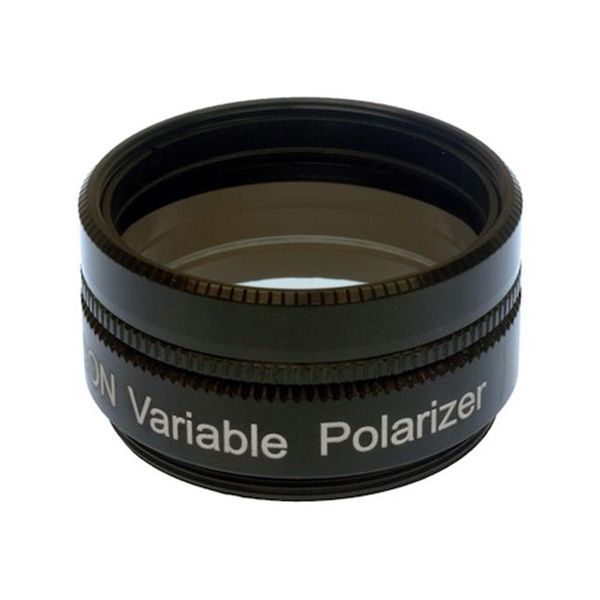
Figure 3 – A 1.25” Lumicon variable polarizing filter. Image credit: Agena AstroProducts
While this may sound complicated, in practice we don’t worry too much about exactly how much light is passed or the values of the angles between the filters. We just rotate one polarizer with respect to the other until we get a comfortable view of the moon, or we make sure the camera is not saturated.
Some variable polarizers are constructed so that the polarizers are integrated together into a single unit that threads onto the barrel of an eyepiece. The polarizers are rotated to achieve the desired level of transmission by, for example, holding it up to the moon before threading it onto the eyepiece. The filter is then threaded onto the eyepiece, then the eyepiece goes into the diagonal or focuser. If a different level of attenuation is needed, the eyepiece must be removed and the filter rotated again.
Other variable polarizers consist of two separable polarizing filters. One can be threaded onto the telescope side of a star diagonal, the other onto the barrel of the eyepiece. To vary the angle between the polarizers (and therefore the amount of transmitted light), simply rotate the eyepiece in the diagonal.
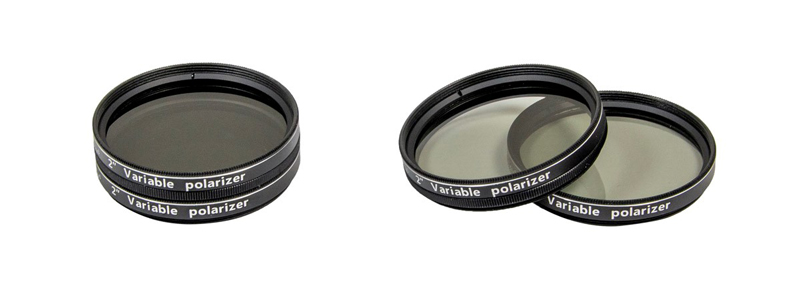

Variable polarizers are not quite as easy to use, and they may (in principle) affect the image more than a single high-quality ND filter, but they are an excellent choice for lunar observers and imagers because of their flexibility. They are also relatively affordable.
4. Color Filters
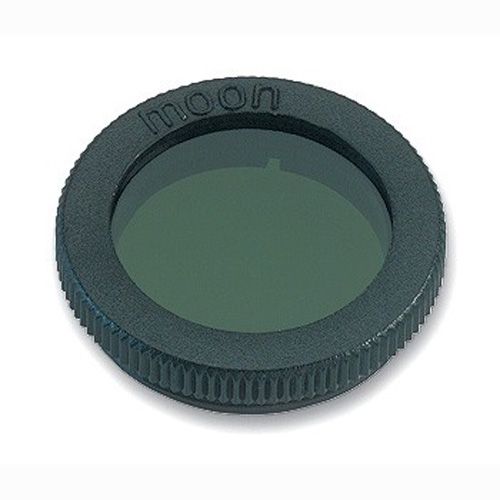
Experienced lunar visual observers often recommend a simple color filter, the Wratten #56 or #58 green, for enhancing contrast of subtle features when observing the moon, especially when used together with a neutral density filter to reduce glare. Many observers already have a #56 or #58 filter in their planetary observing toolkit. The #58 filter, with its smaller passband, might work best for purely lunar observing. Celestron and GSO, among other vendors, also offer specialized moon filters that include green light transmission and transmission reduction of up to 80% in a single filter. These filters are affordable and come in 1.25” cells that thread directly to an eyepiece or diagonal. With a little practice, most observers learn to ignore the green color cast of these filters.
5. Moon and Skyglow Filters
Another option for lunar observation: Moon and Skyglow filters from Baader Planetarium and Optolong. These filters incorporate neodymium, a rare earth element, into their glass substrates to pass and block select wavelengths of visible light. These filters are not primarily intended for lunar work, but rather for visual observation of planets such as Mars and Jupiter, and for observation of deep-sky objects in light-polluted sky. However, some observers report these filters do enhance the visual appearance of some lunar features. Bill Paolini, in an article published at the Alpine Astro blog, suggests the Baader Moon and Skyglow filter, when stacked with a pale blue #82A color filter, can enhance the appearance of features in the lunar maria and ejecta patterns, for example.
6. Summary
Moon filters make lunar viewing more comfortable and pleasurable for visual observers, and they help bring out subtle and low-contrast visual details on the moon’s surface. These filters also help lunar imagers with large telescopes who may need to dim the moon to avoid oversaturation of the camera sensor. While they are just about the simplest astronomical filters, moon filters are useful and inexpensive additions to any astronomer’s toolkit.

About the Author
Brian Ventrudo is a writer, scientist, and astronomy educator. He received his first telescope at the age of 5 and completed his first university course in astronomy at the age of 12, eventually receiving a master's degree in the subject. He also holds a Ph.D. in engineering physics from McMaster University. During a twenty-year scientific career, he developed laser systems to detect molecules found in interstellar space and planetary atmospheres, and leveraged his expertise to create laser technology for optical communications networks. Since 2008, Brian has taught astronomy to tens of thousands of stargazers through his websites OneMinuteAstronomer.com and CosmicPursuits.com.
