

Review of the Askar 72mm f/5.6 Quintuplet Petzval Flat-Field Astrograph and Askar 0.7x Reducer

1. Overview
Many vendors offer premium small triplet refractors for visual use and astrophotography. An ED or apochromatic objective, a relatively fast focal ratio around f/6, and a rotatable two-speed focuser are standard fare, and an optional field flattener facilitates imaging with larger APS-C and full-frame sensors. The new ASKAR FRA400 72mm f/5.6 astrograph builds on the basic idea of a compact triplet, adding two additional elements to achieve a five-element f/5.6 Petzval configuration with two ED elements. With an optional 0.7x focal reducer, the FRA400 delivers a very fast f/3.9 with a flat field across a full 44mm image circle. This makes this little astrograph ideal for capturing wide-field images of the deep sky with large-sensor cameras, and a great premium travel-friendly telescope for wide-field visual observation. This review takes this compact astrograph out for a spin, with and without its focal reducer, to see how it performs on a few wide-field targets in the northern summer sky.
2. Fit, Finish, and Mechanics
Out of the box the ASKAR FRA400 "Flatfield Refractive Astrograph" looks like a well-crafted instrument with clean design and a visually appealing look and feel. As delivered, the setup weighs in at just under 7 pounds (including the aluminum rings, Vixen-style dovetail, and carrying handle). It's heavier than it looks, not surprising given the quality of the components and five glass elements inside. In my set-up, once I added a camera and other accessories, the whole rig crept into the 15-pound range. The mounting rings include areas on both sides and on the carrying handle to mount additional equipment.
The ASKAR FRA400 includes a large 3" rack-and-pinion dual-speed focuser that's fully rotatable through 360 degrees. This worked out great for framing images, and the rotation worked smoothly and did not move the mount or telescope. The rotator is also fitted with a red anodized lock-down screw. The focus knobs are easily removed with an Allen wrench to add a focus motor control (Figure 2).

The focuser tube terminates with an M68x1 thread for direct camera attachment and it comes with an M68-M48 adapter. It also includes a 2" adapter ring and 1.25"-2" adapter for use with diagonals, eyepieces, or smaller cameras. A star diagonal is not included. The ASKAR FRA400 also has a collapsible dew shield that extends outward by approximately 1 ⅜ inches.
The following equipment was used for testing the imaging capacity of the ASKAR FRA400 and associated focal reducer:
- Celestron CGEM-DX equatorial mount (pier mounted)
- Stock Canon 6D full-frame camera
- ZWO ASI290MC (guide camera)
- Orion 60mm Guide Scope
- Anker Model A7515 7-Port USB 3.0 Data Hub.
- iOptron ZEQ25GT equatorial mount
- ZWO 2" UV/IR cut filter
- Optolong 2" L-eNhance filter
- Daystar Quark Chromosphere (for solar imaging)
- Canon EOS M48 adapter
3. Imaging with the ASKAR FRA400 at f/5.6
3.1 Location
The initial image testing was done at 400mm and the native focal ratio of f/5.6 with a Canon 6D (stock) full-frame camera. Sixty-second exposures were used to check for any optical aberrations in the image. The software package Backyard EOS was used to capture each image taken for this article. Using the ability to "live view" with the Canon 6D, I was able to achieve focus without using a focus mask. The fine focus knob on this scope was instrumental in obtaining a precise focus.

If you are new to astrophotography with a Canon 6D stock camera, you will need the Canon EOS M48 adapter that can be purchased here or here .

The first test image was on the open cluster Messier 29 in the constellation Cygnus (Figure 4). This 60-second image of Messier 29 showed good optical performance into the corners of the image. Note these 60-second test images were not processed with darks, bias, or flats frames. Each square is a 360 x 360 pixel clip, with the corner clips doubled in size to show star details.

Figure 5 shows a 10-minute stacked and processed image of the Messier 29 area, uncropped, full-frame view at f/5.6 The image shows good details and star image to the edge of the frame.
Image details from Astrometry.net:
Center (RA, hms): 20h 24m 38.501s
Center (Dec, dms): +38° 33' 20.270"
Size: 5.1 x 3.4 deg
Radius: 3.066 deg
Pixel scale: 3.36 arcsec/pixel

The second test image at 400mm f/5.6 was the Messier 57 area (the Ring Nebula). Again, the 60-second image of Messier 57 showed good optical performance into the corners of the image with no aberrations detected.

A 5-minute stacked and processed image (Figure 7) shows the uncropped, full-frame view around M57. The image shows good and sharp detail to the frame edge.
Image details from Astrometry.net:
Center (RA, hms): 18h 53m 30.249s
Center (Dec, dms): +32° 58' 53.064"
Size: 5.12 x 3.42 deg
Radius: 3.081 deg
Pixel scale: 3.36 arcsec/pixel
4. Imaging with the ASKAR FRA400 at f/3.9
While the fast f/5.6 focal ratio is ideal for deep-sky imaging, ASKAR also makes an optional 0.7x FRA72RD focal reducer for the FRA400 scope to bring the focal ratio to f/3.9 and a focal length of 280mm while still supporting full-frame imaging. This reducer offers a 2x increase in image brightness. The next series of tests examined the effect of the reducer on image quality. The same Canon 6D (stock) full-frame camera was used for this testing (see Figure 8). The back portion of the focal reducer unscrews to easily enable the addition of a two-inch M48x0.75 threaded filter of your choice.

As with the tests of the FRA400 at the native focal ratio, sixty-second exposures were used to check for any optical aberrations in the image. The first test image was on the Vega star field.

The 60-second test image of Vega showed good optical performance in the center of the image but did show some minor field curvature in the corners and around the far edges of the frame (Figure 9). While not immediately visible when looking at the full frame image, when zoomed to 100% the field curvature becomes more evident. No false color was evident around Vega itself.
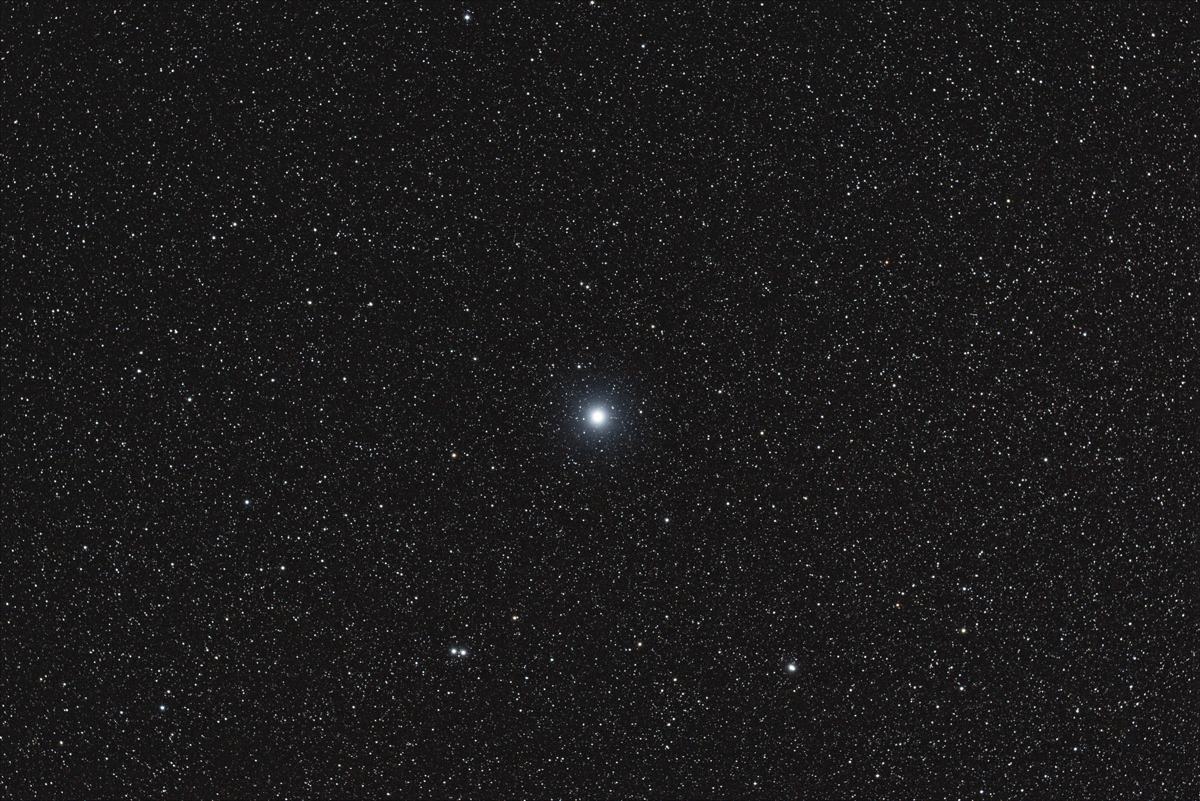
Image details from Astrometry.net:
- Center (RA, hms): 18h 36m 25.725s
- Center (Dec, dms): +38° 46' 06.265"
- Size: 7.34 x 4.9 deg
- Radius: 4.415 deg
- Pixel scale: 4.81 arcsec/pixel

The second test image at 280mm f/3.9 was the Messier 13 area (Hercules Cluster). The 60-second image of Messier 13 showed good optical performance in the center of the image, but as in the image of Vega, it does show some minor field curvature in the corners and around the far edges of the frame (see Figure 11). Figure 12 shows a 15-minute stacked and processed image of Messier 13, uncropped, full-frame view.

Image details from Astrometry.net:
- Center (RA, hms): 16h 41m 04.428s
- Center (Dec, dms): +36° 19' 44.683"
- Size: 7.34 x 4.9 deg
- Radius: 4.410 deg
- Pixel scale: 4.8 arcsec/pixel
5. Image Testing at f/3.9 with the Optolong L-eNhance 2" Filter
Since many amateur astronomers will be using the ASKAR FRA400 72mm Petzval astrograph for wide-field astrophotography, I tested it on the North America Nebula and Veil Nebula regions using the Optolong L-eNhance Dual Bandpass Light Pollution Reduction Imaging Filter. The 2" L-eNhance filter threads directly into the imaging train on the back side of the reducer in the order shown in Figure 13.

The resulting images of the North America Nebula and Veil Nebula are shown in Figures 14 and 15 respectively. Again, the quality of these two full-frame images is impressive, especially given they are captured with a narrowband filter and an unmodified DSLR. This is where the fast f/3.9 focal ratio is a great benefit. Pixel peepers will see some aberrations when zooming in at the corners, but this is the trade off for enjoying a very fast focal ratio. These are impressive results, especially in a telescope in this price range.

Image details from Astrometry.net:
- Center (RA, hms): 20h 56m 31.088s
- Center (Dec, dms): +44° 27' 43.654"
- Size: 4.89 x 7.32 deg
- Radius: 4.400 deg
- Pixel scale: 4.79 arcsec/pixel

Image details from Astrometry.net:
- Center (RA, hms): 20h 50m 50.013s
- Center (Dec, dms): +31° 05' 08.694"
- Size: 7.32 x 4.89 deg
- Radius: 4.403 deg
- Pixel scale: 4.8 arcsec/pixel

6. Solar Imaging at f/3.9
While not an obvious choice for a solar/lunar/planetary scope, especially with the focal reducer, I decided to try out the ASKAR FRA400 for a few solar images since my refractors always pull double duty in the observatory. I tried a few images using a UV/IR block filter, the Daystar Quark Chromosphere, and the ZWO ASI290MC camera. The image train is shown in Figure 17.

The ASKAR FRA400 performed admirably on the Sun in H-alpha, revealing fine surface and limb detail even at this short focal length. This suggests this little 72mm astrograph would serve well as a travel scope for eclipse chasers who might also want to do a little visual night time observing and imaging. A good all-around package!


7. Final Thoughts
The ASKAR FRA400 72mm f/5.6 Quintuplet Petzval Flat-Field Astrograph and Askar 0.7x focal reducer make a fine addition to any deep-sky wide-field astrophotography setup. Its compact size also makes this a great scope for field setup in your favorite dark-sky area or for travel, and it works well as a piggy-back wide-field telescope to place on a bigger imaging rig.
The ASKAR 72mm astrograph features a solid build quality, premium features, and an attractive appearance. Most of all, it features excellent and fast optics with a triplet ED objective and doublet ED Petzval corrector. The base focal ratio of f/5.6 is nearly as fast as many refractors can operate, even with a focal reducer. With its optional 0.7x focal reducer that takes it to f/3.9, the scope renders slight field curvature in the extreme corners with full-frame cameras. But for many imagers, this is an acceptable trade-off for extremely fast and high-quality optics in a package that costs less than $1,400.
When you look at the stars, in the test with the reducer, they are circling the center, which is a strong indicator, that the sensor is too far away from the reducer.