

ZWO ASI2600MM Pro Cooled Monochrome Astronomy Camera

Stock count is accurate & shown in real time.
- This item is out of stock.
- Sign up for back-in-stock alerts to be notified when this item becomes available (account login required).
- This item is out of stock.
- Sign up for back-in-stock alerts to be notified when this item becomes available (account login required).
Contiguous US / Lower 48:
Free shipping applies to orders over $50 using our chosen carrier/method. Faster paid options are available at checkout.
Alaska, Hawaii & US Territories:
Free shipping applies to many—but not all—products. Enter your ZIP code in cart or upon checkout to confirm options and costs.
International:
International orders do not qualify for free shipping. Shipping, duties, brokerage, tariffs, and taxes are the customer’s responsibility. Some items may be restricted due to export, size, or manufacturer limitations.
- Upgraded from previous version: lower read noise, higher frame rates, and new matte finish
- 26 megapixel APS-C sensor delivers exceptional detail
- Versatile 3.76um pixel size works well with many telescope types and focal lengths
- True 16-bit ADC provides 14 stops of high dynamic range
- 91% peak quantum efficiency for greater sensitivity
- High 75Ke- full well capacity captures bright details without bloated stars
- Power supply (required) sold separately
ASI2600MM Pro: The Next-Generation Camera for Deep Space Astrophotography
The upgraded ZWO ASI2600MM Pro builds on the reputation as a favorite among both backyard imagers and professional observatories. Still powered by the highly sensitive Sony IMX571 APS-C monochrome sensor with 3.76µm pixels, it delivers the outstanding performance, low read noise, and filter-based flexibility that astrophotographers trust for everything from galaxies to faint nebulae. What sets this upgraded version apart is its expanded full-well capacity, enhanced dynamic range, larger DDR3 buffer, and improved cooling and dew prevention—giving you even more control, reliability, and image quality in a wide range of observing conditions.
ZWO ASI2600MM Pro Overview & Results
Take a closer look at the ZWO ASI2600MM Pro and see what makes it such a popular choice for deep-sky astrophotography. We cover its key features, performance, and real imaging results in this short overview video:
ZWO ASI2600MM Pro Highlights
Built-in Dew Prevention
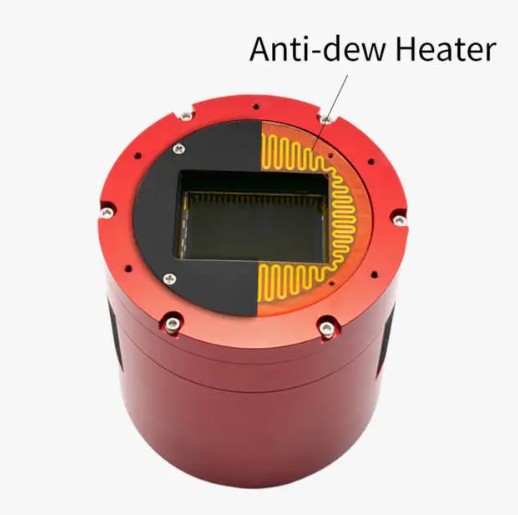
The ZWO ASI2600MM Pro uses a polyimide heater that fits perfectly behind the front cover of the sensor. The heater can be turned on or off depending on your climate. It dramatically reduces frost or dew that can form in higher-humidity environments. The heating element uses 5W at maximum power and can be controlled through any app that uses ASCOM.
512MB DDR3 RAM

The ASI2600MM Pro features 512MB of built-in DDR3 memory, which helps prevent dropped frames during image capture. This onboard cache also works alongside the USB 3.0 interface to eliminate amp glow—an unwanted bright patch that can appear in your images during long exposures, caused by heat and power from the camera’s electronics.
High Speed USB Connection
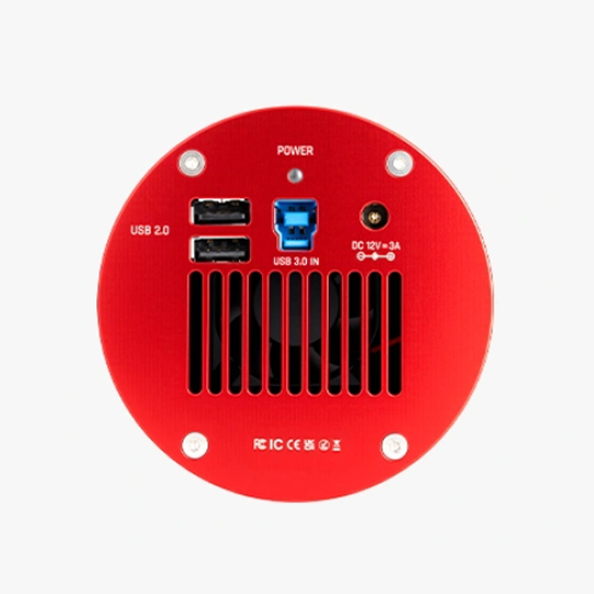
With its high-speed USB 3.0 port, the ZWO ASI2600MM Pro can download files with minimal lag time! Like all ZWO cameras in the pro series, it also has two USB 2.0 ports for accessories like a filter wheel, guider, or the ZWO Camera Angle Adjuster (CAA).
The Perfect Sensor for All Your Favorite Deep Sky Targets
Nebulae
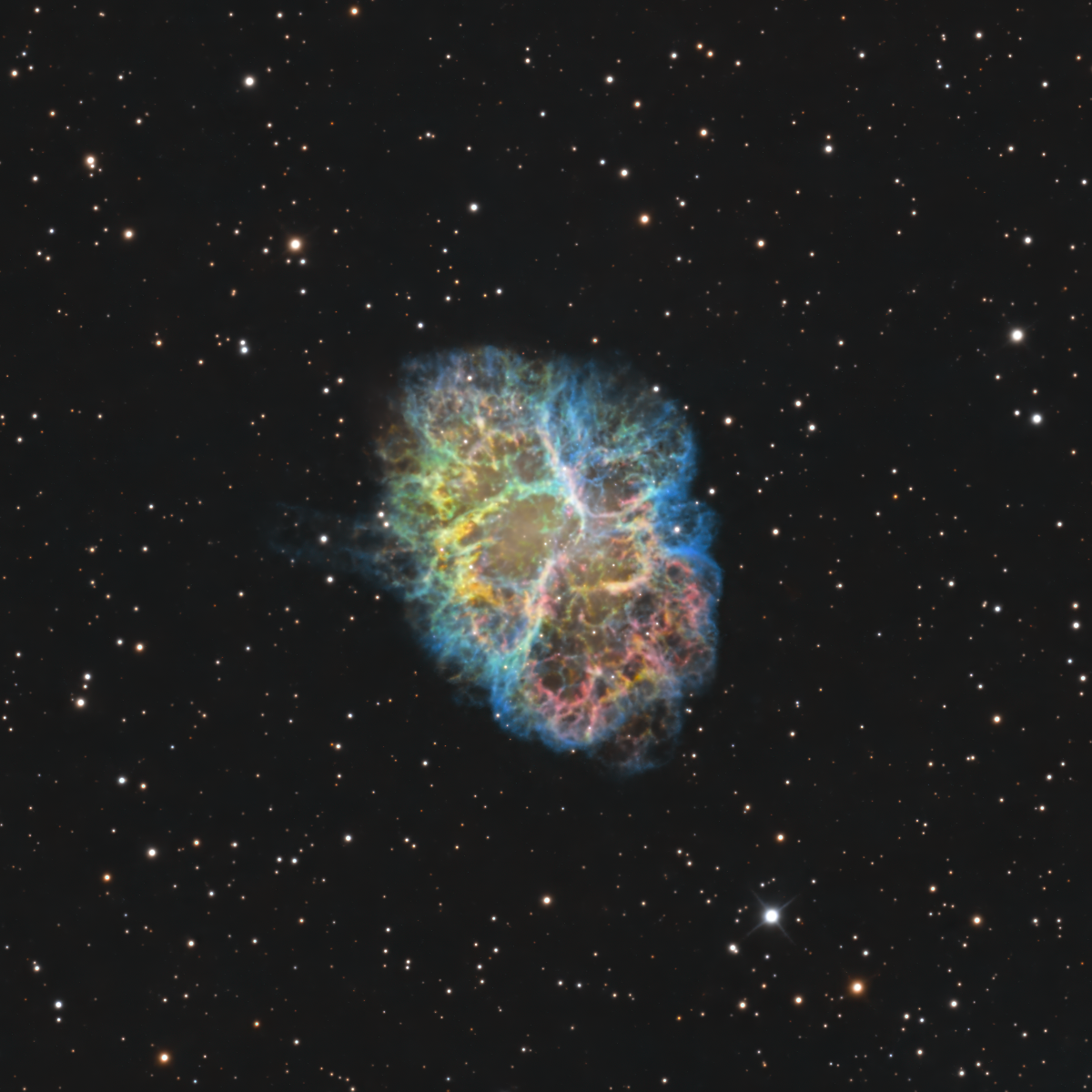
The Crab Nebula
Taken by Isaac Garfinkle using a ZWO ASI2600MM Pro with 3nm Chroma SHO filters and a 10” GSO Truss Tube RC. Total exposure time of 27.5 hours.
Galaxies
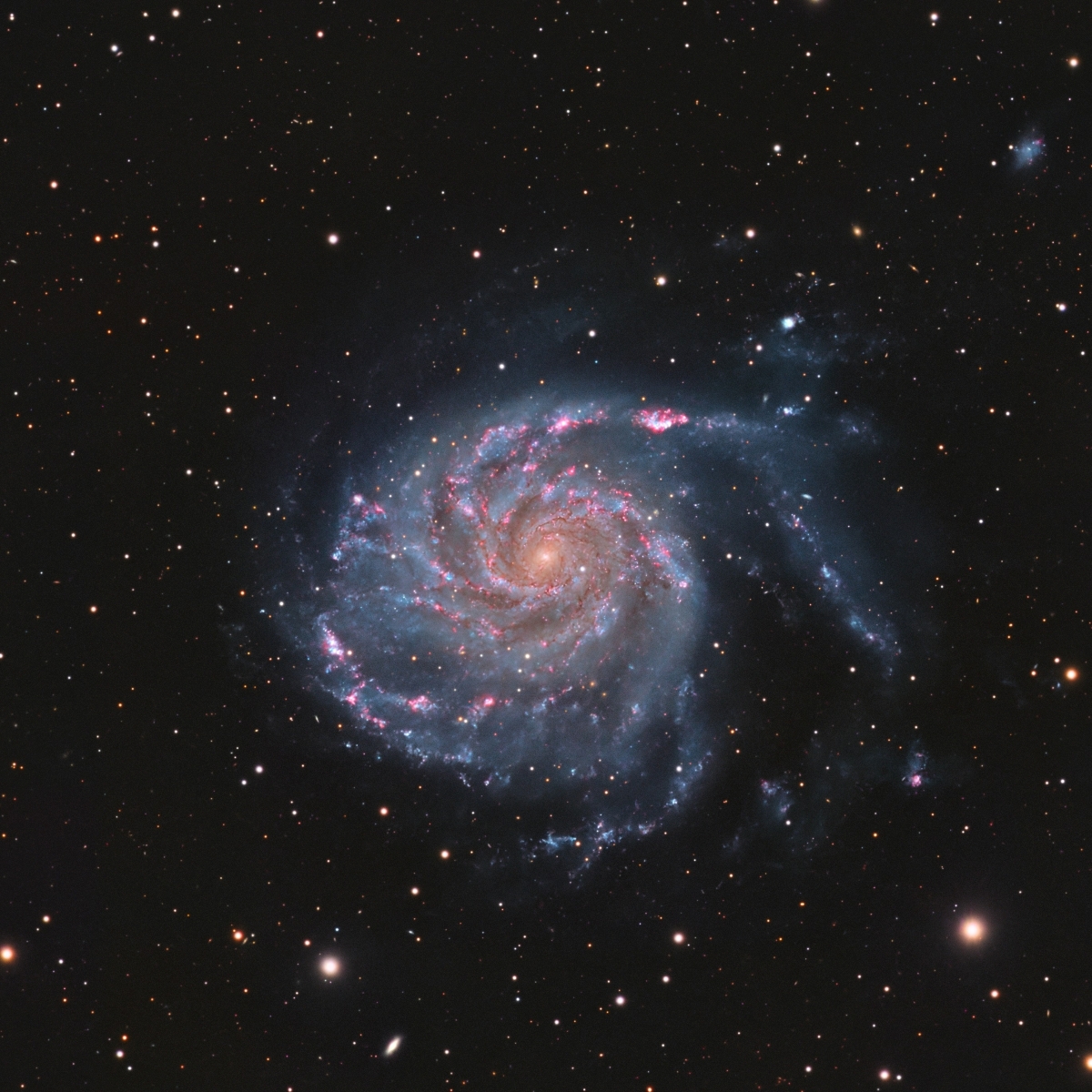
The Pinwheel Galaxy
Taken by Tommy Lease using a ZWO ASI2600MM Pro with 36mm Antlia LRGB filters, a 3nm H-alpha filter, and an Explore Scientific 127mm ED APO. Total exposure time of 30.5 hours.
Star Clusters
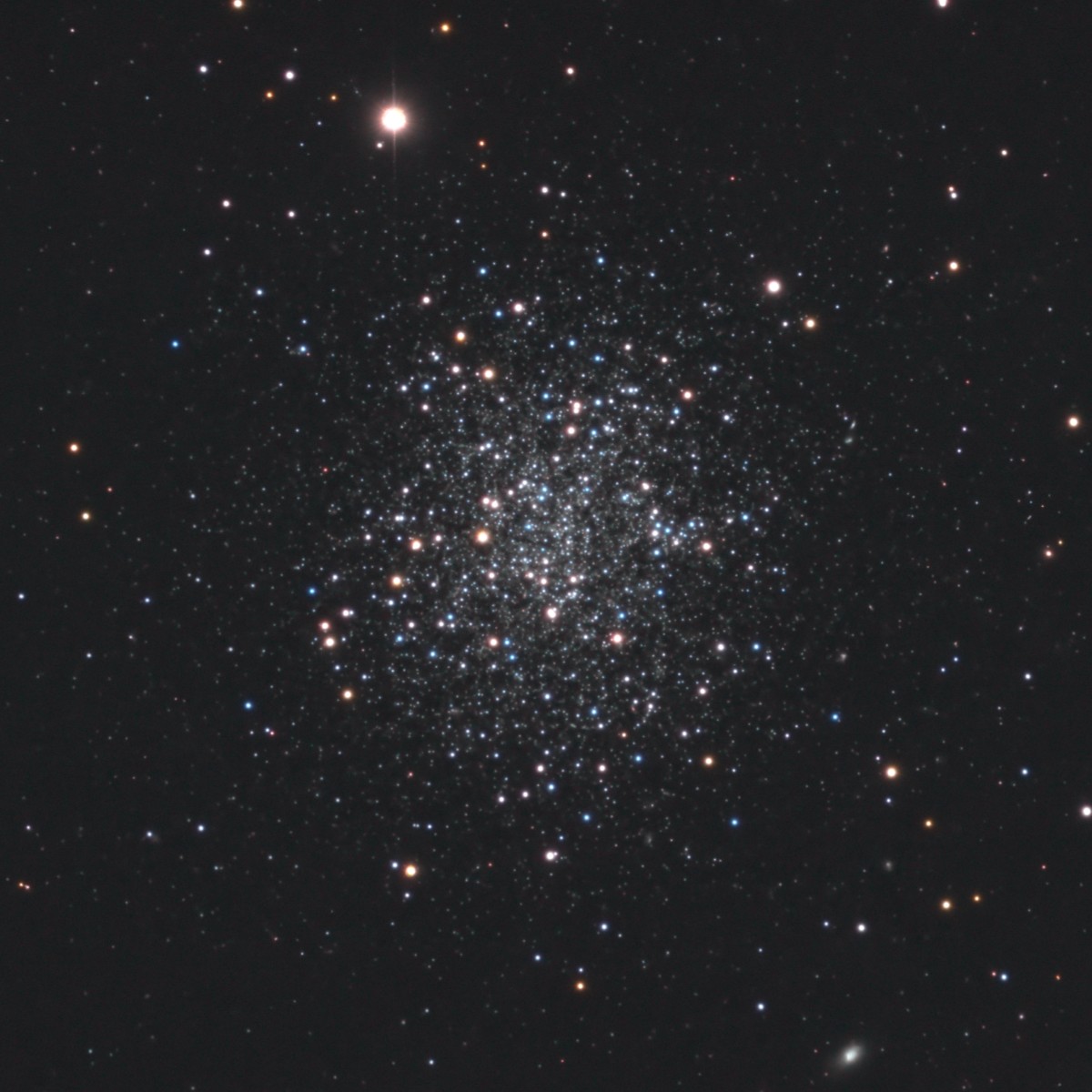
NGC 5053 Globular Cluster
Taken by Drew Evans using a ZWO ASI2600MM Pro with 2-inch Chroma LRGB filters and a Celestron EdgeHD 1100 reduced to f/7. Total exposure time of 2hr 20 minutes.
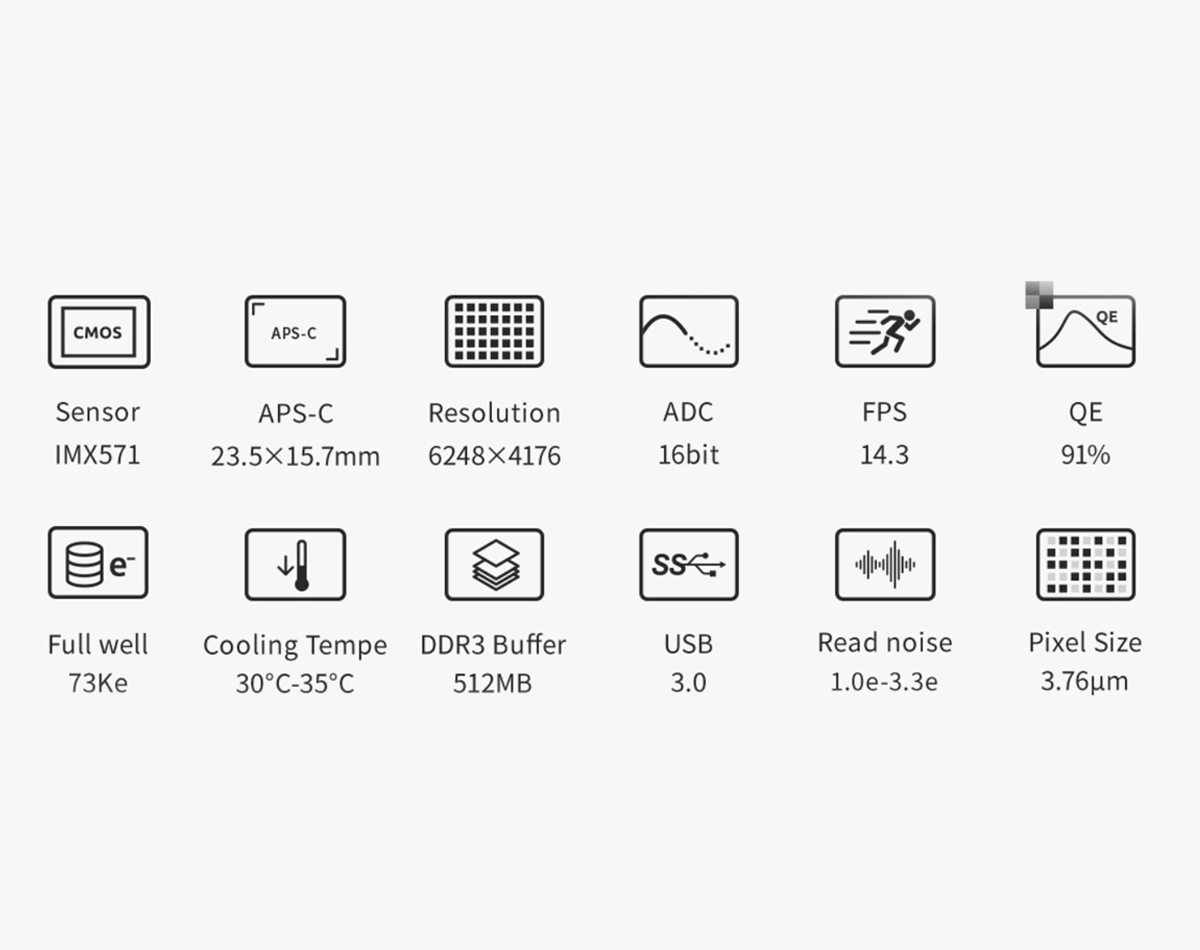
ASI2600MM Pro Specifications Overview
The ASI2600MM Pro has some of the best technical capabilities of any cooled astronomy camera on the market. Starting with a quantum efficiency (QE) of 91% means that the camera records nearly all of the photons hitting its sensor as data. This means it collects more light more efficiently, so your camera captures faint targets faster and with better detail. This is truly beneficial when imaging faint objects like galaxies and dark nebulae. Its 3.76µm pixels are perfect for a wide range of focal lengths and dynamic ranges too, all of which is complemented by an expanded 73 Ke full well capacity.
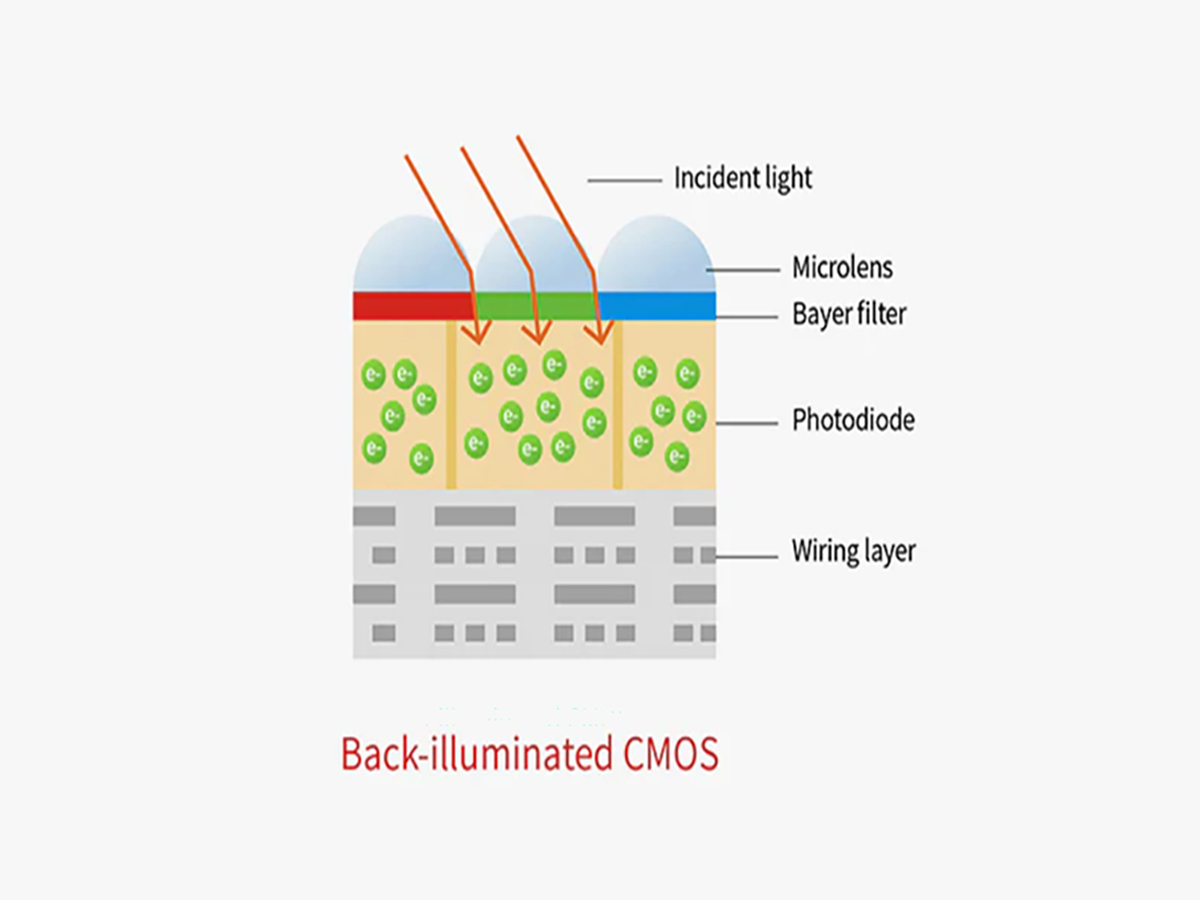
Better Light Collection with Sony’s Back-Illuminated Sensor
Sony's BSI CMOS sensor technology enhances sensitivity and reduces noise by positioning electronics behind the silicon layer rather than on top. This creates an unobstructed path for photons to reach the photodiode, rather than traditional CCD sensors, which have the layers reversed. This BSI technology also helps to reduce download speed, and it has proven especially helpful when managing the data output of high-resolution sensors like the IMX571.
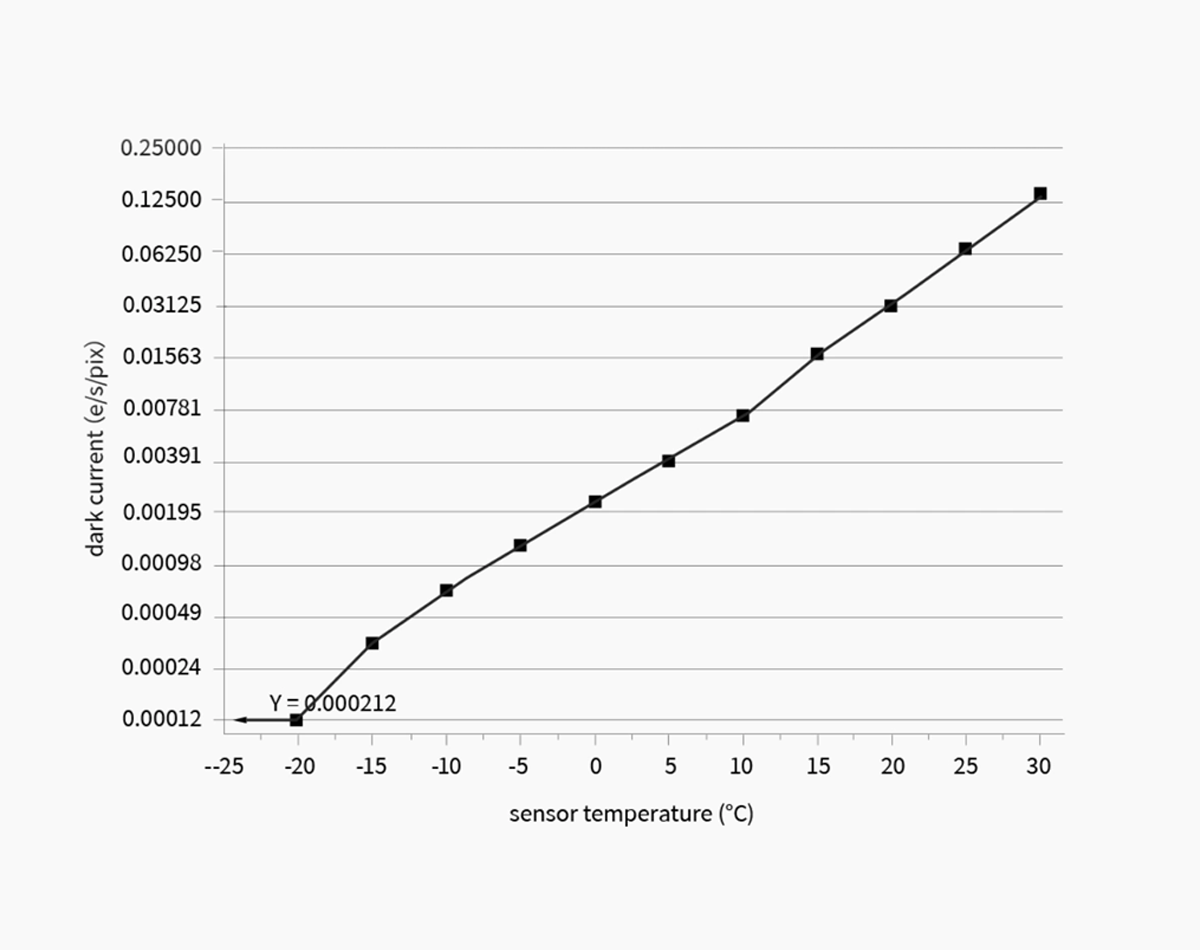
Reduced Noise with Two-stage TEC Cooling
The ASI2600MM Pro employs an advanced dual-stage thermoelectric (TEC) cooling system capable of lowering the sensor temperature by up to 35°C below the surrounding environmental conditions. Thanks also to ZWO’s dark current suppression technology, the dark current at 32°F (0°C) is only about 0.0022 electrons of thermal noise per pixel each second; meaning a 5-minute (300 s) exposure contributes only 0.7e of thermal noise, which is typically lower than the read-noise in many imaging setups. At -4°F (-20°C), dark current plunges further, reaching 0.00012 e/s/pixel, a level so low that for at most exposure times, the effect of dark current is so small it doesn’t noticeably add to the overall noise in your images.
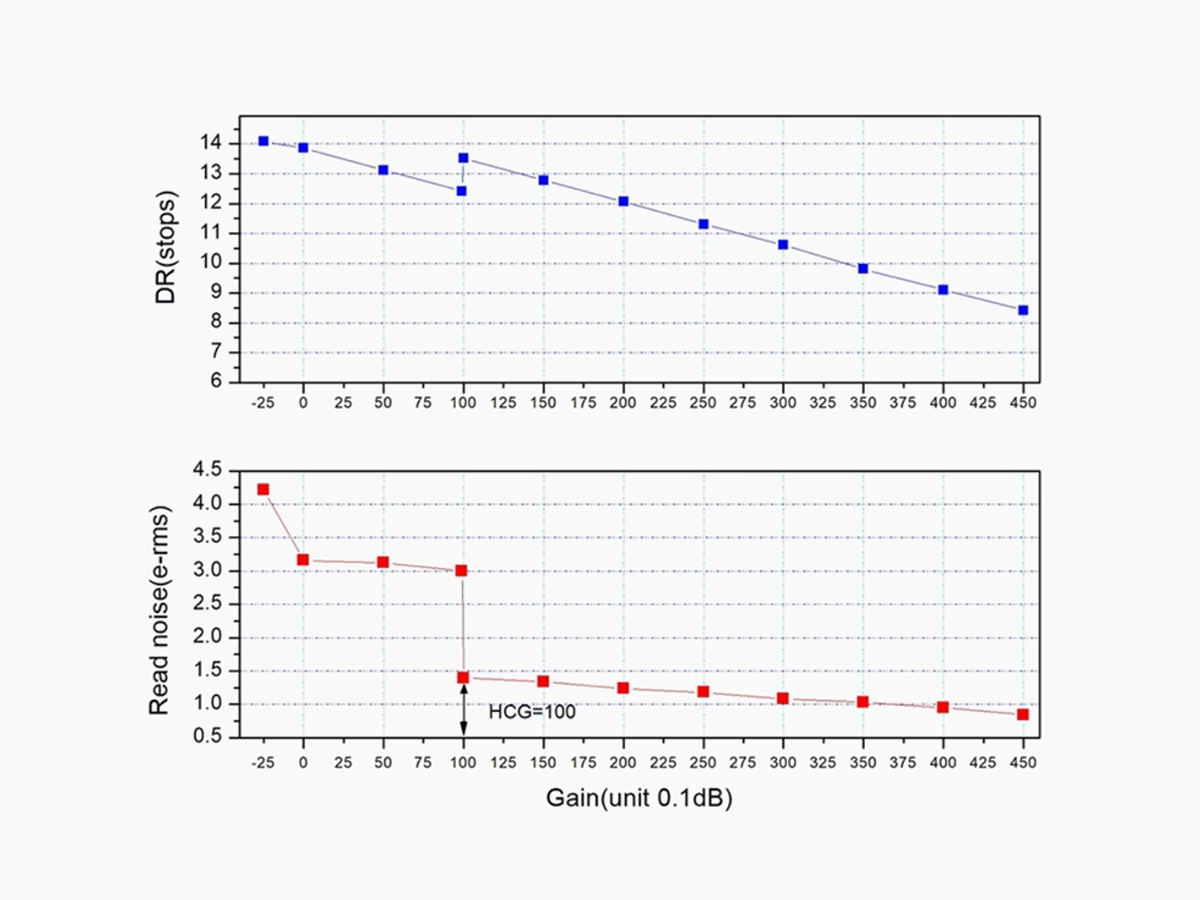
Dual Gain Modes Give You More Control Over Image Quality
The ASI2600MM’s IMX571 sensor introduces a significant improvement over earlier camera sensor models through its dual gain architecture. When you adjust the gain setting to 100, you'll instantly minimize read noise while enhancing dynamic range. This also boosts sensitivity, enabling you to record subtle details with reduced noise interference.
For most imaging scenarios, ZWO suggests using gain 100 as the optimal setting. The primary exceptions involve bright deep-sky targets or situations requiring brief exposure times, where lower or higher gain settings may prove more effective.
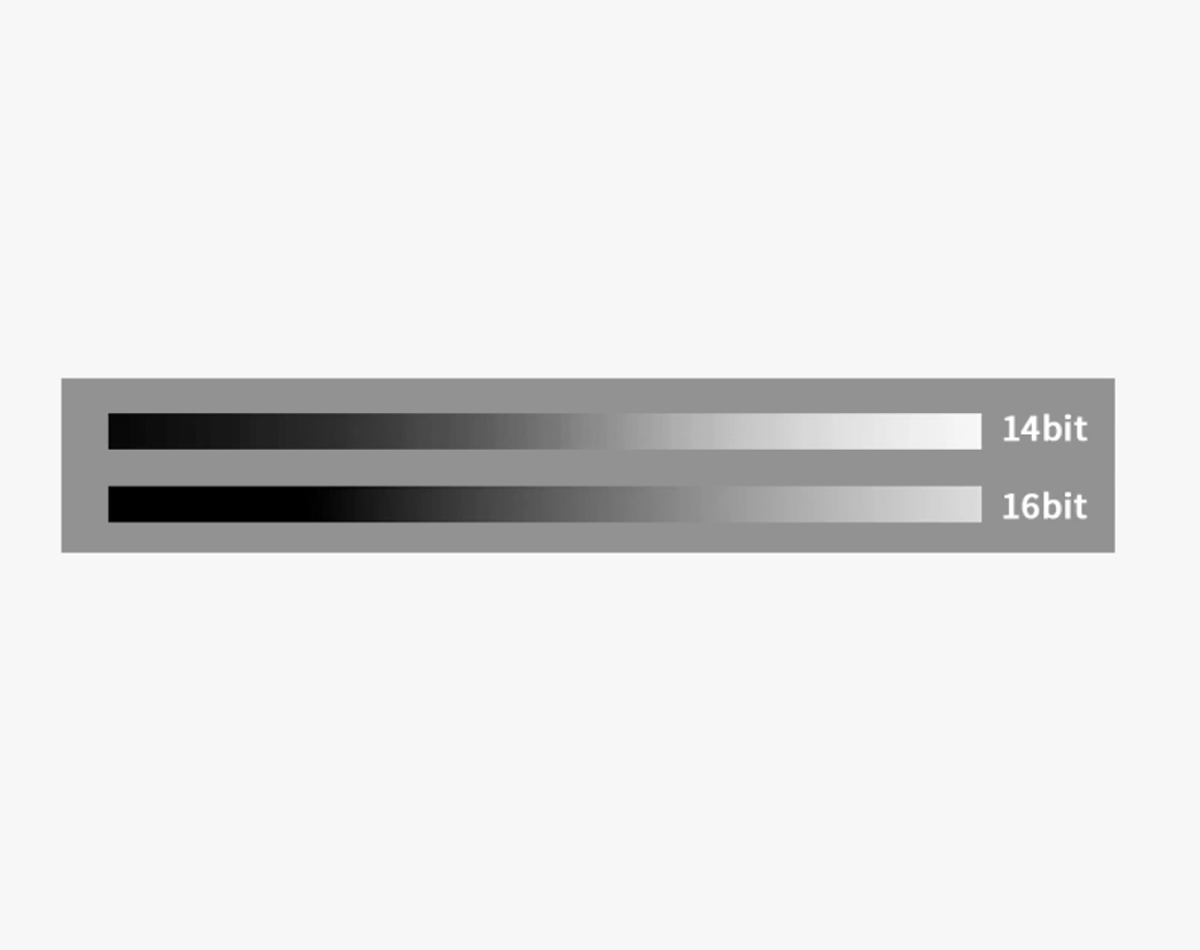
Native 16-bit ADC Improves Dynamic Range
The ZWO ASI2600MM Pro features a true 16-bit ADC and delivers up to 14 stops of dynamic range under optimal gain settings, allowing for excellent contrast and smooth tonal gradation even with narrowband filters. From faint nebular detail to relatively bright stars, it captures a wide range of signal in a single exposure. While extremely bright stars may still saturate under certain conditions, the ASI2600MM Pro gives you more headroom than many competing cooled astronomy cameras.

Zero Amp Glow Makes Post-Processing Easier
The ZWO ASI2600MM Pro shows a major advance with its total removal of amp glow. Amp-glow happens when infrared light leaks onto the sensor, creating unwanted marks that ruin your final images. Amp glow affects many older astro cameras, DSLRs, and even some modern cameras. Sometimes the issue is so severe that dark calibration frames need flat frames to fix it. No amp glow in the ASI2600MM Pro means you get cleaner, high-quality images right out of the camera.
How to Connect the ASI2600MM Pro for the Recommended 55mm Back Focus
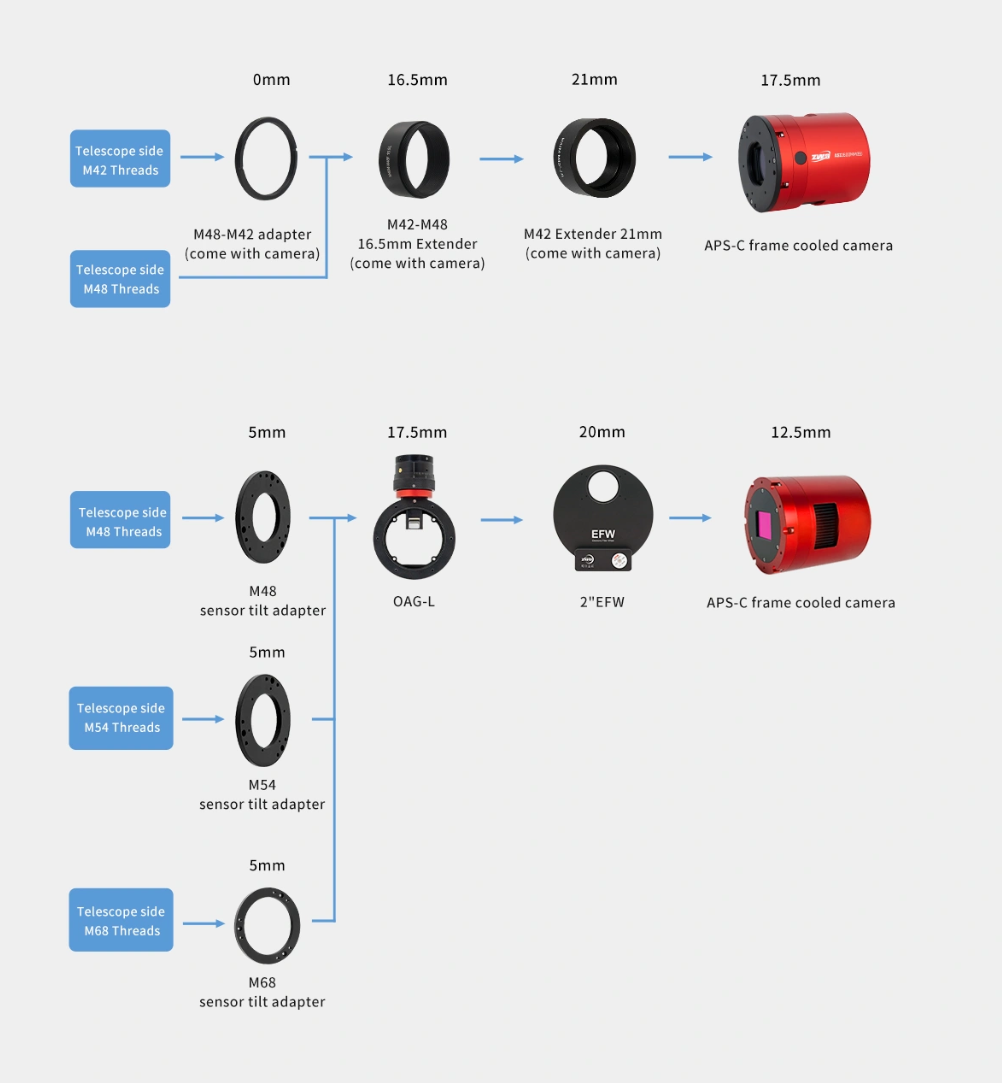

For other detailed connection methods, refer to ZWO's ASI2600MM Pro Connection Methods.
Specifications
- Sensor: Sony IMX571
- Format: APS-C
- Sensor Dimensions: 23.5x15.7 mm
- Diagonal: 28.3 mm
- MAX fps: 3.51fps
- Back Focus: 17.5 mm
- Resolution: 26 MP (6248 × 4176 px)
- Pixel size: 3.76 µm
- ADC: 16-bit
- Peak Quantum Efficiency (QE): 91%
- Full-Well: 75 Ke
- DDR Memory: 512MB
- Readout noise: 1.0-3.3e
- Backlit: Yes
- Weight: 1.54 lb (0.7 kg)
- Protective Window: D60 AR
Other Information
- Country of Manufacture: China
ASI2600MM Pro: The Next-Generation Camera for Deep Space Astrophotography
The upgraded ZWO ASI2600MM Pro builds on the reputation as a favorite among both backyard imagers and professional observatories. Still powered by the highly sensitive Sony IMX571 APS-C monochrome sensor with 3.76µm pixels, it delivers the outstanding performance, low read noise, and filter-based flexibility that astrophotographers trust for everything from galaxies to faint nebulae. What sets this upgraded version apart is its expanded full-well capacity, enhanced dynamic range, larger DDR3 buffer, and improved cooling and dew prevention—giving you even more control, reliability, and image quality in a wide range of observing conditions.
ZWO ASI2600MM Pro Overview & Results
Take a closer look at the ZWO ASI2600MM Pro and see what makes it such a popular choice for deep-sky astrophotography. We cover its key features, performance, and real imaging results in this short overview video:
ZWO ASI2600MM Pro Highlights
Built-in Dew Prevention
The ZWO ASI2600MM Pro uses a polyimide heater that fits perfectly behind the front cover of the sensor. The heater can be turned on or off depending on your climate. It dramatically reduces frost or dew that can form in higher-humidity environments. The heating element uses 5W at maximum power and can be controlled through any app that uses ASCOM.
512MB DDR3 RAM
The ASI2600MM Pro features 512MB of built-in DDR3 memory, which helps prevent dropped frames during image capture. This onboard cache also works alongside the USB 3.0 interface to eliminate amp glow—an unwanted bright patch that can appear in your images during long exposures, caused by heat and power from the camera’s electronics.
High Speed USB Connection
With its high-speed USB 3.0 port, the ZWO ASI2600MM Pro can download files with minimal lag time! Like all ZWO cameras in the pro series, it also has two USB 2.0 ports for accessories like a filter wheel, guider, or the ZWO Camera Angle Adjuster (CAA).
The Perfect Sensor for All Your Favorite Deep Sky Targets
Nebulae
The Crab Nebula
Taken by Isaac Garfinkle using a ZWO ASI2600MM Pro with 3nm Chroma SHO filters and a 10” GSO Truss Tube RC. Total exposure time of 27.5 hours.
Galaxies
The Pinwheel Galaxy
Taken by Tommy Lease using a ZWO ASI2600MM Pro with 36mm Antlia LRGB filters, a 3nm H-alpha filter, and an Explore Scientific 127mm ED APO. Total exposure time of 30.5 hours.
Star Clusters
NGC 5053 Globular Cluster
Taken by Drew Evans using a ZWO ASI2600MM Pro with 2-inch Chroma LRGB filters and a Celestron EdgeHD 1100 reduced to f/7. Total exposure time of 2hr 20 minutes.
ASI2600MM Pro Specifications Overview
The ASI2600MM Pro has some of the best technical capabilities of any cooled astronomy camera on the market. Starting with a quantum efficiency (QE) of 91% means that the camera records nearly all of the photons hitting its sensor as data. This means it collects more light more efficiently, so your camera captures faint targets faster and with better detail. This is truly beneficial when imaging faint objects like galaxies and dark nebulae. Its 3.76µm pixels are perfect for a wide range of focal lengths and dynamic ranges too, all of which is complemented by an expanded 73 Ke full well capacity.
Better Light Collection with Sony’s Back-Illuminated Sensor
Sony's BSI CMOS sensor technology enhances sensitivity and reduces noise by positioning electronics behind the silicon layer rather than on top. This creates an unobstructed path for photons to reach the photodiode, rather than traditional CCD sensors, which have the layers reversed. This BSI technology also helps to reduce download speed, and it has proven especially helpful when managing the data output of high-resolution sensors like the IMX571.
Reduced Noise with Two-stage TEC Cooling
The ASI2600MM Pro employs an advanced dual-stage thermoelectric (TEC) cooling system capable of lowering the sensor temperature by up to 35°C below the surrounding environmental conditions. Thanks also to ZWO’s dark current suppression technology, the dark current at 32°F (0°C) is only about 0.0022 electrons of thermal noise per pixel each second; meaning a 5-minute (300 s) exposure contributes only 0.7e of thermal noise, which is typically lower than the read-noise in many imaging setups. At -4°F (-20°C), dark current plunges further, reaching 0.00012 e/s/pixel, a level so low that for at most exposure times, the effect of dark current is so small it doesn’t noticeably add to the overall noise in your images.
Dual Gain Modes Give You More Control Over Image Quality
The ASI2600MM’s IMX571 sensor introduces a significant improvement over earlier camera sensor models through its dual gain architecture. When you adjust the gain setting to 100, you'll instantly minimize read noise while enhancing dynamic range. This also boosts sensitivity, enabling you to record subtle details with reduced noise interference.
For most imaging scenarios, ZWO suggests using gain 100 as the optimal setting. The primary exceptions involve bright deep-sky targets or situations requiring brief exposure times, where lower or higher gain settings may prove more effective.
Native 16-bit ADC Improves Dynamic Range
The ZWO ASI2600MM Pro features a true 16-bit ADC and delivers up to 14 stops of dynamic range under optimal gain settings, allowing for excellent contrast and smooth tonal gradation even with narrowband filters. From faint nebular detail to relatively bright stars, it captures a wide range of signal in a single exposure. While extremely bright stars may still saturate under certain conditions, the ASI2600MM Pro gives you more headroom than many competing cooled astronomy cameras.
Zero Amp Glow Makes Post-Processing Easier
The ZWO ASI2600MM Pro shows a major advance with its total removal of amp glow. Amp-glow happens when infrared light leaks onto the sensor, creating unwanted marks that ruin your final images. Amp glow affects many older astro cameras, DSLRs, and even some modern cameras. Sometimes the issue is so severe that dark calibration frames need flat frames to fix it. No amp glow in the ASI2600MM Pro means you get cleaner, high-quality images right out of the camera.
How to Connect the ASI2600MM Pro for the Recommended 55mm Back Focus
For other detailed connection methods, refer to ZWO's ASI2600MM Pro Connection Methods.
Specifications
- Sensor: Sony IMX571
- Format: APS-C
- Sensor Dimensions: 23.5x15.7 mm
- Diagonal: 28.3 mm
- MAX fps: 3.51fps
- Back Focus: 17.5 mm
- Resolution: 26 MP (6248 × 4176 px)
- Pixel size: 3.76 µm
- ADC: 16-bit
- Peak Quantum Efficiency (QE): 91%
- Full-Well: 75 Ke
- DDR Memory: 512MB
- Readout noise: 1.0-3.3e
- Backlit: Yes
- Weight: 1.54 lb (0.7 kg)
- Protective Window: D60 AR

- ZWO ASI2600MM Pro Camera Body
- Soft Case
- Quick Guide
- USB 3.0 cable (2 meters)
- 2x USB 2.0 cable (0.5 meters
- T2 - M48 Extender (16.5mm)
- T2 Extender (21mm)
- M42 to M48 Adapter
- Dust Cover
- Hexagon Wrench
- Upgraded from previous version: lower read noise, higher frame rates, and new matte finish
- 26 megapixel APS-C sensor delivers exceptional detail
- Versatile 3.76um pixel size works well with many telescope types and focal lengths
- True 16-bit ADC provides 14 stops of high dynamic range
- 91% peak quantum efficiency for greater sensitivity
- High 75Ke- full well capacity captures bright details without bloated stars
- Power supply (required) sold separately
ASI2600MM Pro: The Next-Generation Camera for Deep Space Astrophotography
The upgraded ZWO ASI2600MM Pro builds on the reputation as a favorite among both backyard imagers and professional observatories. Still powered by the highly sensitive Sony IMX571 APS-C monochrome sensor with 3.76µm pixels, it delivers the outstanding performance, low read noise, and filter-based flexibility that astrophotographers trust for everything from galaxies to faint nebulae. What sets this upgraded version apart is its expanded full-well capacity, enhanced dynamic range, larger DDR3 buffer, and improved cooling and dew prevention—giving you even more control, reliability, and image quality in a wide range of observing conditions.
ZWO ASI2600MM Pro Overview & Results
Take a closer look at the ZWO ASI2600MM Pro and see what makes it such a popular choice for deep-sky astrophotography. We cover its key features, performance, and real imaging results in this short overview video:
ZWO ASI2600MM Pro Highlights
Built-in Dew Prevention
The ZWO ASI2600MM Pro uses a polyimide heater that fits perfectly behind the front cover of the sensor. The heater can be turned on or off depending on your climate. It dramatically reduces frost or dew that can form in higher-humidity environments. The heating element uses 5W at maximum power and can be controlled through any app that uses ASCOM.
512MB DDR3 RAM
The ASI2600MM Pro features 512MB of built-in DDR3 memory, which helps prevent dropped frames during image capture. This onboard cache also works alongside the USB 3.0 interface to eliminate amp glow—an unwanted bright patch that can appear in your images during long exposures, caused by heat and power from the camera’s electronics.
High Speed USB Connection
With its high-speed USB 3.0 port, the ZWO ASI2600MM Pro can download files with minimal lag time! Like all ZWO cameras in the pro series, it also has two USB 2.0 ports for accessories like a filter wheel, guider, or the ZWO Camera Angle Adjuster (CAA).
The Perfect Sensor for All Your Favorite Deep Sky Targets
Nebulae
The Crab Nebula
Taken by Isaac Garfinkle using a ZWO ASI2600MM Pro with 3nm Chroma SHO filters and a 10” GSO Truss Tube RC. Total exposure time of 27.5 hours.
Galaxies
The Pinwheel Galaxy
Taken by Tommy Lease using a ZWO ASI2600MM Pro with 36mm Antlia LRGB filters, a 3nm H-alpha filter, and an Explore Scientific 127mm ED APO. Total exposure time of 30.5 hours.
Star Clusters
NGC 5053 Globular Cluster
Taken by Drew Evans using a ZWO ASI2600MM Pro with 2-inch Chroma LRGB filters and a Celestron EdgeHD 1100 reduced to f/7. Total exposure time of 2hr 20 minutes.
ASI2600MM Pro Specifications Overview
The ASI2600MM Pro has some of the best technical capabilities of any cooled astronomy camera on the market. Starting with a quantum efficiency (QE) of 91% means that the camera records nearly all of the photons hitting its sensor as data. This means it collects more light more efficiently, so your camera captures faint targets faster and with better detail. This is truly beneficial when imaging faint objects like galaxies and dark nebulae. Its 3.76µm pixels are perfect for a wide range of focal lengths and dynamic ranges too, all of which is complemented by an expanded 73 Ke full well capacity.
Better Light Collection with Sony’s Back-Illuminated Sensor
Sony's BSI CMOS sensor technology enhances sensitivity and reduces noise by positioning electronics behind the silicon layer rather than on top. This creates an unobstructed path for photons to reach the photodiode, rather than traditional CCD sensors, which have the layers reversed. This BSI technology also helps to reduce download speed, and it has proven especially helpful when managing the data output of high-resolution sensors like the IMX571.
Reduced Noise with Two-stage TEC Cooling
The ASI2600MM Pro employs an advanced dual-stage thermoelectric (TEC) cooling system capable of lowering the sensor temperature by up to 35°C below the surrounding environmental conditions. Thanks also to ZWO’s dark current suppression technology, the dark current at 32°F (0°C) is only about 0.0022 electrons of thermal noise per pixel each second; meaning a 5-minute (300 s) exposure contributes only 0.7e of thermal noise, which is typically lower than the read-noise in many imaging setups. At -4°F (-20°C), dark current plunges further, reaching 0.00012 e/s/pixel, a level so low that for at most exposure times, the effect of dark current is so small it doesn’t noticeably add to the overall noise in your images.
Dual Gain Modes Give You More Control Over Image Quality
The ASI2600MM’s IMX571 sensor introduces a significant improvement over earlier camera sensor models through its dual gain architecture. When you adjust the gain setting to 100, you'll instantly minimize read noise while enhancing dynamic range. This also boosts sensitivity, enabling you to record subtle details with reduced noise interference.
For most imaging scenarios, ZWO suggests using gain 100 as the optimal setting. The primary exceptions involve bright deep-sky targets or situations requiring brief exposure times, where lower or higher gain settings may prove more effective.
Native 16-bit ADC Improves Dynamic Range
The ZWO ASI2600MM Pro features a true 16-bit ADC and delivers up to 14 stops of dynamic range under optimal gain settings, allowing for excellent contrast and smooth tonal gradation even with narrowband filters. From faint nebular detail to relatively bright stars, it captures a wide range of signal in a single exposure. While extremely bright stars may still saturate under certain conditions, the ASI2600MM Pro gives you more headroom than many competing cooled astronomy cameras.
Zero Amp Glow Makes Post-Processing Easier
The ZWO ASI2600MM Pro shows a major advance with its total removal of amp glow. Amp-glow happens when infrared light leaks onto the sensor, creating unwanted marks that ruin your final images. Amp glow affects many older astro cameras, DSLRs, and even some modern cameras. Sometimes the issue is so severe that dark calibration frames need flat frames to fix it. No amp glow in the ASI2600MM Pro means you get cleaner, high-quality images right out of the camera.
How to Connect the ASI2600MM Pro for the Recommended 55mm Back Focus
For other detailed connection methods, refer to ZWO's ASI2600MM Pro Connection Methods.
Specifications
- Sensor: Sony IMX571
- Format: APS-C
- Sensor Dimensions: 23.5x15.7 mm
- Diagonal: 28.3 mm
- MAX fps: 3.51fps
- Back Focus: 17.5 mm
- Resolution: 26 MP (6248 × 4176 px)
- Pixel size: 3.76 µm
- ADC: 16-bit
- Peak Quantum Efficiency (QE): 91%
- Full-Well: 75 Ke
- DDR Memory: 512MB
- Readout noise: 1.0-3.3e
- Backlit: Yes
- Weight: 1.54 lb (0.7 kg)
- Protective Window: D60 AR
Other Information
- Country of Manufacture: China
- ZWO ASI2600MM Pro Camera Body
- Soft Case
- Quick Guide
- USB 3.0 cable (2 meters)
- 2x USB 2.0 cable (0.5 meters
- T2 - M48 Extender (16.5mm)
- T2 Extender (21mm)
- M42 to M48 Adapter
- Dust Cover
- Hexagon Wrench

ZWO ASI2600MM Pro Cooled Monochrome Astronomy Camera