

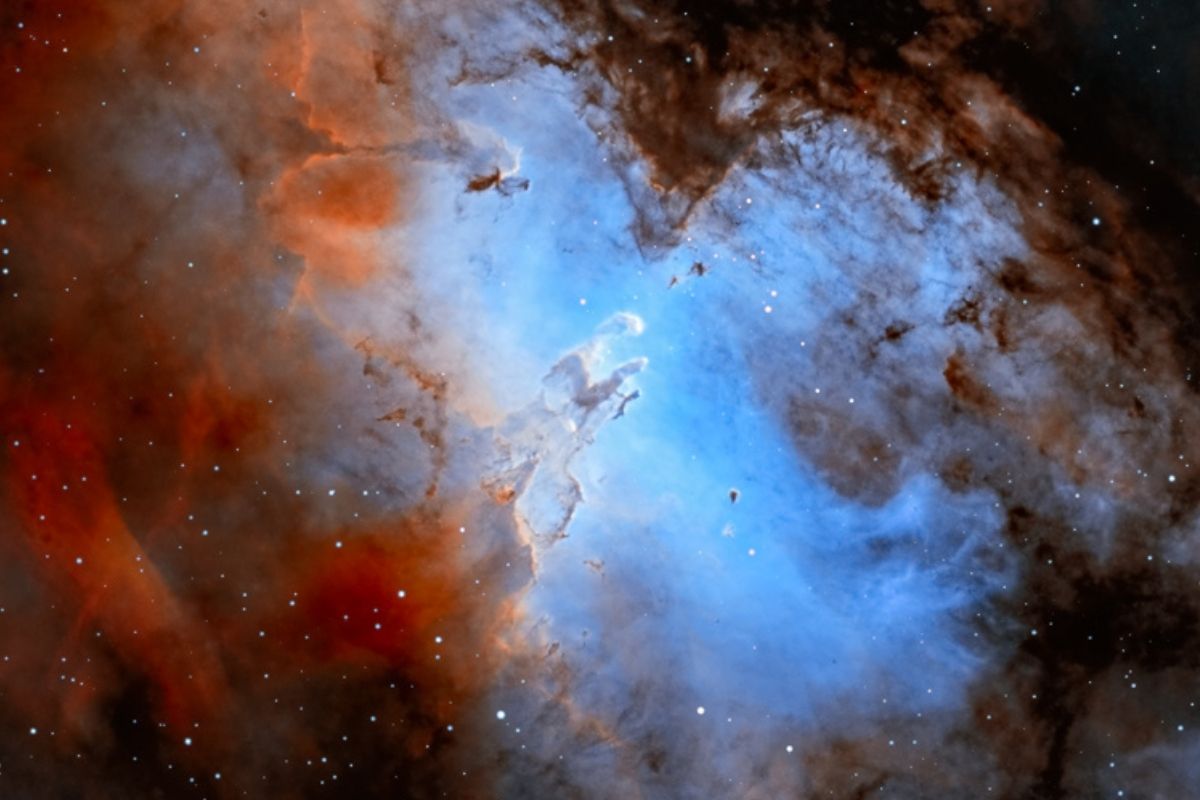
25 Best Summer Deep Sky Objects for Stargazing and Astrophotography
Summer is the golden season for deep sky astronomy, especially if you're in the Northern Hemisphere. From June through August, the night sky puts on a show with some of the most spectacular and colorful objects in our corner of the galaxy. This is the time of year when the brilliant core of the Milky Way rises high overhead, bringing with it a treasure trove of emission nebulae, star clusters, and stellar nurseries concentrated in constellations like Sagittarius, Cygnus, and Scorpius.
Unlike the challenge of hunting tiny, faint galaxies all spring, summer’s night skies offer bright, bold targets. It rewards observers with stunning colors and intricate structures. The iconic red and pink hues of hydrogen emission nebulae dominate the season. They’re joined by the brilliant blues of reflection nebulae and ancient globular clusters. With such variety, summer is when narrowband filters can get every bit as much use as a wide-field eyepiece.
Deep sky astronomy during the summer is not without its challenges though. Warmer temperatures can create atmospheric turbulence. This affects fine detail, and many of the best targets sit low in the southern sky where atmospheric distortion takes its biggest toll. But the payoff is worth it. Even with only a few hours of exposure time these objects often wind up published in your favorite astronomy magazines. Their splendor inspires newcomers to join the hobby.
We've gathered 25 of the best deep sky objects you can explore during summer's short nights. You'll find something for every skill level: beginner, intermediate, and advanced. We’ve included practical observing tips, photography advice, and insights to what makes each target special.
While summer nebulae are generally brighter and more forgiving than spring galaxies, you'll still benefit from larger apertures and darker skies. That’s just physics.To help you make the most of the season, we’ve recommended a variety of equipment that can handle both bright showpieces and faint extended objects.
Best Regions of the Night Sky for Viewing
June through to August is peak summer constellation visibility. This includes Sagittarius right in the heart of the Milky Way, Scorpius (a little to the south of Sagittarius), and Cygnus much higher in the night sky. Cygnus may also lead your eye to the famed “Summer Triangle”. An asterism comprising the stars of Vega, Deneb, and Altair. These three monsters are visible even from the center of your nearest major city. They form a very well-defined triangle that passes right overhead throughout the summer.
- Sagittarius targets: Best viewed July-August when the constellation is highest.
- Cygnus targets: Excellent throughout summer, overhead by late evening in August. The most recognizable options here include the Pelican Nebula, the Crescent Nebula, and the North America Nebula. All of these are massive emission nebulae.
Equipment Recommendations
The right gear to capture the night sky depends on your experience level. We’ve divided the target list into beginner, intermediate, and advanced categories so you can match your equipment to the objects you want to capture.
- Beginners: 6-8" reflecting telescope, 50mm - 90mm refracting telescope, or quality binoculars (10x50 or larger).
- Intermediate: 8-12" reflecting telescope, 100mm - 152mm refracting telescope, or tripod-mounted binoculars. At this level, all optics should be paired with a tracking mount for longer observations or images.
- Advanced: 12" or more aperture with precise tracking, specific eyepieces, monochrome cameras, and a wide range of broadband and narrowband filters for astrophotography.
Easy Tips for Stellar Astrophotography
To get the best results in astrophotography, these key techniques and tools can make a big difference:
- Light pollution filters: Essential for emission nebulae. The hydrogen alpha bandwidth is the most prominent, with Oxygen-III and Sulphur-II being the other two most commonly used narrowband filters. Some manufacturers have also combined multiple bandwidths into a single filter, designed to be used with one-shot color cameras.
- Exposure times: Beginners can start with 30-60 second exposures for targets like the Milky Way or specific constellations. But more advanced targets may require hours, and with proper tracking any target would at least benefit from longer exposures.
- Stacking: Multiple shorter exposures typically better than single long exposures.
Simple Tricks for Sharper Eyepiece Views
To see more detail and contrast at the eyepiece while observing try these techniques:
- Dark adaptation: Allow 20-30 minutes for eyes to adjust.
- Averted vision: Look slightly away from faint objects to use more sensitive rod cells.
- Filters: UHC or OIII filters enhance nebula contrast significantly.
Beginner Summer Targets

The Lagoon Nebula by Kat Miller
1: Lagoon Nebula (M8)
- Object Type: Emission Nebula
- Constellation: Sagittarius
- Distance: ~4,100 light-years
- Apparent Size: 90' × 40'
- Apparent Magnitude: 6.0
The Lagoon Nebula earned its name from a striking dark dust lane that cuts through bright glowing gas clouds, creating the appearance of water separating luminous shores. This massive star-forming region shines brightly enough for ancient observers to see without telescopes. For photography, use a wide-field setup and combine H-alpha with RGB data. Under dark skies, even a 200mm lens captures the full structure beautifully.
The stars within this cosmic lagoon are remarkably young, only about 2 million years old. That’s considered infancy on astronomical timescales. Dense molecular material continues collapsing under gravity to form new stellar generations. If this nebula were positioned at the same distance as the famous Orion Nebula, it would span six full moon widths across our sky, dramatically changing how we view winter constellations.

The Trifid Nebula by Dennis Sprinkle
2: Trifid Nebula (M20)
- Object Type: Emission and Reflection Nebula
- Constellation: Sagittarius
- Distance: ~5,200 light-years
- Apparent Size: 28' × 28'
- Apparent Magnitude: 9.0
The Trifid Nebula showcases two different types of cosmic phenomena in one remarkable object. Three prominent dust lanes divide the nebula into distinct sections, giving it the "trifid" name. Visually, use moderate magnification (100-150x) to see the dark lanes best, while photography benefits from combining OIII and H-alpha filters to separate the blue reflection from red emission regions.
The central star powering this display is extraordinarily young, only 300,000 years old. It began nuclear fusion while early humans were developing agriculture around 10,000 years ago. The nebula demonstrates active star formation processes, with dense molecular cores collapsing throughout the structure. Spectroscopic studies reveal complex motion patterns that indicate ongoing evolution within this stellar birthplace.

The Eagle Nebula by Isaac Garfinkle
3: Eagle Nebula (M16)
- Object Type: Emission Nebula with Star Cluster
- Constellation: Serpens
- Distance: ~7,000 light-years
- Apparent Size: 35' × 28'
- Apparent Magnitude: 6.4
The Eagle Nebula became famous when space telescopes revealed towering columns of gas and dust called the "Pillars of Creation." These massive structures represent active star formation sites where dense material resists destruction by stellar winds long enough for gravity to compress it into new stars. For the best pillar detail, use at least 8 inches of aperture with an OIII filter, or photograph with long H-alpha exposures and careful processing.
Each pillar extends roughly 4-5 light-years in height. Light takes nearly five years to travel from bottom to top. The nebula demonstrates how young stars both illuminate and gradually destroy their birth environment through intense radiation. Scientists believe ancient supernova explosions may have already destroyed these iconic pillars thousands of years ago, but the light carrying news of their destruction hasn't reached us yet.

M17 by Leah Thiel
4: Omega/Swan Nebula (M17)
- Object Type: Emission Nebula
- Constellation: Sagittarius
- Distance: ~5,500 light-years
- Apparent Size: 46' × 37'
- Apparent Magnitude: 7.5
The Omega Nebula takes its name from its curved shape resembling the Greek letter omega. However, many observers see a swan with an outstretched neck. This enormous star-forming region contains enough material to create hundreds of Sun-like stars. Its bright curved edge shows beautifully at 75-100x magnification. Photographers should expose for at least 2-3 hours total to capture the fainter outer regions.
This nebula produces more total energy than the famous Orion Nebula, making it one of the most luminous emission regions in the night sky. Its central area contains multiple O-type stars. This is the most massive and short-lived stellar class. Their combined radiation heats surrounding gas to temperatures exceeding 10,000 degrees Celsius. These extreme conditions create perfect laboratories for studying how massive stars form and evolve.

The Veil Complex by Tommy Lease
5: Veil Nebula Complex (NGC 6960/6992)
- Object Type: Supernova Remnant
- Constellation: Cygnus
- Distance: ~2,100 light-years
- Apparent Size: 180' × 130'
- Apparent Magnitude: 7.0
The Veil Nebula Complex preserves the aftermath of a massive stellar explosion that occurred about 8,000 years ago, when human civilization was just developing agriculture. The original star was roughly 20 times more massive than our Sun. When it exploded, it would have blazed brighter than Venus for several weeks. It is visually stunning with OIII filters at low magnification (50-75x). Photographers should use narrowband H-alpha and OIII filters with 4+ hours exposure to capture the full filamentary structure.
The nebula's delicate structures result from the supernova shock wave interacting with the surrounding space environment. Different elements glow in characteristic colors. Oxygen creates blue-green light enhanced by OIII filters, while hydrogen produces red emissions. This cosmic recycling returns heavy elements forged in the dying star back to space, where they'll eventually become part of future stars and planet

NGC 7000 by Travis Patterson
6: North America Nebula (NGC 7000)
- Object Type: Emission Nebula
- Constellation: Cygnus
- Distance: ~2,590 light-years
- Apparent Size: 120' × 100'
- Apparent Magnitude: 4.0
This nebula's resemblance to North America is so accurate that photographs clearly show the "coastline," "Gulf of Mexico," and even "Florida." The sharp boundaries creating this continental shape mark where glowing hydrogen gas meets dense dust clouds that block background light. Best captured with fast lenses (f/2.8 or faster) at 85-200mm focal lengths. Using an H-alpha filter willenhance the continental outline dramatically.
Scientists continue debating which star actually powers this massive emission region. While the brilliant star Deneb seems like the obvious choice, recent studies suggest multiple hot stars may work together to ionize the gas. The nebula contains enough hydrogen to form thousands of Sun-like stars, with active star formation ongoing along the eastern boundary known as the "Cygnus Wall." This demonstrates sustained stellar birth within one of the northern hemisphere's most prominent emission regions.

Rho Ophiuchi Complex by Brian Fulda
7: Rho Ophiuchi Complex
- Object Type: Emission and Reflection Nebula Complex
- Constellation: Ophiuchus
- Distance: ~400 light-years
- Apparent Size: 4.5° × 6°
- Apparent Magnitude: Variable (individual stars 4.6-7.0)
The Rho Ophiuchi complex is one of the most colorful and photogenic regions in the entire night sky. It combines brilliant blue reflection nebulae with red emission regions and dark dust lanes in a cosmic masterpiece. This nearby star-forming region showcases stellar birth across multiple stages, from dense dark clouds where stars haven't yet formed to bright young stars already illuminating their surroundings. It is best captured with wide-field lenses (85-200mm focal length) using several hours of exposure. The complex is too large for most telescopes but shows beautifully in binoculars from dark sites.
This massive region takes its name from the bright star Rho Ophiuchi, whose intense blue-white light illuminates surrounding dust clouds through reflection. This is in contrast to the pink and red regions where hydrogen gas glows from ultraviolet radiation put out by the stars. The dark lanes provide dramatic contrast where dense material blocks background light completely. At just 400 light-years away, this is one of the closest major star-forming regions to Earth, making it an ideal laboratory for studying how new stars and planetary systems develop within molecular clouds.
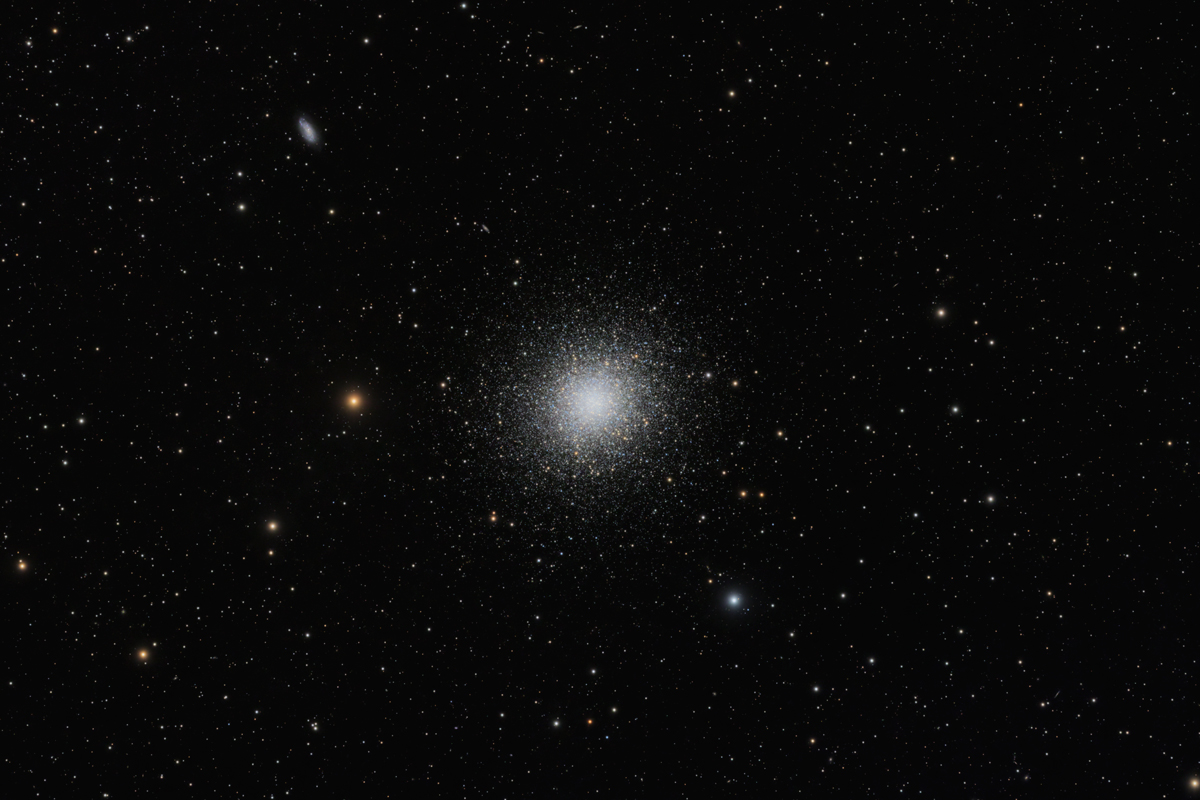
M13 by Douglas Triggs
8: Hercules Cluster (M13)
- Object Type: Globular Cluster
- Constellation: Hercules
- Distance: ~25,100 light-years
- Apparent Size: 20.0'
- Apparent Magnitude: 5.8
Messier 13 is one of the most spectacular globular clusters in the night sky, and it is certainly the most well-known of all star clusters. M13 is a massive sphere containing about 300,000 stars packed into a space roughly 145 light-years across. Visually, use high magnification (200x+) to resolve individual stars at the edges, while photography requires precise tracking and 3-5 minute exposures to avoid blown-out cores. It is such a large, bright target that even a modest pair of binoculars will show the presence of a large, bright, bloated object that’s clearly neither nebula nor galaxy.
This cluster holds special significance as the target of humanity's first deliberate message to potential extraterrestrial intelligence. In 1974, scientists used the Arecibo radio telescope to transmit information about human civilization toward M13. The message will take 25,000 years to arrive, with any possible response requiring another 25,000 years to return. This makes it our species' longest-duration communication project, extending far beyond human historical timescales.

M27 by Drew Evans
9: Dumbbell Nebula (M27)
- Object Type: Planetary Nebula
- Constellation: Vulpecula
- Distance: ~1,360 light-years
- Apparent Size: 8.0' × 5.7'
- Apparent Magnitude: 7.5
The Dumbbell Nebula earned the distinction of being the first planetary nebula discovered. It was, catalogued by Charles Messier in 1764. Its distinctive dumbbell or apple-core shape results from complex interactions between stellar winds during different phases of the central star's evolution. This nebula responds excellently to OIII filtering for visual observation, while photographers should bracket exposures from 2-10 minutes to capture both the bright core and faint outer shell.
The nebula currently expands at 27 kilometers per second and scientists estimate it formed about 14,600 years ago. The central white dwarf may look like just a faint star in amateur telescopes, but it represents one of the most extreme objects in our cosmic neighborhood, roughly Earth's size but containing more mass than our Sun, with surface gravity 100,000 times stronger than Earth's.
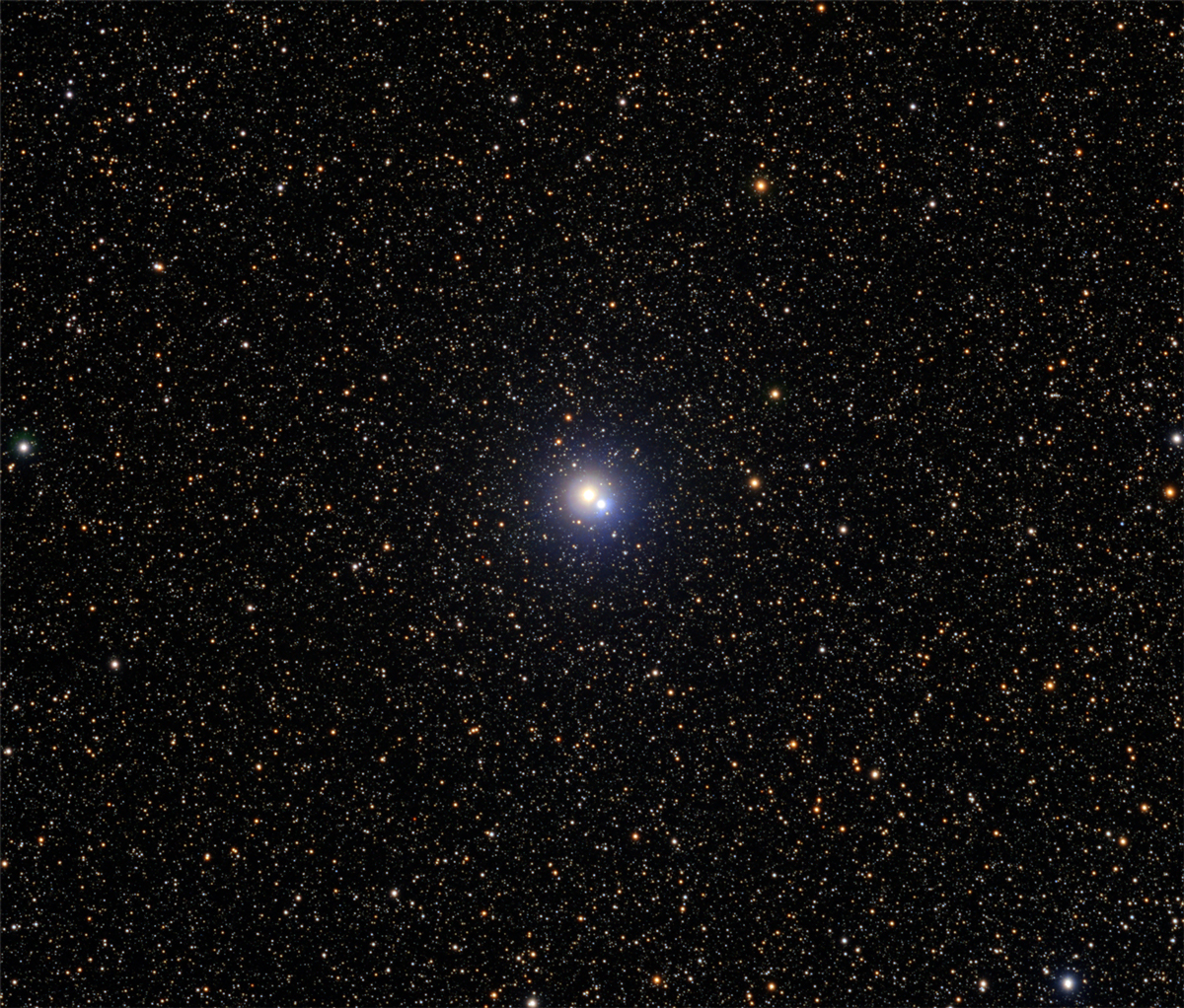
Albireo by Joel Shepherd
10: Albireo
- Object Type: Double Star
- Constellation: Cygnus
- Distance: ~430 light-years
- Apparent Size: 34.3" separation
- Apparent Magnitude: 3.1, 5.1
Albireo offers one of the most beautiful demonstrations of stellar diversity visible through telescopes. The primary star shines golden-yellow, representing a K-type giant that has evolved beyond its main-sequence phase and expanded to enormous size. This double star splits cleanly at just 30x magnification in any telescope, making it perfect for beginners. The color contrast becomes more striking at 75-150x power.
Scientists remain uncertain whether these stars actually orbit each other or simply appear aligned from our perspective. If truly binary, they orbit at least 4,400 times farther apart than Earth orbits the Sun, requiring over 100,000 years to complete one orbit. This extreme separation, combined with their vastly different masses and evolutionary states, challenges our understanding of how binary star systems form and develop over time.
Intermediate Summer Targets

SH2-190 by Craig Dixon
11: The Heart Nebula (Sharpless 2-190)
- Object Type: Emission Nebula
- Constellation: Cassiopeia
- Distance: ~7,500 light-years
- Apparent Size: 150' × 130'
- Apparent Magnitude: 18.3 (surface brightness)
The Heart Nebula's distinctive cardiac shape forms when hot, young stars carve vast cavities in surrounding gas and dust. A central cluster of massive stars creates the characteristic two-lobed structure that genuinely resembles a human heart when captured through specialized photographic filters. Requires dedicated H-alpha imaging with at least 3-4 hours total exposure time. Use a fast telescope (f/4 or faster) and frame with the nearby Soul Nebula for stunning widefield compositions.
This stellar nursery connects with the nearby Soul Nebula to form one of the largest emission regions visible from northern latitudes. Radio observations confirm that new stars continue forming throughout the nebula as dense molecular cores collapse under gravity. The region shows how star formation can spread across hundreds of light-years, with shock waves from earlier stellar births triggering collapse in previously stable gas clouds.

IC1848 by Douglas Triggs
12: Soul Nebula (IC1848)
- Object Type: Emission Nebula
- Constellation: Cassiopeia
- Distance: ~6,500 light-years
- Apparent Size: 150' × 75'
- Apparent Magnitude: 18.5 (surface brightness)
The Soul Nebula displays stellar evolution happening across multiple generations within its extensive ghostly structure. Embedded O and B-type stars selectively ionize hydrogen gas, creating regions of different density and brightness that sculpt the nebula's distinctive appearance. Best photographed with widefield setups (200-400mm focal length) using H-alpha and OIII filters. The ghostly outline becomes apparent after 2+ hours of narrowband imaging.
Spectroscopic studies reveal complex motion throughout the nebula. They show stellar winds and supernova shock waves have stirred the interstellar medium over millions of years. Dense globules scattered through the emission regions mark potential sites for future star formation, continuing the endless cycle of stellar birth, death, and renewal. The nebula's extended structure provides excellent opportunities for studying how massive stars influence their environment across both space and time.

NGC 6888 by Kat Miller
13: Crescent Nebula (NGC 6888)
- Object Type: Wolf-Rayet Nebula
- Constellation: Cygnus
- Distance: ~5,000 light-years
- Apparent Size: 18' × 12'
- Apparent Magnitude: 10.4
The Crescent Nebula surrounds one of the rarest and most extreme stars in our galaxy - a Wolf-Rayet star undergoing catastrophic mass loss during its final evolutionary phase. These stellar monsters burn so intensely that they shed material thousands of times faster than normal stars, creating the complex structures visible in deep photographs. OIII filtering dramatically enhances the crescent structure visually at 100-150x magnification. For photography, combine H-alpha and OIII data with 4+ hours total exposure.
Wolf-Rayet stars exist for only a few hundred thousand years before exploding as supernovae, making them extremely rare. The central star loses mass equal to our entire Sun every 10,000 years, with material racing away at speeds up to 1,700 kilometers per second. This extreme mass loss exposes the star's nuclear-processed interior, providing crucial data for understanding how the most massive stars end their lives.

NGC 7822 by Charles Hagen
14: The Question Mark Nebula (NGC 7822)
- Object Type: Emission Nebula
- Constellation: Cygnus
- Distance: ~2,590 light-years
- Apparent Size: 60' × 50'
- Apparent Magnitude: 8.0
NGC 7822 displays active star formation through prominent pillars and bright features that have been created by young, hot stars within the Cepheus molecular cloud complex. Stellar winds and ultraviolet radiation from newly formed O and B-type stars have shaped all of this dense gas, and the resulting nebula can even be visually observed with the right gear and dark-enough skies. This would require H-alpha filters and a large telescope of at least 10+ inches. Photographically the best results will come from a combination of H-alpha and OIII data. Ideally you would capture a minimum of 6+ hours total exposure to reveal the pillar structures and surrounding emission.
The star formation that produced all of this detail began several million years ago. Dense cores of dust and gas continue forming new stars within the pillars, while stellar winds gradually erode these same regions and densely compacts all of its material. Infrared observations into these denser areas have revealed numerous embedded protostars. This proves this region continues producing new stars despite its evolved appearance. This object connects to a handful of other emission regions including the Cave Nebula, making it a very enjoyable region of space to point your cameras.
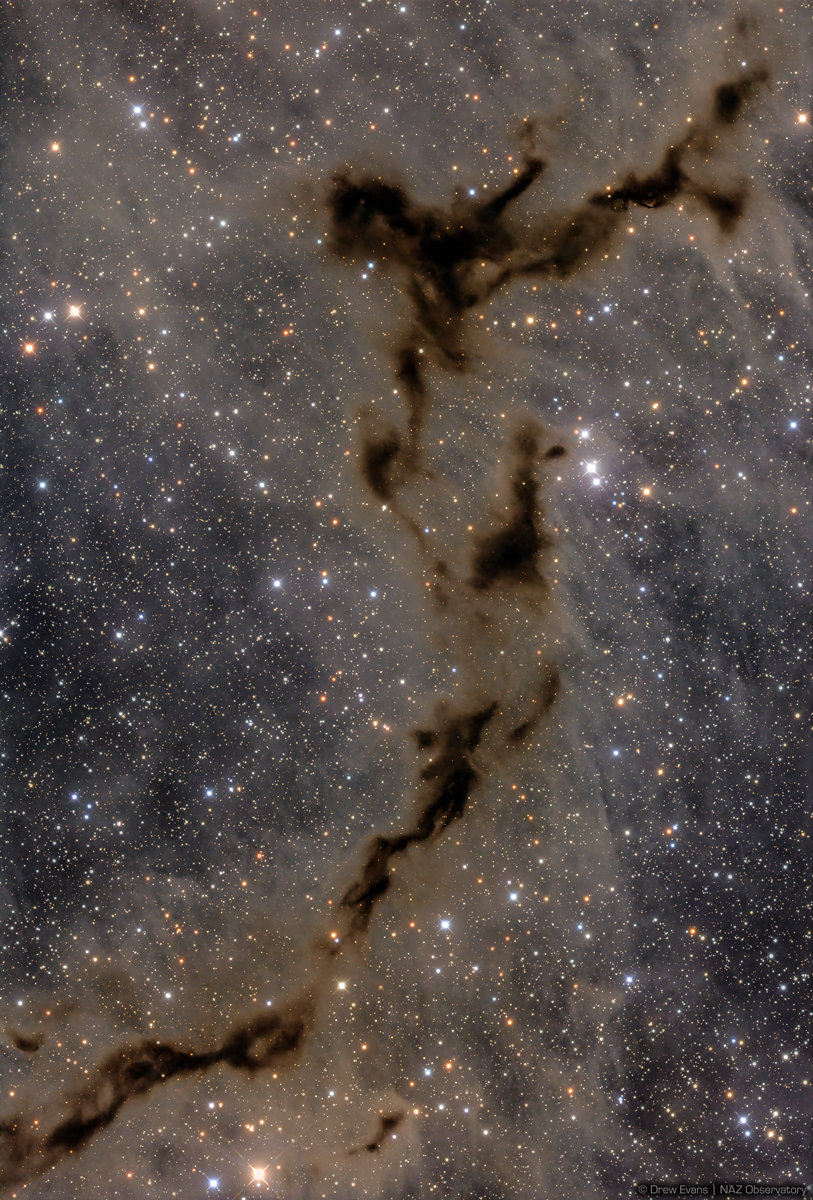
The Seahorse Nebula by Drew Evans
15: The Seahorse Nebula (Barnard 150)
- Object Type: Dark Nebula
- Constellation: Cepheus
- Distance: ~1,200 light-years
- Apparent Size: 30' × 15'
- Apparent Magnitude: N/A (dark nebula)
The Seahorse Nebula creates one of the most distinctive silhouettes in the northern sky, its dark lanes carving an unmistakable equine profile against the rich star fields of Cepheus. This dense molecular cloud blocks background starlight so effectively that early astronomers mistook such regions for holes in the heavens, not realizing they were looking at stellar nurseries where future generations of stars would eventually form. Best observed with wide-field telescopes or binoculars at low magnification (25-50x) to appreciate the full seahorse outline. For photography, use wide-field lenses (85-200mm) with 2-4 hours total exposure to capture the contrast between dark dust and background stars.
Barnard 150 belongs to the extensive Cepheus molecular cloud complex. The complex is one of the densest concentrations of dust and gas in our local galactic neighborhood. The seahorse's distinctive "head" and "curved tail" result from complex three-dimensional structures viewed from our perspective, where varying dust density creates different levels of extinction. While appearing empty to casual observation, radio telescopes reveal intense molecular activity within these dark regions as gravity slowly compresses the material toward eventual stellar birth. The nebula demonstrates how dark clouds serve as cosmic recycling centers, concentrating material ejected by previous stellar generations into reservoirs for future star formation cycles.

IC 1396 by Terry Hancock
16: Elephant's Trunk Complex (IC 1396)
- Object Type: Emission Nebula Complex
- Constellation: Cepheus
- Distance: ~2,400 light-years
- Apparent Size: 170' × 140'
- Apparent Magnitude: 3.5 (central star)
This vast nebula complex surrounds the red supergiant star Mu Cephei and features the distinctive "Elephant's Trunk", a dark pillar of dense gas and dust stretching about 20 light-years long. We suggest using a wide-field telescope or camera lens (85-135mm) to frame the entire complex. Shooting with a narrow-band H-alpha filter will help reveal the trunk's intricate structure against the bright background.
The elephant's trunk contains dense knots where new stars are actively forming. Recent infrared observations have detected numerous baby protostars hidden within the densest regions. This proves this ancient-looking structure continues producing new stellar generations. The formation demonstrates how massive stars influence their cosmic neighborhoods across multiple light-year distances through radiation pressure and stellar winds.

M51 by Isaac Garfinkle
17: Whirlpool Galaxy (M51)
- Object Type: Spiral Galaxy
- Constellation: Canes Venatici
- Distance: ~31 million light-years
- Apparent Size: 11.2' × 6.9'
- Apparent Magnitude: 8.4
The Whirlpool Galaxy made history as the first galaxy where astronomers could definitively observe spiral structure. It was, discovered by Lord Rosse in 1845 using his massive telescope. This discovery helped establish that "nebular objects" were actually separate "island universes" beyond our own Milky Way. It is best observed at 150-200x magnification to see spiral arm structure. For photography, try to use at least 6-8 hours total exposure time to capture all the details from both the main galaxy and its captured companion.
The dramatic interaction with its smaller companion galaxy has enhanced M51's spiral structure through gravitational forces. This cosmic encounter has triggered waves of star formation throughout the spiral arms while creating extended streams of stars and gas. Computer simulations suggest this interaction began hundreds of millions of years ago. It will continue until both galaxies eventually merge into a single larger system.
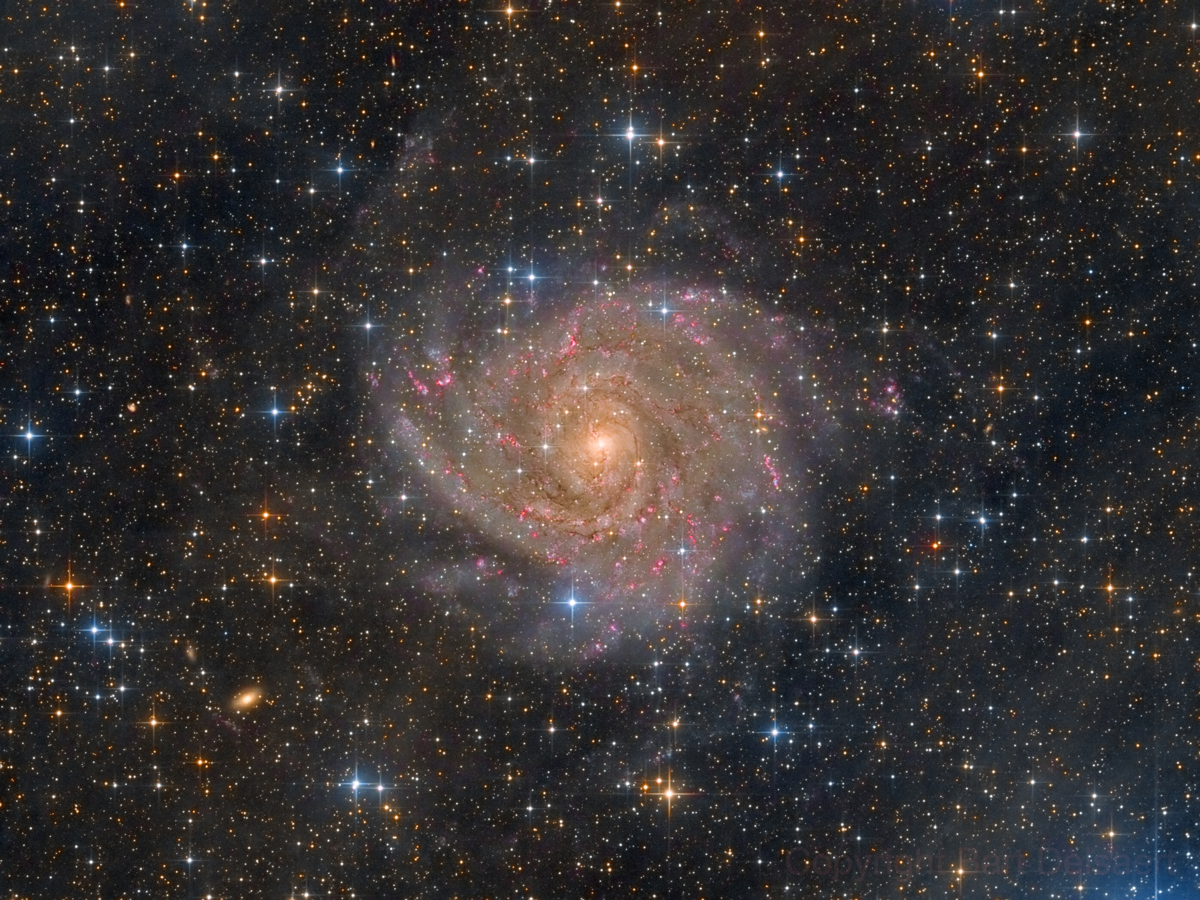
IC 342 by Bart Delsaert
18: The Hidden Galaxy (IC 342)
- Object Type: Spiral Galaxy
- Constellation: Camelopardalis
- Distance: ~10 million light-years
- Apparent Size: 21' × 20'
- Apparent Magnitude: 9.1
The Hidden Galaxy earns its nickname from lying directly behind our Milky Way's dusty disk, which obscures and reddens its light dramatically. Despite being one of our closest galactic neighbors, IC 342 remains surprisingly elusive due to heavy interstellar extinction that dims it by several magnitudes. This challenging target requires exceptional dark skies and low magnification (50-75x) for visual detection. Photographically, expect long exposures (10+ hours) and use techniques to overcome heavy dust extinction.
IC 342 spans roughly 50,000 light-years in diameter and shows beautiful face-on spiral structure when the obscuring dust is penetrated. The galaxy anchors its own small group along with the nearby Maffei galaxies, forming one of the closest galaxy groups to our Local Group. Advanced imaging reveals intricate spiral arms dotted with star-forming regions. The intervening dust creates an amber coloration that distinguishes it from more distant, unobscured spirals. This cosmic hide-and-seek demonstrates how our galactic location affects our view of the surrounding universe.

NGC 7789 by Bart Delsaert
19: Caroline's Rose (NGC 7789)
- Object Type: Open Star Cluster
- Constellation: Cassiopeia
- Distance: ~7,600 light-years
- Apparent Size: 16.0'
- Apparent Magnitude: 6.7
Caroline's Rose is one of the most elegant stellar patterns in the northern sky, with delicate chains of stars radiating outward from a denser central region like petals on a cosmic flower. This beautiful open cluster was discovered by Caroline Herschel in 1783. It is one of the first deep sky objects found by a woman astronomer. The rose pattern emerges beautifully at 100-150x magnification in telescopes 6 inches or larger. Look for subtle color differences among the cluster members, with evolved red giants mixed among the main sequence stars.
At roughly one billion years old, Caroline's Rose is a mature open cluster where many original members have evolved beyond their main sequence phase into red giants and white dwarfs. This intermediate age creates the cluster's distinctive appearance, as the brightest blue stars have long since exploded as supernovae while cooler, longer-lived stars continue burning steadily. The cluster contains approximately 1,000 stars spread across about 50 light-years of space, though only the brightest members are visible through amateur telescopes.
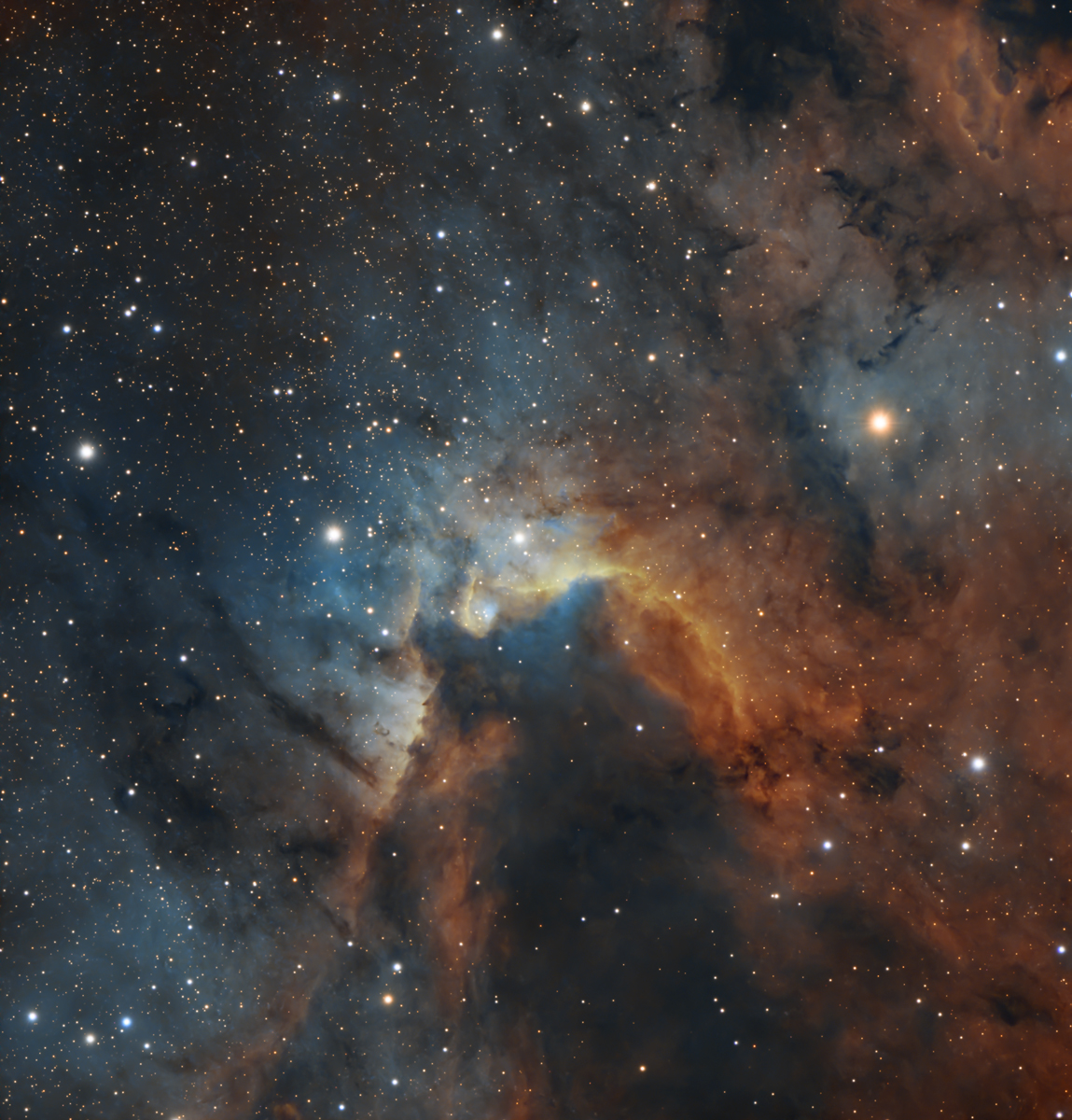
SH2-155 by Craig Dixon
20: Cave Nebula (Sh2-155)
- Object Type: Emission Nebula
- Constellation: Cepheus
- Distance: ~2,400 light-years
- Apparent Size: 50' × 30'
- Apparent Magnitude: Very faint (no integrated magnitude)
The Cave Nebula represents one of the fainter emission regions accessible to amateur astronomers. It requires patience and specialized techniques to appreciate fully. Its cave-like appearance results from a complex three-dimensional arrangement of glowing gas and absorbing dust clouds. Dense molecular material blocks background light while foreground gas glows from stellar ionization. This extremely faint nebula requires H-alpha filtering and exceptionally dark skies. Use widefield imaging (85-200mm focal length) with 6+ hours total exposure time to reveal the cave structure.
Deep imaging reveals numerous Bok globules scattered throughout. These are small, dark, dense clouds representing star formation in its earliest stages. These regions may eventually collapse under gravity to form new protostars, continuing the cycle of stellar birth. The nebula's faint surface brightness makes it an excellent test target for advanced imaging techniques. It requires long exposures and careful processing to reveal subtle hidden structures.
Advanced Summer Targets
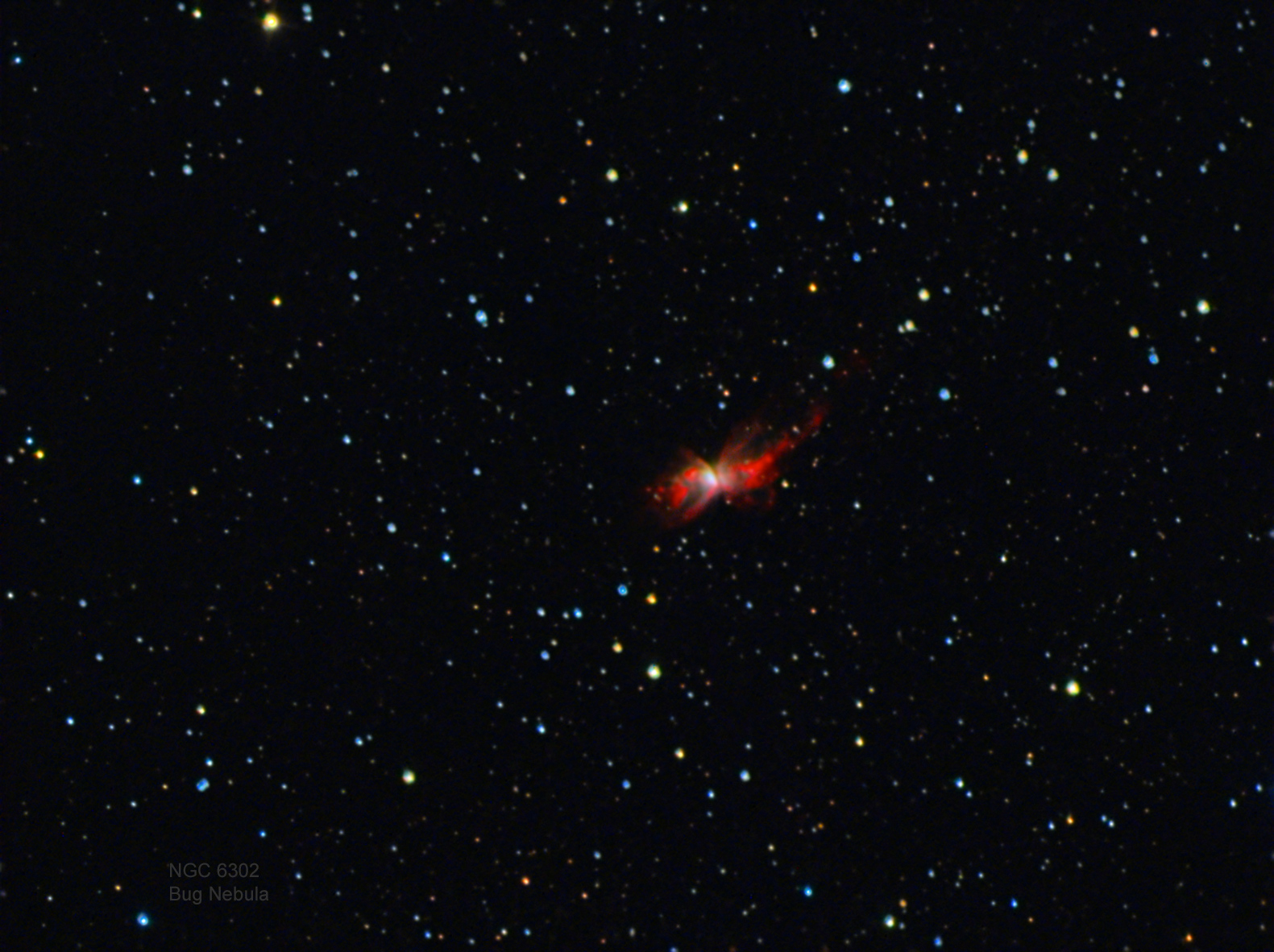
The Bug Nebula by Joe Gafford (2003 Texas Star Party)
21: Bug Nebula (NGC 6302)
- Object Type: Planetary Nebula
- Constellation: Scorpius
- Distance: ~4,000 light-years
- Apparent Size: 1.2' × 2.6'
- Apparent Magnitude: 7.1
The Bug Nebula challenges our understanding of planetary nebula formation through its extraordinary complexity and extreme central star properties. Surface temperatures exceeding 200,000°C make this white dwarf one of the hottest stellar objects known. , Its intricate wing-like structure suggests formation involving magnetic fields, rapid rotation, and possibly binary interactions. From northern latitudes, observe when Scorpius is highest (July-August) using at least 8 inches of aperture and a magnification of 20x or more to see wing structure details.
Spectroscopic analysis reveals unusually high concentrations of iron and heavy elements. This indicates the original star was much more massive than typical planetary nebula progenitors. This composition, combined with the central star's extreme temperature, suggests formation processes not fully explained by current stellar evolution theory. The nebula's low altitude from northern latitudes creates observational challenges. Yet, successful captures reveal one of the most structurally complex objects in the planetary nebula catalog.

Sh2-129 & OU4 by Terry Hancock
22: The Flying Bat & The Squid (Sh2-129 & OU4)
- Object Type: Emission Nebula & Planetary Nebula Complex
- Constellation: Cepheus
- Distance: ~3,200 light-years (Sh2-129), ~2,300 light-years (OU4)
- Apparent Size: 138' × 75' (Sh2-129), 80" × 50" (OU4)
- Apparent Magnitude: Very faint (no integrated magnitude)
The Flying Bat (SH2-129) and the Squid complex (OU4) combine two vastly different cosmic phenomena in one of the most challenging astrophotography targets in the northern sky. Sh2-129, the Flying Bat, spreads its wing-like structures across more than two degrees. It is an ancient supernova remnant shaped by stellar winds and radiation. Superimposed on this vast emission region lies OU4, the Squid Nebula, which is an extremely faint planetary nebula whose tentacle-like structures require extreme amounts of exposure time in OIII to detect. They are one of the most difficult targets for advanced astrophotographers. Sh2-129 requires 10+ hours of H-alpha exposure with wide-field setups, while OU4 demands additional 15+ hours of OIII data with precise processing to separate it from the background emission.
The chance alignment of these objects creates a fascinating study in cosmic scales and evolution. While the Flying Bat represents the aftermath of massive stellar death spread across dozens of light-years, the tiny Squid shows a Sun-like star's final moments compressed into a structure barely larger than our solar system. OU4's discovery in 2011 revolutionized our understanding of planetary nebula diversity. Its unusual morphology and extreme faintness had kept it hidden despite being embedded within a well-studied emission region. The complex demonstrates how much invisible structure exists in apparently familiar areas of the sky, rewarding dedicated observers who push their equipment and techniques to the absolute limits.

NGC6334 by Kat Miller
23: Cat's Paw Nebula (NGC 6334)
- Object Type: Emission Nebula
- Constellation: Scorpius
- Distance: ~5,500 light-years
- Apparent Size: 50' × 40'
- Apparent Magnitude: 10.0
The Cat's Paw Nebula ranks among the most prolific star-forming regions in our local galactic neighborhood. It contains an estimated 2,000 young stars in various stages of evolution. Many of them remain embedded within their cocoons of gas and dust, detectable only through infrared observations that can penetrate all of this material. This target is deep in the southern skies, and thus requires exceptional conditions from northern latitudes. The best time to observe is when it is at least 20° above the horizon, and preferably from sites below 35° north latitude for best results.
Northern hemisphere observers face significant challenges when attempting to observe this southern sky treasure. This is because atmospheric extinction severely reduces brightness and detail when viewed through thick air masses near the horizon. However, the nebula's intrinsic brightness and active star formation make it worth the effort for dedicated observers willing to wait for optimal conditions. Studies reveal star formation continues at exceptional rates throughout the complex, making it one of the most luminous emission regions in our galaxy.

NGC 6826 by Joe Gafford
24: Blinking Planetary (NGC 6826)
- Object Type: Planetary Nebula
- Constellation: Cygnus
- Distance: ~2,200 light-years
- Apparent Size: 0.4'
- Apparent Magnitude: 8.8
The unique "blinking" phenomenon that characterizes this planetary nebula demonstrates fundamental differences between direct and peripheral vision in human eyesight. When observers look directly at the nebula, the bright central star overwhelms the surrounding emission, causing the extended structure to fade from view. To see the blinking effect, use 150-250x magnification and alternate between direct vision (nebula disappears) and averted vision (nebula reappears). This works best with telescopes 6 inches or larger.
NGC 6826 exhibits unusually high expansion velocities, with the shell racing outward at 57 kilometers per second. This is significantly faster than typical planetary nebulae. High-resolution images reveal strange knots of fast-moving material called FLIERS, which stands for Fast Low-Ionization Emission Regions. These appear as material being ejected in specific directions rather than expanding uniformly. They challenge standard evolution models and suggest complex magnetic fields or binary interactions may play larger roles in shaping them than previously understood.

SH2-115 by Tommy Lease
25: Sharpless SH2-115 Emission Nebula
- Object Type: Emission Nebula
- Constellation: Cygnus
- Distance: ~7,500 light-years
- Apparent Size: 45' × 30'
- Apparent Magnitude: Very faint (no integrated magnitude)
Sh2-115 is one of the more elusive members of the Sharpless catalog, requiring dedicated techniques to reveal its subtle structure within Cygnus's rich star fields. This faint emission region glows weakly from hydrogen ionized by embedded hot stars, creating delicate wisps and filaments that challenge both visual observers and astrophotographers. Visual detection requires excellent dark skies and H-alpha or OIII filtering with telescopes 10 inches or larger. Photographically, plan for 8+ hours of narrowband H-alpha exposure to bring out the faint emission structure.
The nebula's low surface brightness makes it a perfect target for testing imaging skills and equipment capabilities. Like many objects in the Cygnus region, Sh2-115 benefits from the area's rich stellar environment, but there are also very dense background star fields which can make the processing particularly complex. This target appears to be part of a larger network of faint emission regions scattered throughout this section of the Milky Way, connected by tenuous streams of ionized gas. Advanced processing techniques often reveal surprising detail in what initially appears as an empty region. This demonstrates how much invisible structure exists in apparently barren areas of the night sky.
Light pollution and nebulae filters like the ones we mention in this article usually feature threads, so you can thread them into a filter drawer or filter wheel for use with a telescope! There are also some that thread directly onto the front of a camera lens, though they are more expensive and harder to find. Another alternative for using with a camera is by purchasing a clip-in filter that goes in front of your camera's sensor. You can find all of this on our website here: https://agenaastro.com/astrophotography/filters.html
Hope this helps!
Clear skies,
— The Agena Astro team