


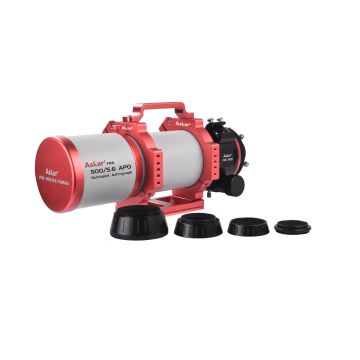
Looking for sharp, edge-to-edge stars in your deep sky images? Petzval refractor telescopes are engineered for plug-and-play astrophotography, offering a perfectly flat field and vivid color correction right out of the box. Unlike standard refractors, which often blur stars at the edges or require separate field flatteners, Petzval designs deliver sharp images across your entire camera sensor—with no extra hassle.
Why Choose a Petzval?
Petzval refractors are renowned for their built-in field correction and user-friendly setup. Their four-lens (or more) optical design creates a flat, sharp image from center to edge, making them the go-to choice for both seasoned imagers and beginners who want reliable results every night. Whether you’re aiming to capture wide-field nebulae, sprawling star clusters, or the rich sweep of the Milky Way, these telescopes make it easy to produce breathtaking photos—especially with today’s large, modern astrophotography camera sensors.
For these reasons, Petzval telescopes are our number one choice for astrophotography telescopes, especially for beginners. While other telescopes can provide higher resolution views at longer focal lengths, they require a more experienced user to maximize their potential. Petzval telescopes, on the other hand, are generally ready for imaging out of the box.
Pros and Cons of Petzval Telescopes:
Pros:
-
Flat field design with built-in field correction—no need for additional field flatteners
-
Sharp stars to the very edge of most sensors
- Precise backspacing not required—just reach focus
-
Plug-and-play with most astrophotography camera systems
-
Fast optical speeds for shorter exposures and brighter images
-
Portable and often lighter than similarly-sized reflectors
Cons:
-
More expensive per inch of aperture than reflector telescopes
-
Best performance is often for imaging rather than visual use
Petzval Refractor Telescope FAQs
What is a Petzval refractor telescope?
A Petzval refractor is a type of telescope that uses four or more carefully designed lenses to create a flat focal plane. This flattens the field of view, so stars remain sharp even at the edges of your camera sensor—perfect for astrophotography. Unlike standard refractors, there’s no need to add field flatteners later; Petzvals do it all internally.
How are Petzval telescopes different from regular refractors?
Petzvals use a unique four-lens system: the front pair focuses light and corrects color, while the rear pair flattens the field and further boosts image quality. Standard refractors only use two or three lenses in one group, which often leads to curved focus and blurred edges in photos. With a Petzval, you get a ready-to-shoot, flat field straight out of the box.
Why are Petzvals so popular for astrophotography?
Because they offer a true plug-and-play experience! You don’t have to worry about exact backspacing, adding spacers, or measuring for field flatteners. As long as your image is focused, you’re set. Their fast optics are ideal for capturing wide-field targets like the North America Nebula or Andromeda Galaxy with crisp stars and minimal fuss.
Who invented the Petzval design, and why does it matter today?
The Petzval design was created in the 1840s by Joseph Petzval, a pioneering Hungarian mathematician. His work introduced the concept of lens systems built on careful mathematical design, and his approach directly influenced both photographic and astronomical instruments for decades. Modern Petzvals use advanced glass, special coatings, and computer-optimized optics for even better results—making these scopes as relevant as ever for today’s astrophotographers.
Are Petzval refractors good for visual observing?
While Petzval telescopes shine in imaging setups, some can be adapted for visual use, especially at low or medium magnifications and with shorter focal lengths. They’re excellent for sweeping views of star fields and large nebulae, but fast focal ratios and short backfocus can make compatibility with certain diagonals and eyepieces trickier. If high-power planetary views are your goal, other designs may serve you better.
How do Petzval telescopes compare to other types?
- vs. Triplet Refractors: While Petzvals are generally more expensive, they offer numerous advantages over triplet refractors for astrophotography: a built in field flattener, no precise backspacing required, and are often capable of producing a flat field across today's large image sensors.
-
vs. Newtonian Reflectors: Newtonians offer more aperture for less money and use mirrors, but require regular collimation and can need extra coma correctors for imaging. Petzvals cost more per aperture, but deliver a flat, sharp field with almost no setup or maintenance.
-
vs. RASA Telescopes: RASA telescopes are ultra-fast (around f/2) and built purely for deep-sky imaging, capturing faint targets in record time. However, their front-mounted cameras limit filter and sensor options, and precise spacing is critical. Petzvals are slower but far more flexible — easier to use, compatible with standard cameras and filters, and deliver flat, sharp fields with minimal setup.
-
vs. Cassegrain Telescopes: Cassegrains (like Schmidt-Cassegrains) are versatile and great for high-magnification objects, but generally have slower optics and often still benefit from field flatteners for astrophotography. Petzvals deliver faster, wider views that are ready for imaging.
- vs. Ritchey-Chrétien (RC) Telescopes: RCs are long-focal-length reflectors ideal for small galaxies and detailed targets. They offer coma-free optics but often need field flatteners and exact collimation. Petzvals trade reach for simplicity — no collimation, no extra correctors, and consistently sharp, flat images right out of the box.
-
vs. Maksutov Telescopes: Maksutovs have long focal lengths and excel at planets, but are slower to cool and heavier. Petzvals stay lighter, cool down quickly, and are optimized for wide-field deep sky imaging.