

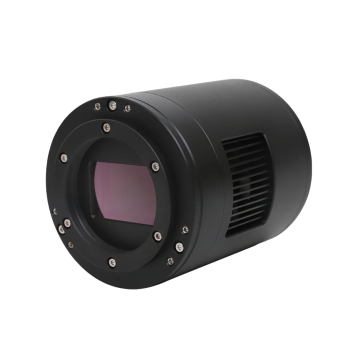
ToupTek Astro Cameras & Accessories!
ToupTek is the astronomy brand of Hangzhou ToupTek Photonics, a camera maker founded at the end of 2010 in Hangzhou, China. The parent company builds industrial and microscope cameras alongside its astronomy line. It also manufactures cameras on contract for other firms in the imaging industry. Those markets require a sensor to operate steadily for hours at a stretch, much like astrophotography on a cold night.
The astronomy catalog covers the whole imaging chain rather than a single product type. A working setup needs a main camera, a way to guide the mount, filters and a means of changing them, plus something to hold focus as the night cools. Buying those pieces from one brand helps keep thread sizes and back focus distances consistent. The sections below explain what each category does.
Cooled Deep Sky Cameras
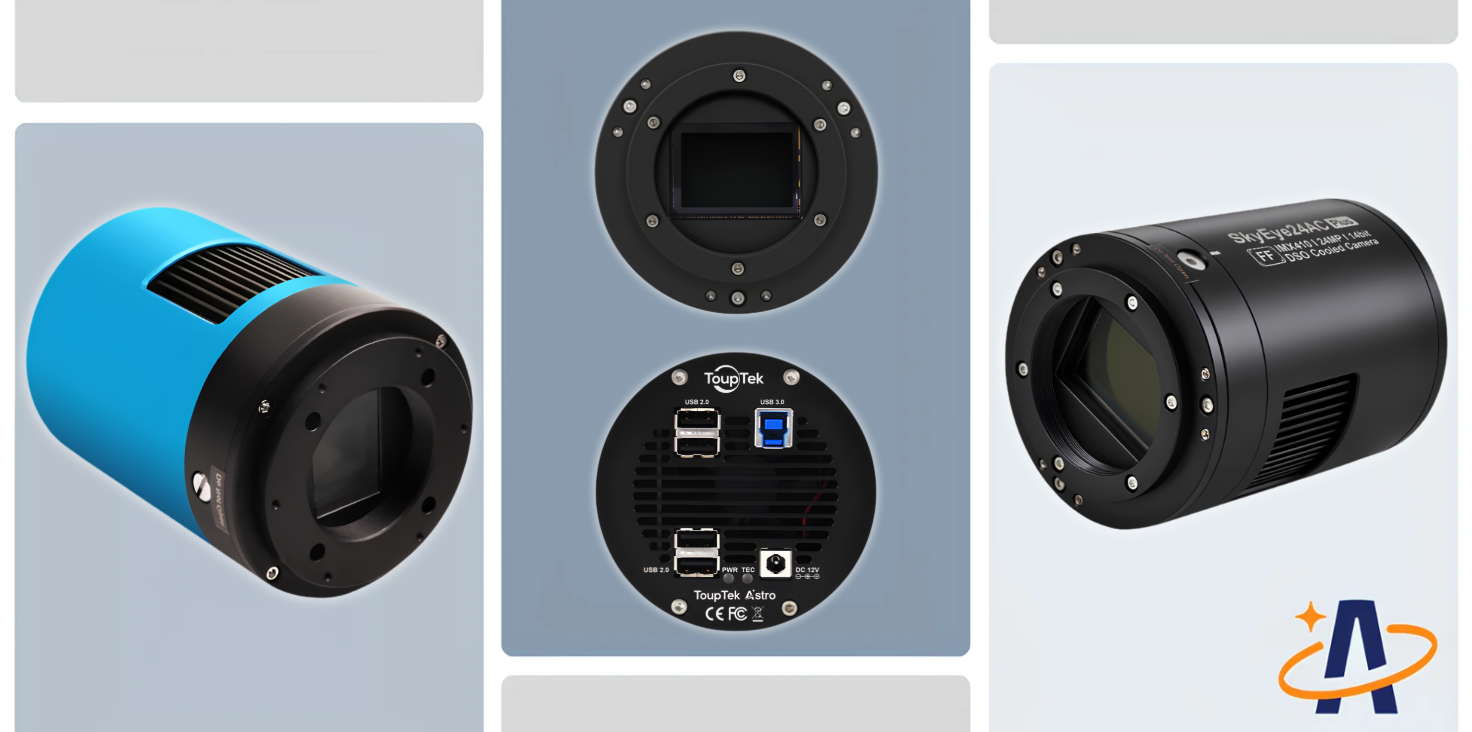
ToupTek’s cooled deep-sky cameras are built for the long exposures used on faint targets. During those exposures, the sensor generates dark current of its own, so thermoelectric cooling holds it well below ambient temperature at a stable set point. This reduces thermal noise and makes it easier to reuse dark calibration frames across multiple nights.
The lineup covers a wide range of sensor and pixel sizes, with broad compatibility across common telescopes, filter systems, and imaging setups. Most formats are available in both color and monochrome versions. Color cameras keep the setup simpler by recording full-color data in one exposure, while monochrome cameras trade that convenience for higher sensitivity and more flexibility with LRGB and narrowband filters. Sensor size, pixel size, and telescope focal length still determine field of view and image scale, so the best choice depends on the rest of the optical system.
Planetary Cameras
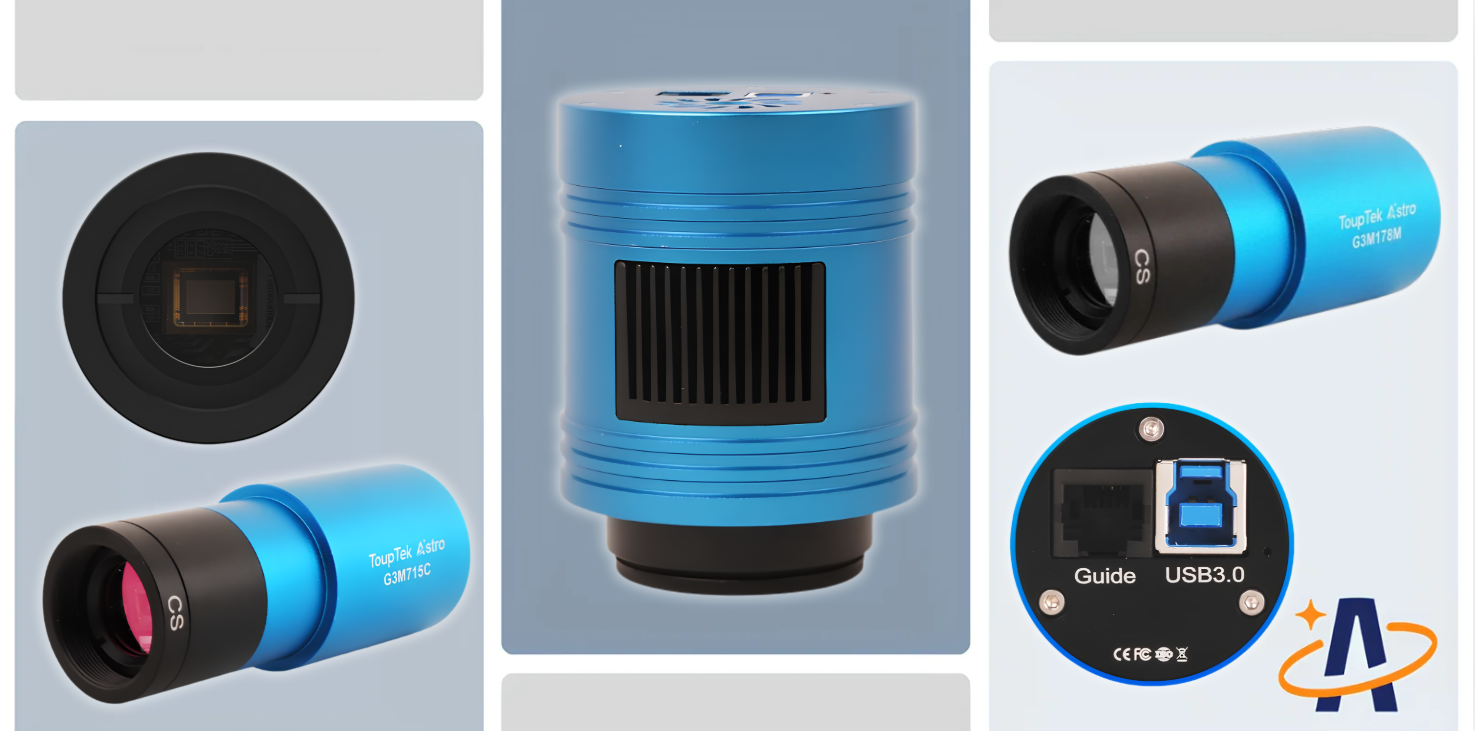
ToupTek’s planetary cameras are built for high frame rates and short exposures, which suits the way planets are typically imaged. Instead of taking long exposures, the camera records thousands of frames so the sharpest moments of steady atmosphere can be selected later. This puts more emphasis on sensor speed and data throughput than on cooling.
ToupTek offers these cameras in several sensor sizes, with both color and monochrome options. Some models use extended bodies that place the sensor farther forward. This design can make it easier to reach focus in Cassegrain and Maksutov telescopes without adding extra extension hardware.
Guide Cameras
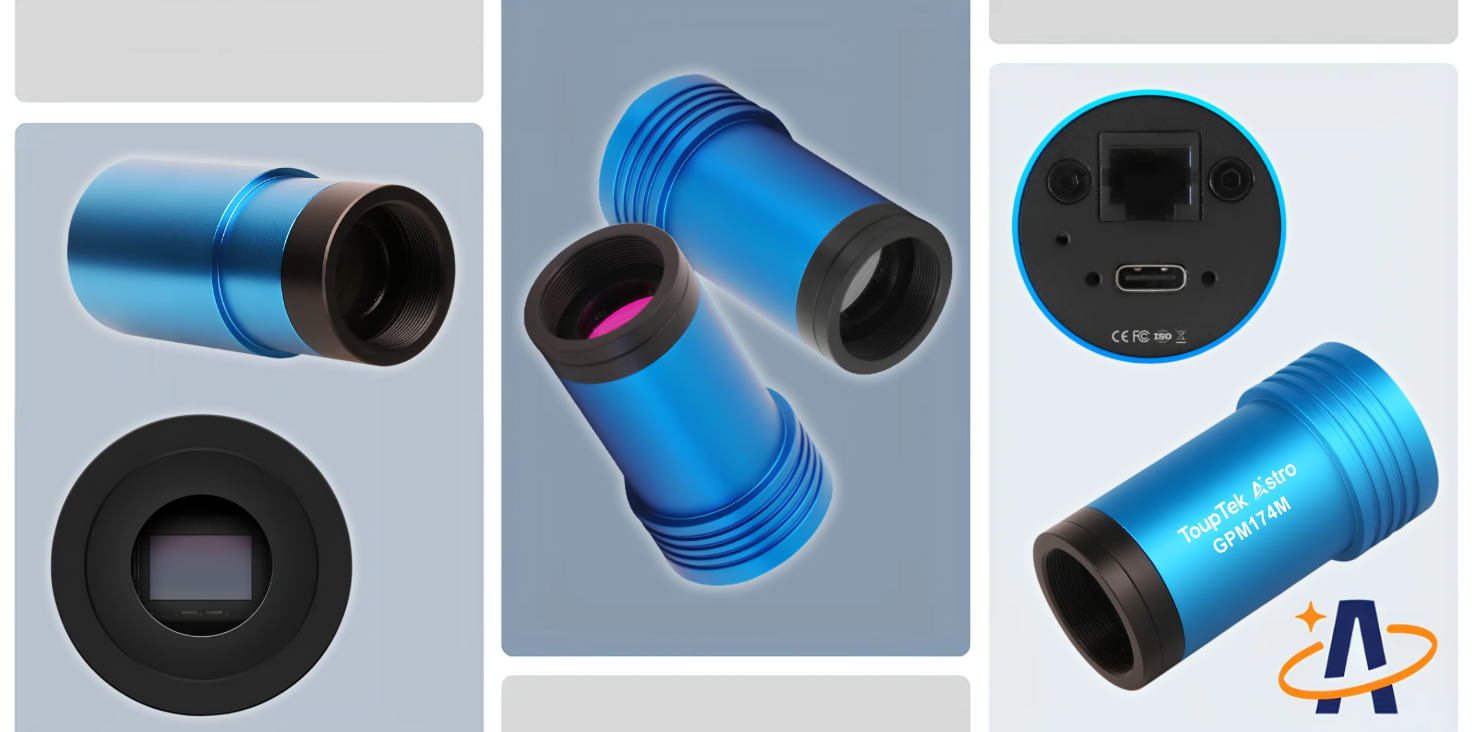
ToupTek offers a broad range of guide cameras with different sensor and pixel sizes to suit various focal lengths and guiding setups. Matching pixel size to guide focal length helps maintain an image scale that can measure small tracking errors without sacrificing unnecessary sensitivity.
The range pairs well with ToupTek’s guide scopes and off-axis guiders, giving users several ways to match the guide camera to the main telescope. Monochrome models are generally the stronger choice for picking up faint guide stars. Color versions can also serve as compact planetary cameras when needed.
Premium Glass and Exceptional Guiding
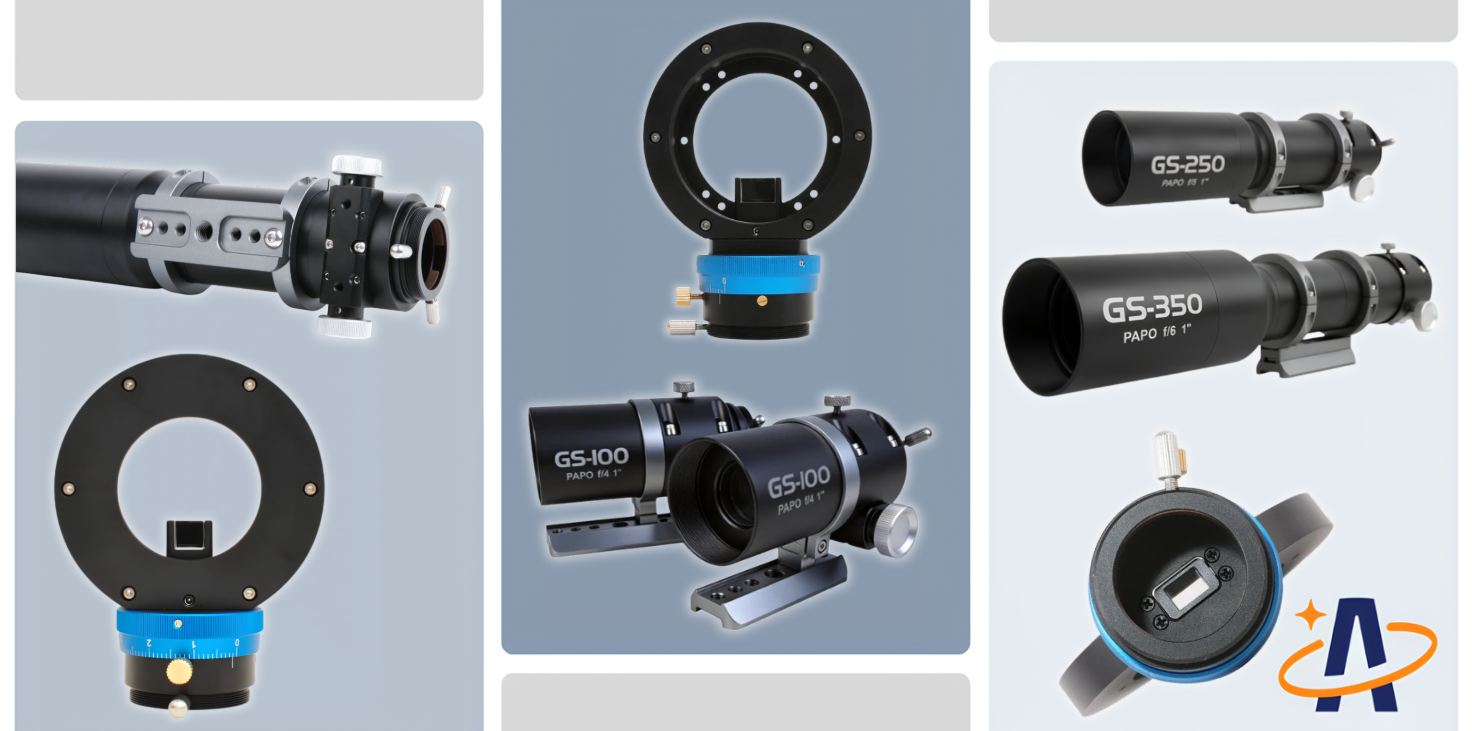
Accurate guiding starts with sharp, well-focused stars. ToupTek guide scopes use high-quality optics, including ED glass and apochromatic designs across much of the lineup, to reduce color fringing and keep guide stars compact. This gives guiding software a cleaner reference point for detecting small movements and sending precise corrections to the mount.
For imaging setups where a separate guide scope isn't ideal, ToupTek also offers off-axis guiders (OAGs). Instead of using a second telescope, an OAG places a small prism at the edge of the main telescope's light path to direct light to a guide camera. Because the imaging and guide cameras share the same optical system, an OAG helps eliminate differential flexure—an important advantage for longer focal-length imaging setups.
ToupTek offers two OAG sizes to accommodate different imaging systems. The larger model is designed for larger sensors and heavier imaging trains, while the smaller model is well suited to APS-C and smaller sensors. Available M42, M48, M54, and M68 adapters make it easy to integrate an OAG into a variety of astrophotography setups.
Filters and Filter Wheels
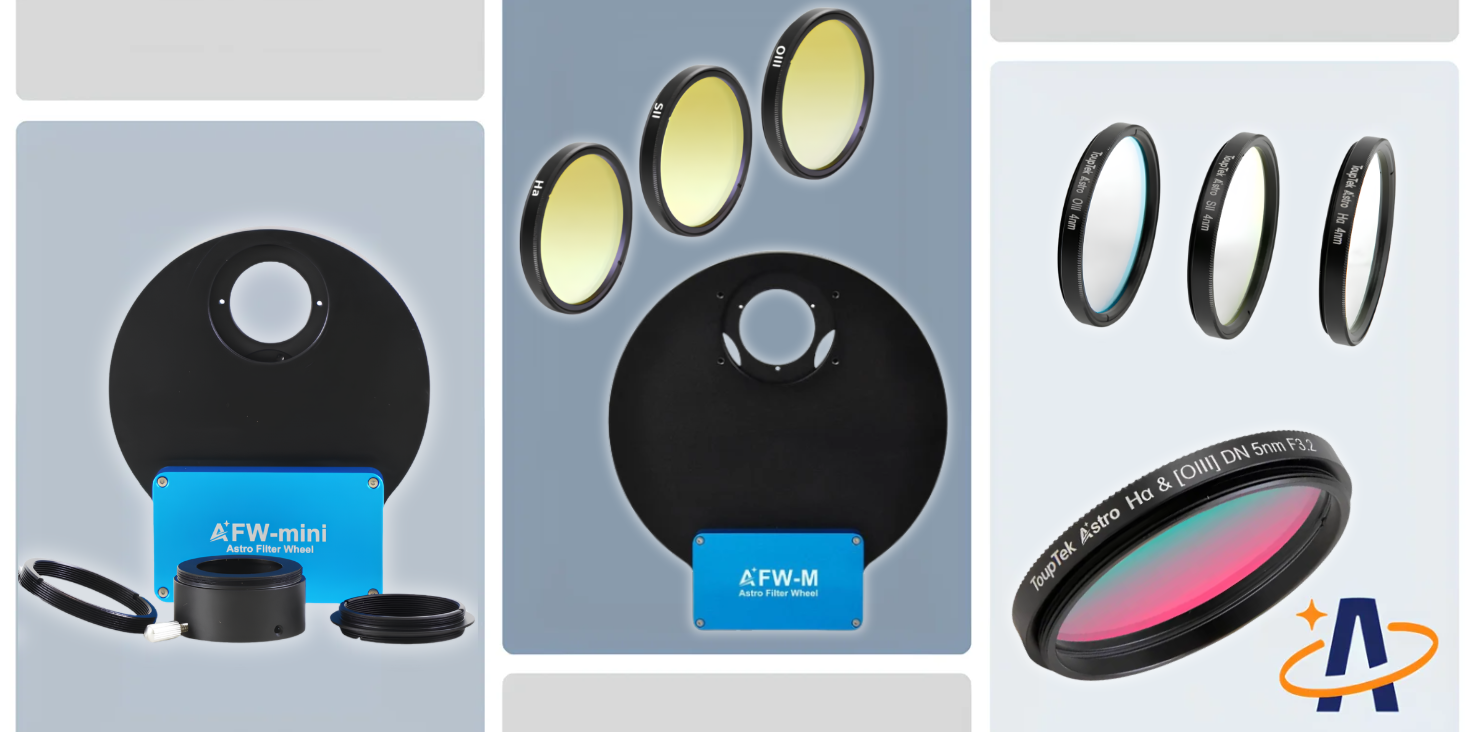
A monochrome sensor records brightness only, so color must be assembled from separate exposures taken through different filters. LRGB filters are made for broadband targets and natural colors. A clear luminance filter carries fine detail, while three color filters supply the hue. They come as 1.25" and 2" mounted rounds as well as 36mm unmounted rounds.
Narrowband filters work differently. Emission nebulae glow at specific wavelengths, so a filter that passes only a few nanometers around one of those lines rejects most streetlight and moonlight. Sulfur II, hydrogen alpha, and oxygen III sets are offered in 4nm and 6.5nm bandwidths. The tighter version rejects more unwanted light but requires longer exposures. A dual-band filter passes hydrogen alpha and oxygen III together at 5nm, allowing a color camera to capture nebulae from a suburban yard.
Electronic filter wheels rotate filters under software control. ToupTek offers five- and seven-slot versions for 2" filters, a seven-slot version for 36mm rounds, and an eight-slot version for 1.25" filters. Manual drawers provide a thinner option for users who change filters less often.
Take Control with StellaVita
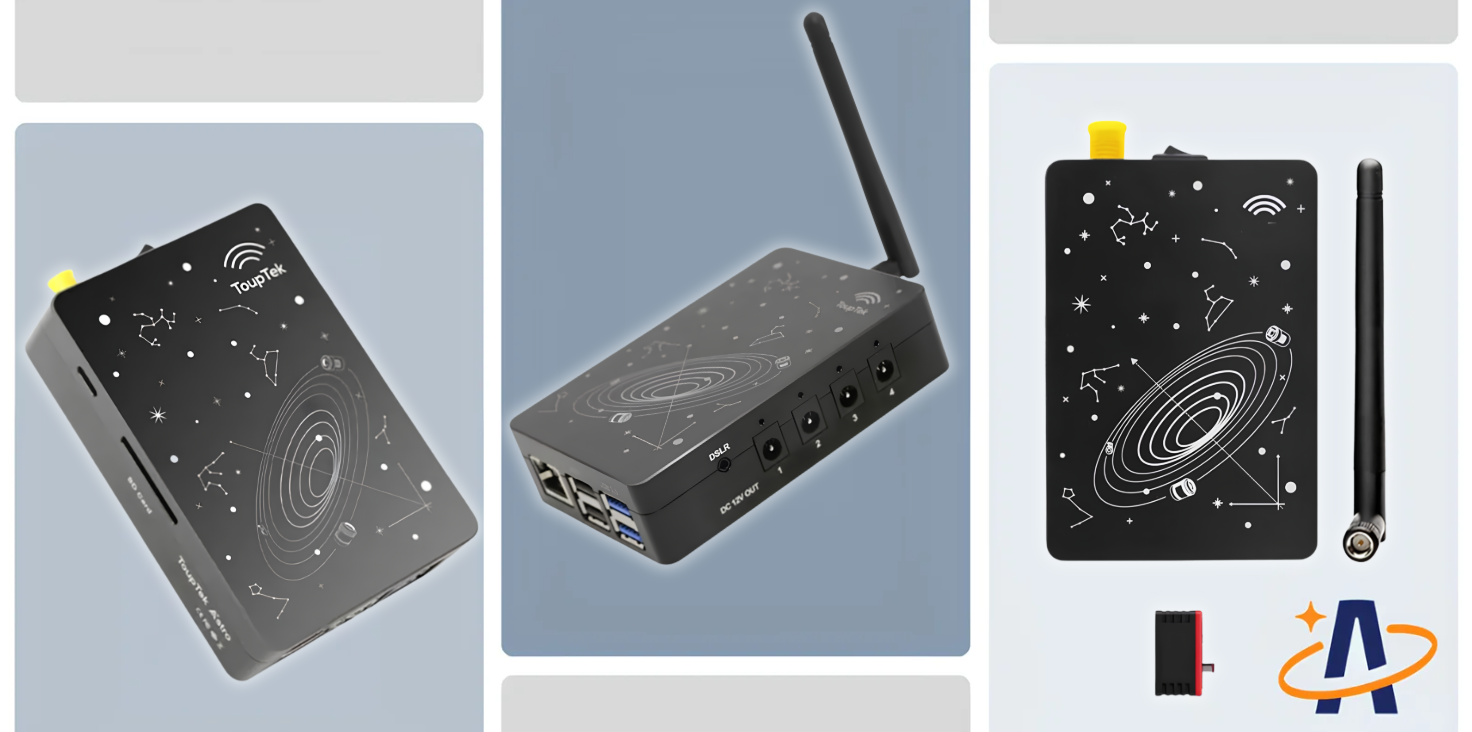
The ToupTek StellaVita Smart Astrophotography Controller brings your imaging setup together in one compact command center. Connect compatible cameras, mounts, electronic focusers, filter wheels, and other accessories, then manage your imaging session wirelessly through the StellaVita 2.0 app. Its open-ecosystem design supports equipment from ToupTek and a range of other astronomy brands, making it a flexible option for mixed-brand imaging setups.
With four USB ports, four 12V DC outputs, Gigabit Ethernet, dual-band Wi-Fi, and SD card storage support, StellaVita helps simplify both power and data connections at the telescope. From polar alignment and focusing to target selection, framing, exposure settings, and automated imaging sequences, the StellaVita app puts the key parts of an astrophotography session in one interface. Its interactive Star Map also includes more than 10,000 celestial targets for finding and framing your next target.
Comprehensive Camera Kits
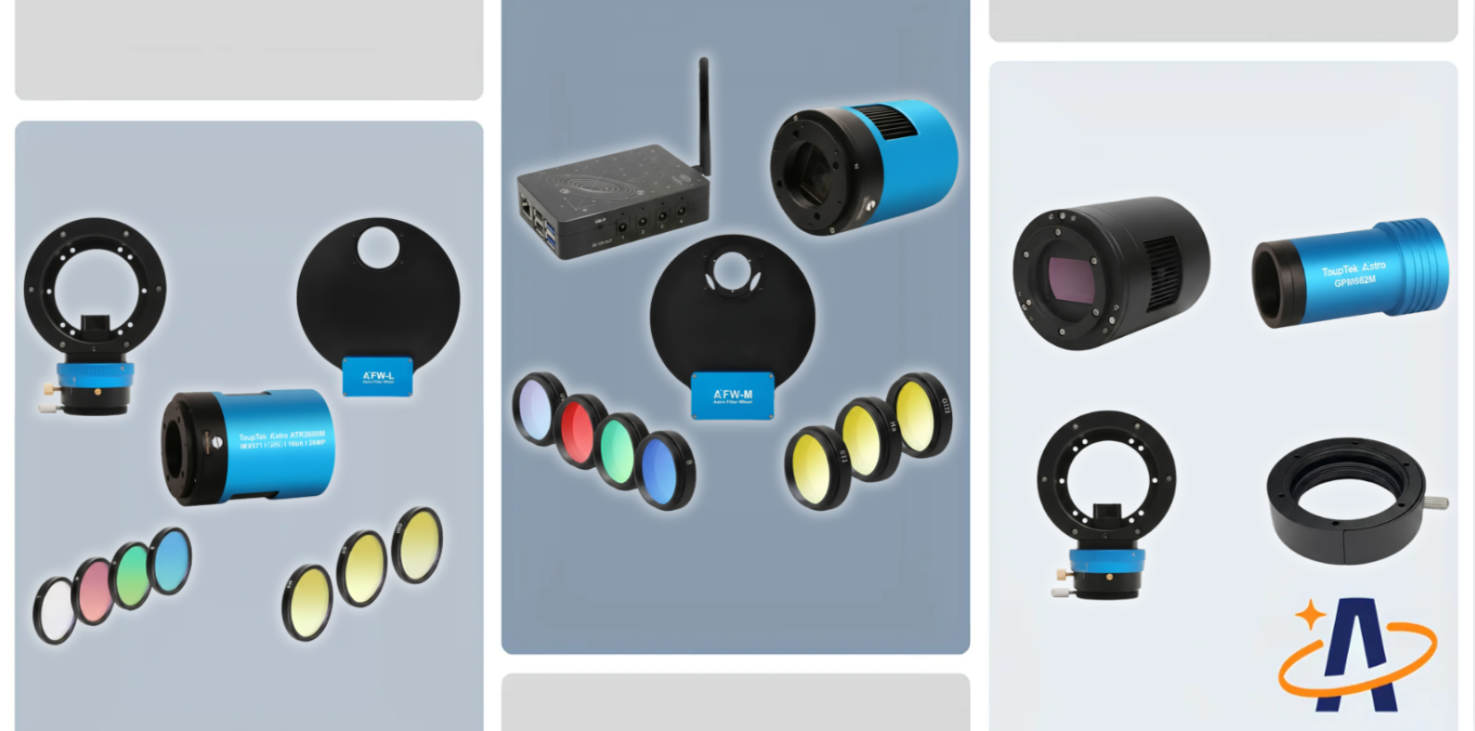
ToupTek camera kits combine the main parts of an imaging train, including the camera, filter wheel, off-axis guider, filters, and adapters needed to connect them. Keeping those components within one system makes it easier to maintain the correct back focus, which is the spacing between the telescope and camera sensor required for proper optical performance.
The accessory range supports several other configurations. Lens adapters allow cooled cameras to work with Canon EF and Nikon F lenses for wide-field imaging, while filter holders and related parts accommodate different filter setups. ToupTek also offers accessories for smaller cameras and portable rigs, allowing the same camera line to work across a range of imaging systems without relying on as many third-party adapters.